Here's a classic case of political math not quite adding up in the real world.
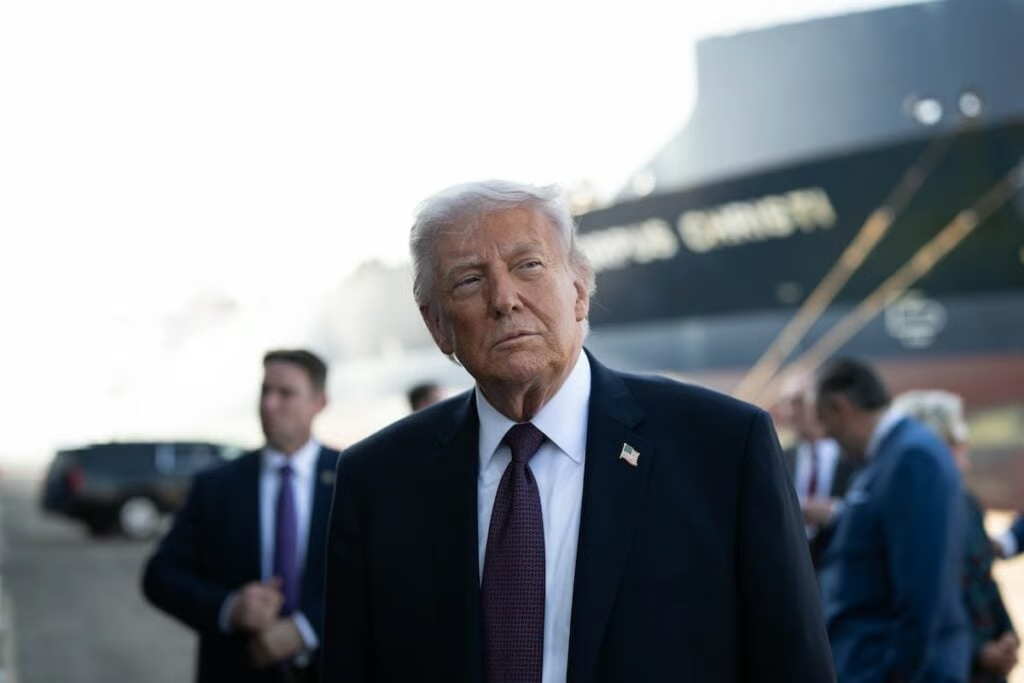
On Wednesday morning, President Donald Trump took to Truth Social to declare the Strait of Hormuz "permanently" open. He credited U.S. military superiority and a new understanding with China, where Beijing agreed not to ship weapons to Iran. He even added that President Xi Jinping would give him "a big, fat hug" during an upcoming visit.
The day before, in a Fox Business interview, Trump pointed to the oil market's resilience. With WTI crude—tracked by the United States Oil Fund (USO)—hovering near $93 a barrel, far from the $200 doomsday predictions some analysts made when the conflict began, he called the price manageable. He forecast much lower gas prices well ahead of the November midterm elections. "If you told me at only $92 a barrel I would've been very surprised. And you know what, it is going to come dropping down," he said.
But if you look at the actual ships moving through the water, you get a very different story. And these two narratives can't both be true at the same time.
Traffic Is Still a Trickle
According to Kpler trade risk analyst Ana Subasic, commercial crossings through the strait fell to just six on April 13. That's down from 14 the day before and a far cry from the pre-conflict average of about 60 per day.
Activity was split evenly across shadow, sanctioned, and mainstream fleet segments, with most voyages running west-to-east. The U.S. blockade of Iranian ports, which took effect Monday, pushed many shipowners into a wait-and-see mode. Uncertainty around enforcement, insurance, and counterparty exposure continues to weigh on transit decisions, Subasic said, and no meaningful normalization in traffic has emerged. The operating environment remains "extremely high risk."
Goldman Sachs commodity strategists Yulia Zhestkova Grigsby and Daan Struyven put average daily Hormuz flows at 2.1 million barrels—roughly 10% of normal on a four-day moving average basis. But the team flagged that the blockade creates additional downside risk for the remaining flows, as Iran-associated tankers have accounted for most of the recent movement. According to Goldman, the U.S. military reported six vessels U-turning back to Iranian ports in the first 24 hours of the blockade.
What the Money Is Actually Betting On
The most direct market verdict on Trump's "permanently open" claim comes from prediction markets. The odds that Hormuz traffic fully normalizes by April 30 are currently sitting at 26%. In other words, about three-quarters of the money is betting it doesn't happen this month.
Traders aren't just betting on whether a ceasefire holds. They're betting on whether the entire chain of steps required to reopen a major shipping lane can be completed anytime soon: a military stand-down, blockade removal, insurer re-certification, and shipowner willingness to re-enter a waterway that was recently mined and bombed. A ceasefire and an open strait are not the same thing. Washington appears to be conflating them.
The deeper question is whether a durable political settlement follows. A ceasefire without Iran's willingness to end uranium enrichment risks leaving the structural supply threat intact—and the Strait of Hormuz exactly where the data shows it today. A temporary ceasefire without a nuclear agreement leaves the structural supply risk fully intact, and the Strait of Hormuz exactly where the data shows it today.
A permanent peace deal by April 30 is trading at 33 cents—roughly one-in-three odds. The market on Iran ending enrichment, which is the tougher nuclear ask, sits at a 54% probability by June 30. Neither is a confident "yes." Both reflect a market that sees resolution as likely over months, not weeks.
The gap between a ceasefire and a peace deal is where the real oil risk lives. Shipowners don't re-enter the Strait of Hormuz because a social media post says it's open. They re-enter when war risk insurance premiums normalize, when mine-clearance is verified, and when the legal and logistical chain that governs a $20 trillion annual oil market has had time to reset.
The president says it's permanently open. The tankers, for now, are saying something else.