Here's a funny thing about the AI boom: it started as a story about Silicon Valley companies spending money to build smarter computers. But when you're talking about spending at the scale we're seeing now—we're talking about capital expenditure numbers that look like national budgets—it stops being a tech story and starts being a macro story. Actually, it starts being an inflation story.
Let's look at the numbers. Meta Platforms (META) is nearing $100 billion in capex. Alphabet (GOOG) is around $85 billion. Microsoft (MSFT) is spending roughly $30 billion a quarter. Total undiscounted future commitments in the sector have reached close to a trillion dollars. At that scale, BlackRock's (BLK) "micro is macro" line sounds less like a clever investment slogan and more like a genuine policy problem for the Federal Reserve.
What makes this different from your typical macro issue—say, wage inflation or an oil shock—is that we're dealing with a concentrated capital-spending boom that's bidding up scarce inputs. We're not talking about abstract economic forces here. We're talking about very real, very physical things: water, land, power, grid equipment. All of these face the same AI-driven pressure. The hottest sector of the 2020s is turning into an inflation story.
When Chips Get Expensive Again
This squeeze matters because it shows how AI's first economic effect might not be cheaper labor or some broad productivity windfall that makes everything better. It might just be tighter capacity. Hyperscalers are pulling forward years of infrastructure demand into a compressed period. There are reports of labor incentives showing desperation to get the work done. But the same forces that support growth are also creating bottlenecks.
David Doyle, Macquarie Group's head of economics, pointed to a telling data point. "Producer Price Index for semiconductors, which had been in a prolonged downtrend — not just disinflation but deflation — for several decades. In the last year, it has turned sharply upward," he told BNN Bloomberg.
That's a big deal. Semiconductors getting more expensive after decades of getting cheaper? That's a signal. Other pressure points are emerging too. Computer software and accessories rose 4% month over month in March's CPI report, while retail electricity prices were running about 5% to 6% higher year over year.
This data demand rally is even starting to show up in political pressure. In 2026, New York, Maine, Oklahoma, and Georgia have all moved to restrict or disincentivize large-scale AI data-center development. The strictest was New York, whose State Senate Bill S9144 introduced a three-year statewide moratorium on data centers capable of using 20 MW or more. When your infrastructure needs start triggering moratoriums, you know you've moved beyond tech conference chatter.
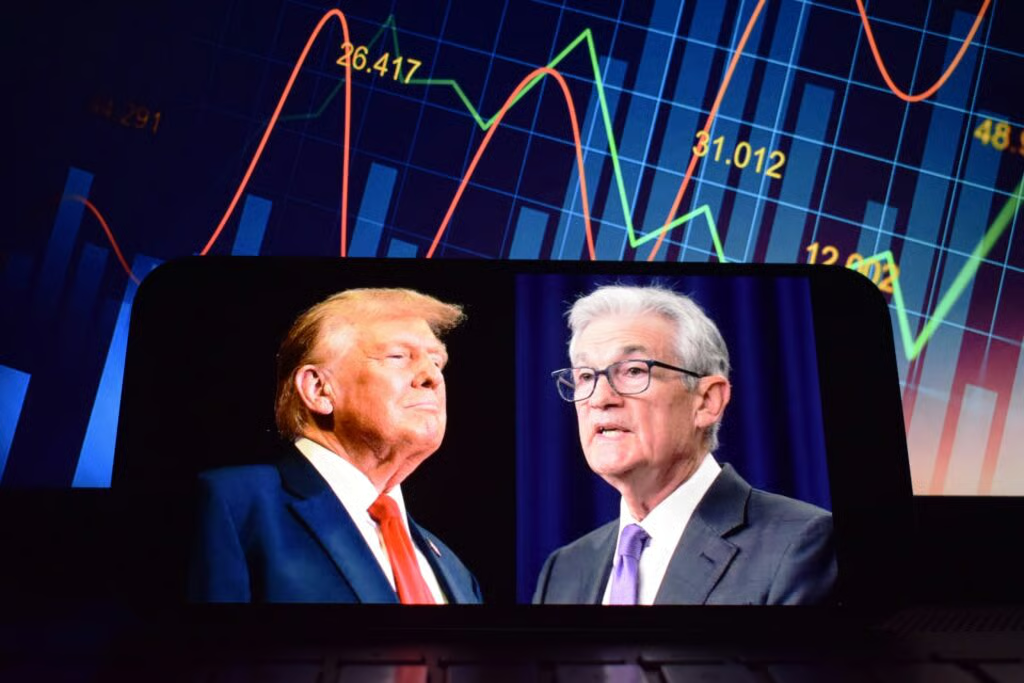
The Fed's Awkward Setup
All this creates what you might call a "K-shaped" inflation problem for the Fed. Investment-led inflation is building underneath the economy, while goods disinflation may continue in other parts of the consumer economy. So you could have an economy that looks like it's cooling at the surface—your typical consumer goods prices maybe coming down—but still running hot in the key industrial arteries that power AI development.
If AI spending accelerates before the productivity gains spread beyond the tech sector, policymakers could face this weird contrast. And in markets, that scenario means AI is no longer just a tech trade. It's become a cross-asset trade touching semiconductors, utilities, power developers, copper miners, and even nuclear and uranium names.
Think about it this way:
| Company/asset | Capex or bottleneck | Market implication |
| MSFT / GOOG / META / Amazon (AMZN) | Massive AI infrastructure spending | Supports demand for chips, power, and grid buildout |
| NVDA | Core compute supplier | Benefits from the capex cycle, but also reflects concentration risk |
| NEE / VST / power providers | Grid and generation demand rising | Utilities become AI infrastructure proxies |
| Copper/uranium | Scarce inputs tied to expansion | Resource pressure can feed sticky inflation |
So what should you watch as an investor? Here's a practical checklist:
- If Nvidia Corp. (NVDA) keeps leading despite macro noise, the market is still rewarding AI infrastructure over AI skepticism.
- If Vistra Corp. (VST) and NextEra Energy, Inc. (NEE) continue to firm, that reinforces the case that power suppliers are emerging as second-order AI winners.
- If copper holds trend support, the scarcity argument remains intact; if it breaks down, the inflation thesis weakens.
Finally, if software estimates remain high while price action lags, it's worth keeping an eye on the discrepancy between the foundation layer and downstream productivity stories. In layman's terms: watch whether the market prefers to invest in shovels during the gold rush, or whether it starts questioning how much gold there actually is to find.