Here's a financial story that isn't about stocks or bonds, but about who pays for the party when the world's biggest sporting event comes to town. Senate Minority Leader Chuck Schumer (D-NY) and Governor Kathy Hochul (D-NY) took aim at FIFA on Tuesday, and the issue is train tickets.
Reports have emerged that New Jersey Transit might charge over $100 for a round-trip ticket from Penn Station in Manhattan to MetLife Stadium in East Rutherford, New Jersey, for the 2026 FIFA World Cup. For context, that's the stadium where the games will be played. Schumer, in a post on X, didn't mince words. "FIFA is set to reap nearly $11 billion from this summer's World Cup," he said. "New York commuters and residents should not subsidize an $11 billion windfall."
His argument is pretty straightforward: if you're the global soccer body about to pocket eleven billion dollars from an event hosted in our backyard, the least you can do is make sure the locals can actually get to the stadium without getting, as he put it, "gouged at the turnstile." He's demanding FIFA cover "transportation costs for host cities and states" in the U.S.
Governor Hochul echoed the sentiment on the same platform. "Charging over $100 for a short train ride sounds awfully high to me," she said, adding that such pricing "won't be happening on the MTA." The implication is clear—this isn't how New York typically handles mass transit to major events, and they don't want FIFA's tournament to set a painful new precedent.
So, about that tournament. The 2026 FIFA World Cup is a big deal, literally. It's scheduled from June 11 to July 19, 2026, and it's being co-hosted by the U.S., Mexico, and Canada. This edition is expanding to 48 teams (up from 32) who will play 104 games across 16 cities. The host nations—U.S., Canada, Mexico—are automatically in. We'll also see debutantes like Jordan and Uzbekistan. Argentina, the defending champion after beating France in 2022, will be there trying for a fourth title.
While politicians debate train fares, FIFA is also making moves in the prediction market. The organization announced a multi-year deal with ADI Predictstreet as its first official partner in the prediction market category. In plain English, this deal will allow bettors worldwide to place bets on World Cup game outcomes through an official partner. It's another revenue stream in the vast ecosystem of a modern mega-event.
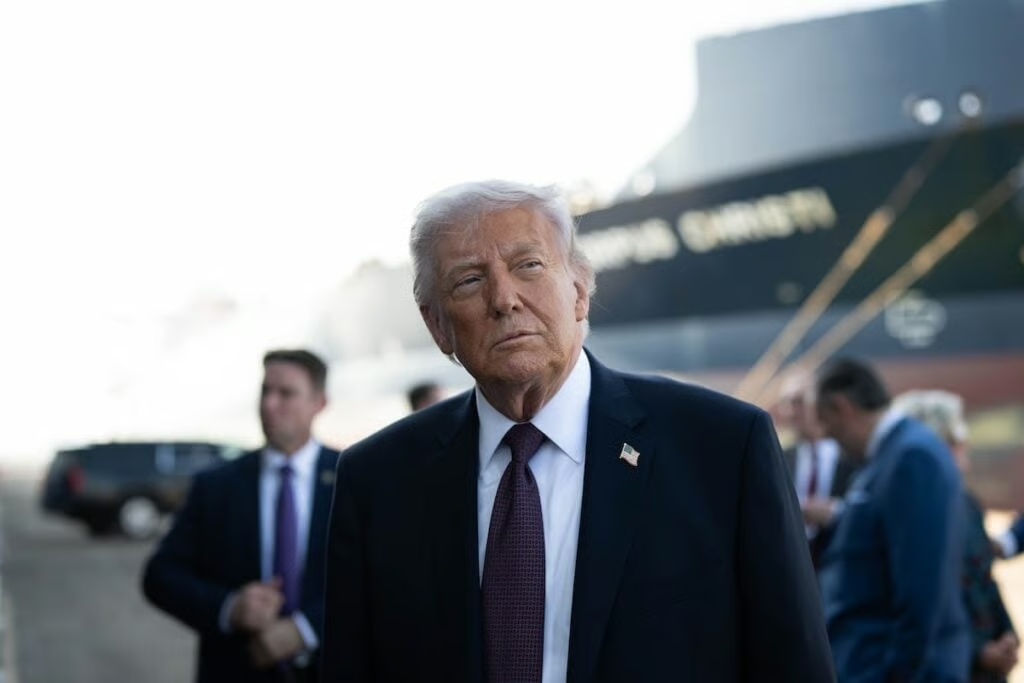
And then there's the geopolitics. The Iranian soccer team issued a statement rebuking warnings from President Donald Trump about safety, confirming its participation. "The World Cup is a historic and international event and its governing body is FIFA — not any individual, country," the team said. This comes amid reported uncertainty over Iran's participation due to escalating tensions after Trump announced a U.S.-led blockade of the Strait of Hormuz. The team's statement is a firm reminder that in their view, the tournament exists separately from international diplomatic spats.
At its core, the story from New York is about the economics of hosting. When a private entity like FIFA reaps billions from a public infrastructure—like a regional transit system—who should bear the cost of accommodating the surge? Schumer and Hochul are drawing a line, arguing that the financial burden shouldn't fall on the daily commuter. It's a fight over who gets the bill for the world's biggest game.