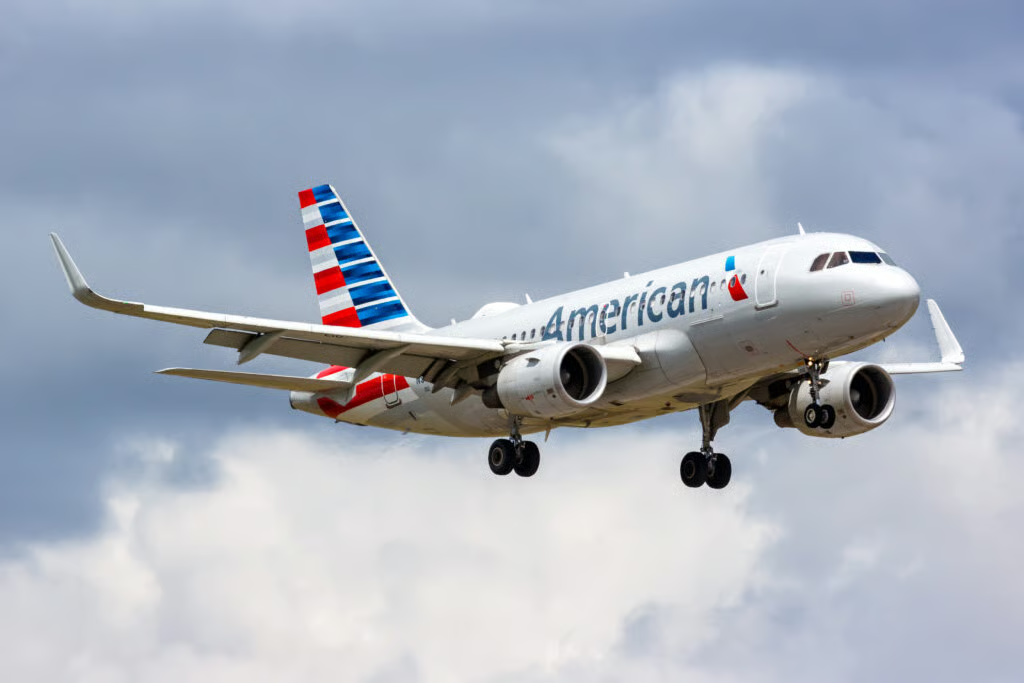
So, here's a fun thing that happens in the stock market sometimes: a company's shares start flying because people start talking about it merging with another company. That's what happened to American Airlines Group Inc. (AAL) on Tuesday. The stock jumped as traders latched onto fresh chatter about a potential tie-up with United Airlines Holdings Inc. (UAL). It's the kind of news that gets investors excited, even if the actual path to a deal looks about as smooth as a turbulent flight.
The story, as reports have it, goes like this: United Airlines CEO Scott Kirby reportedly discussed a potential merger with American Airlines in a meeting with President Donald Trump back in late February. Now, before you get too carried away, it's worth noting the meeting was apparently originally intended to discuss the future of Dulles Airport. It also took place just three days before the U.S.-Israeli war with Iran began, which gives you a sense of the timeline we're dealing with here. United's stock moved higher on the report too, though not as dramatically.
But let's talk about the giant regulatory elephant in the room. Antitrust lawyer Seth Bloom chimed in, basically saying this deal is unlikely to ever get off the ground with regulators. The reasoning is pretty straightforward: combining two of the biggest U.S. airlines would likely give the industry even more pricing power, which is regulator-speak for "it would probably hurt consumers' wallets." So, you have excitement on one side and a dose of reality on the other. Classic market dynamics.
Now, let's look at what the charts are saying. Technically, it's a bit of a mixed bag. The stock is trading 13.3% above its 20-day simple moving average, which suggests the short-term mood is improving. But it's still 9% below its 100-day average, meaning the intermediate trend isn't exactly roaring back. There's also some damage from earlier this year: the 20-day SMA is still below the 50-day, and a "death cross" (where the 50-day falls below the 200-day) back in March has longer-term trend followers staying cautious.
That said, the MACD indicator—a tool that looks at momentum—is above its signal line and showing a positive histogram. In plain English, that's consistent with upside momentum building rather than fizzling out. Over the past year, the stock is actually up about 28%, which shows the longer-term tape has rewarded buying the dips, even with plenty of volatility along the way. For traders watching levels, the cleanest ones to note are $14 as overhead resistance (a prior ceiling where rallies have stalled) and $10.50 as a key downside support area (where buyers have historically shown up).
Meanwhile, there's another event on the horizon that could move the needle: earnings. American Airlines is scheduled to report its first-quarter results for 2026 on April 23. Here's what analysts are expecting:
- EPS Estimate: A loss of 45 cents per share. That's an improvement from the loss of 59 cents a year ago.
- Revenue Estimate: $13.76 billion, up from $12.55 billion year-over-year.
- Valuation: The stock sports a P/E ratio of 66.1x, which indicates a premium valuation compared to many of its peers.
The analyst consensus currently sits at a Hold rating with an average price target of $16.01. Recent moves from big firms include UBS and Citigroup reiterating Buy ratings in March, though both lowered their price targets (UBS to $14 and $15 on different dates, Citigroup to $14).
If you're trying to score the stock's overall profile, the picture is a bit weak. Using a common market data framework, American Airlines scores poorly on Momentum (17.91 out of 100) and Growth (17.13), while its Value score is more neutral (33.62). The verdict here fits the narrative: this is a stock that can pop on headlines like merger talk, but it likely needs sustained fundamental follow-through to really improve its longer-term technical posture.
One other mechanical factor to consider: American Airlines isn't just a standalone stock; it's a big component in some exchange-traded funds (ETFs). Most notably, it carries a 10.35% weight in the US Global Jets ETF (JETS) and a 2.22% weight in the Invesco S&P MidCap 400 Revenue ETF (RWK). What does that mean? Simply put, significant inflows or outflows from these funds can trigger automatic buying or selling of AAL shares, adding another layer to its price movements.
As of publication time on Tuesday, American Airlines shares were up 8.24% at $12.15. United Airlines shares were up 2.38% at $97.48. So, the merger talk gave both a lift, but American got the bigger bounce. Whether that flight path continues will depend on earnings, regulatory whispers, and whether the market still believes in this story next week.

.jpeg)