If you want to know how hot the AI chip business is, don't just look at the chips. Look at the incredibly expensive, ultra-precise machines that make them. That's where the real money is flowing right now.
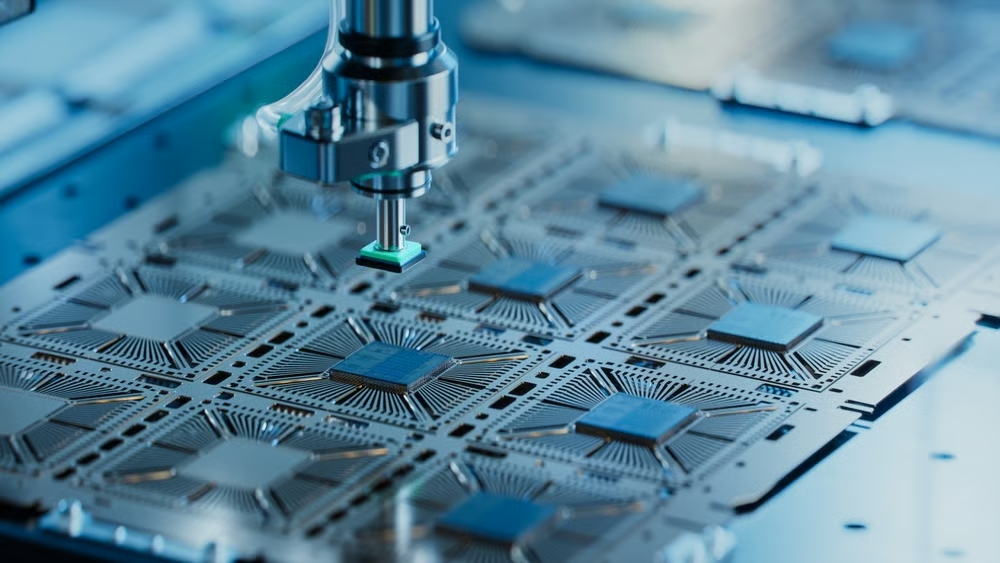
Spending on wafer fab equipment—the tools that etch, deposit, and pattern silicon wafers into semiconductors—climbed 12% year-over-year to hit $143 billion globally in 2025. That's according to the latest data from Counterpoint Research's Wafer Fab Equipment Tracker. The surge is almost entirely thanks to the industry's frantic build-out of AI infrastructure, which is gobbling up tools for leading-edge logic chips, high-bandwidth memory (HBM), and advanced packaging.
The top five equipment manufacturers alone saw their combined revenue jump 14% to $114 billion. It seems everyone is buying new gear.
2026: The Upcycle Continues (With a Few Caveats)
This party isn't over. Analysts project WFE revenues will grow another 11% in 2026, with the action really picking up in the second half of the year. The big winners are expected to be the makers of lithography, etch, deposition, process control, and advanced packaging tools.
But, as with any good party, there are potential headaches. Export controls, infrastructure bottlenecks, and the sheer technical nightmare of transitioning to 2nm manufacturing could throw timing off or slow things down. Meanwhile, spending on older, "trailing-edge" tech for things like IoT, automotive, and power sensors is expected to stay flat. The money is all rushing to the cutting edge.
Foundries and Memory: The Twin Engines
So where is all this cash going? Two main places.
First, the foundry-logic segment. This is where companies like Taiwan Semiconductor Manufacturing Company Limited (TSM) make the brains for AI servers and smartphones. Revenue here rose 8% in 2025 and accounted for a whopping 65% of all net system sales. The push for AI has accelerated the adoption of the most advanced nodes, with chips made on processes smaller than 5nm now making up over half of shipments.
Second, memory made a roaring comeback. Revenue jumped 16% year-over-year, driven by skyrocketing demand for AI-optimized DRAM and NAND, particularly HBM. A sharp sequential increase in orders late in 2025 signals that memory suppliers are still ramping up capacity to get ready for next-gen transitions, including the upcoming HBM4 standard.
Geography and a Structural Shift
The map of where this equipment is being installed is also changing. China's share of revenue among the top WFE vendors fell to 32% in 2025, a reflection of export controls and a re-shuffling of global investment. Capacity is expanding in other hubs around the world to pick up the slack.
More importantly, the nature of the spending itself is transforming. Over the last decade, WFE spending has grown at a 14% compound annual rate. But it's no longer just about building more factory floor space. It's about buying more sophisticated tools to make more complex chips. As nodes shrink to 2nm and packaging gets more advanced, the "tool intensity"—the amount of equipment needed per chip—is going up. This is a more durable, technology-driven capex cycle.
The Analyst View: Welcome to the 'WFE Intensity' Cycle
Counterpoint analyst Ashwath Rao calls this the new reality. "The traditional model of evenly distributed WFE spending is giving way to a new reality," he said. The complexity demanded by AI and the 2nm transition is structurally increasing equipment demand across both logic and memory.
He points out that this trend is a tailwind for the giants of the equipment world: ASML Holding N.V. (ASML), Applied Materials, Inc. (AMAT), Tokyo Electron Limited, Lam Research Corporation (LRCX), KLA Corporation (KLAC), Advantest Corporation, and Teradyne, Inc. (TER).
The HBM boom, driven by Samsung Electronics Co., Ltd. (SSNLF), SK Hynix Inc., and Micron Technology, Inc. (MU), is also shifting value toward the foundries that assemble these advanced packages, like TSMC, and the packaging specialists themselves, such as ASE Technology Holding Co., Ltd. (ASX) and Amkor Technology, Inc. (AMKR).
Another analyst, William Li, highlighted a capacity crunch. "Given ongoing capacity constraints at Taiwan Semiconductor, AI customers are actively securing additional capacity through long-term partnerships with OSAT vendors," he noted. The result? Industry capacity for advanced packaging could balloon by roughly 80% year-over-year in 2026.
Rao summed it up: "We are moving into a cycle dominated by leading-edge foundry, DRAM/HBM, and advanced packaging. This is driving a higher WFE intensity cycle that will persist through the second half of the decade."
In short, the race to build smarter AI isn't just about software geniuses or chip designers. It's also a bonanza for the companies that sell the billion-dollar machine tools. And for now, their order books are looking very, very full.







.jpeg)