Intrinsic Value: What a Stock Is Really Worth (and How to Find the Cheap Ones)
MarketDash Editorial Team
Author
Someone offers to sell you a $100 bill for $70. You do not need a spreadsheet. You take the deal, and then you ask if they have any more.
That is the whole idea behind intrinsic value. A stock has a price: what people pay for it today. The company behind it has a value: what the business is really worth. The two are supposed to match. They often do not.
Warren Buffett said it in one line: "Price is what you pay, value is what you get."
Most people only ever look at the first half. They see a price go up and feel smart. They see it go down and feel sick. They never ask the only question that matters: what is this thing worth? Buying a stock without knowing that is just vibes with a brokerage account.
No formulas here. Just what intrinsic value is, why it works, and how to check it on MarketDash in about ten seconds.
What Is the Intrinsic Value of a Stock?
Intrinsic value is what a company is worth based on the money it makes now and the money it will likely keep making.
Not what the chart did last week. Not what a stranger on the internet thinks. Just the cash.
Think about a house worth $400,000. The owner takes a job across the country and has to be gone in two weeks, so they list it at $300,000. The roof did not cave in. The price dropped. The value did not.
Stocks go on sale like that all the time, and for stranger reasons. A CEO says something awkward on an earnings call. A big fund needs cash and dumps shares on a Tuesday. The company did not change. The price did.
Berkshire Hathaway, Buffett's company, defines it plainly in its owner's manual: a business is worth all the cash you could take out of it over its lifetime. That is intrinsic value. Everything else is a mood.
A price can jump 10% before lunch. A real business almost never gets 10% better before lunch. That gap is where every good deal in the stock market lives.
Why It Works
In the short run, the stock market is a popularity contest. A good company can drop 15% in a week over a story nobody will remember in a year.
In the long run, the market is a scale. It weighs one thing: how much money the business makes. A company that earns more every year eventually sees its stock price catch up. The timing is rude, but it happens.
So when you buy a good company below its value, you are making one simple bet: the price drifts back toward what the business is worth. You are not betting on the next headline. You are betting on gravity. That is the whole premise of fundamental stock analysis.
The cushion
The second reason it works is the one that lets you sleep.
Engineers build a bridge to hold far more weight than it will ever carry, because their math might be off and they would like the bridge to stand anyway. Buying well below value is the same move. The fancy name is a margin of safety. Pay $35 for something worth $50 and a lot can go wrong before you lose money. Pay $60 for it and you are underwater before anything goes wrong at all.
The catch: cheap can mean broken
Intrinsic value is an estimate, not a promise. Nobody knows what a company will earn in five years.
And some stocks are cheap because they deserve it. Customers are leaving. Debt is piling up. The stock looks like a bargain and keeps falling, because the business keeps shrinking underneath it. That is a value trap, and it has quietly emptied a lot of accounts.
So the number is where you start, not where you stop.
What It Means for Your Money
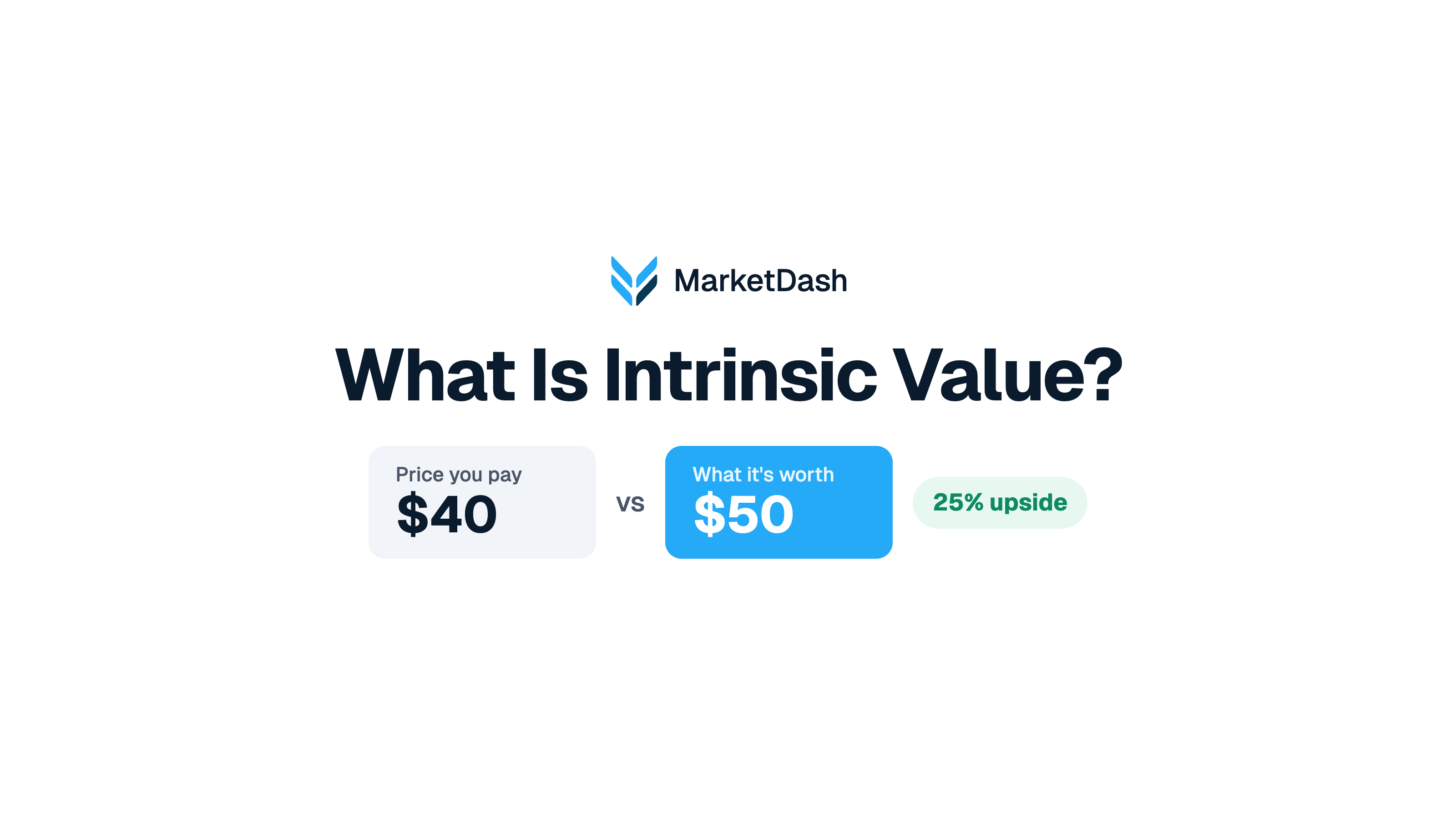
Round numbers. Made-up company. Say a stock has an intrinsic value of $50 a share.
Buy it at $40 and you are paying $40 for $50 of value. If the price climbs to $50, you make $10 a share.
Buy it at $60 and you are paying $60 for the same $50 of value. If the price falls to $50, you lose $10 a share.
Same company. Same value. Opposite results. Now put $1,000 into each:
- At $40: you get 25 shares, worth $1,250 at the $50 value. If the price gets there, you are up about $250.
- At $60: you get about 16.7 shares, worth about $833 at the $50 value. If the price gets there, you are down about $167.
Prices do not always return to value, and never on a schedule. But look at what just happened. Your return was mostly decided before the stock moved an inch. It was decided at checkout.
This is why the best investors are obsessed with price and bored by excitement. Our investment tips guide has more habits like this one.
How the Experts Estimate It
You do not need to do this math. It just helps to know what is in the number, the way it helps to know that bread has flour in it.
There are two approaches. Future cash: estimate how much cash the company will make over the next several years, trim each future dollar a little (a dollar next year is worth slightly less than a dollar today), and add it up. Comparison: look at what investors pay for similar companies, and what this company's own stock has sold for in the past.
MarketDash shows you both, then averages them. If you want the raw ingredients, Investor.gov explains how to read a 10-K, the yearly report every public company files. Most people never will, and that is what the tool is for.
How to Use Intrinsic Value in MarketDash
Here is the part that makes you money. Five steps, no math, about ten seconds per stock on a MarketDash plan.
Step 1: Open a stock page
Go to any stock page on MarketDash, like Apple's. Type any other ticker into the search bar to switch. Scroll to the section called Intrinsic Value. The subheading reads "What the company might be truly worth."
Step 2: Read the box
Here is Nike (NKE) in early October 2026:

Screenshot from October 2026. These numbers change every day. This is an example of the tool, not a recommendation to buy Nike.
The sentence at the top does the work for you: "The Intrinsic Value of $56.48 presents a 37.8% UPSIDE. Compared to the Current Price of $35.15, NKE is UNDERVALUED BY 37.8%."
Read it like a price tag. The business is estimated to be worth $56.48 a share. The market is selling it for $35.15. The gap is 37.8%, and that is what the green box is shouting about. The green stretch on the bar chart is the same gap, drawn.
Under the headline are the two estimates that went into it. DCF Value ($57.28) is the future-cash approach. (DCF stands for discounted cash flow, the expert name for "future cash, trimmed a little.") Relative Value ($57.67) is the comparison approach. The intrinsic value is the average of the two.
Step 3: Read the label
Next to the numbers you get one of three verdicts:
- Undervalued. Price is more than 5% below intrinsic value. Possibly a bargain.
- Fairly Valued. Price is within 5% of intrinsic value. You are paying about what it is worth.
- Overvalued. Price is more than 5% above intrinsic value. You may be paying up.
The 5% band is on purpose. Prices wiggle all day. Without it, a stock would flip from Undervalued to Overvalued and back before you finished your coffee.
Step 4: Let the Screener do the hunting
Checking stocks one at a time is slow. The Screener checks the whole market at once. Open it and pick the preset card called MarketDash Undervalued.

Screenshot from October 2026. The list changes as prices move. It is an example of how the preset works, not a list of stocks to buy.
Look at the row of filter chips under the preset cards. Each one is a question the preset asks so you do not have to:
- Intrinsic Value % at least 20%. Is it at least 20% below what it is worth?
- PE Ratio 0 to 25 and ROE at least 0%. Is it making money, and is the price reasonable for those profits?
- D/E Ratio 0 to 1. Is the debt under control?
- # of Analysts at least 10, Analyst Buy % at least 50%, Analyst Upside at least 10%. Do enough pros follow it, and do most of them think it is cheap too?
- Market Cap at least $10B. Is it a big, established company rather than a lottery ticket?
What survives is a short list of large, profitable, low-debt companies the market is selling at a discount and Wall Street mostly likes anyway. In the screenshot that is four stocks, JD, NU, FSLR, and UNH, each with its own "X% undervalued" tag. The preset is not telling you to buy them. It is telling you they are worth a look, which is a far better use of an evening than scrolling someone's list of "cheap stocks."
The app's own tip: "Pick a stock you recognize, do your research, and if the story checks out, consider adding a position." Our guide on how to identify undervalued stocks walks through the same filters by hand.
Step 5: Ask four questions before you buy
A green label is a reason to look closer. It is not a reason to click buy. First, answer four questions:
- Do you understand what this company does? If you cannot explain it in one sentence, skip it.
- Is it making money? Open the Financials section. Profits should be steady or growing.
- Why is it cheap? Every bargain has a reason. Short-term scare, or a business getting worse?
- What is the news? A lawsuit, a recall, a new competitor. The price usually knows something. Find out what.
The stock page answers these. The AI SWOT analysis sums up strengths, weaknesses, opportunities, and threats in plain English. Hedge fund holdings shows whether big professional investors are buying or selling. Insider trading shows whether the company's own executives are buying, one of the more honest signals in finance.
The stock picks page has picks from real analysts, fresh every Monday, with the report behind each one. For the full routine, see how to analyze a stock before investing.
Common Mistakes
- Treating the number like a promise. A 30% upside does not mean the stock will go up 30%. It means the price is well below what the business seems to be worth today. The market still has to agree with you.
- Buying because it is cheap. A bad business at a low price is a bad business with a discount.
- Not asking why. Markets are not stupid. If a stock is 40% below its value, something is scaring people. Find out what before you decide they are all wrong.
- Betting the house on one stock. Even careful research is wrong sometimes. Spread your money across several companies so no single miss can hurt you. Our guide on portfolio risk assessment explains how, and for most people a base of index funds under the picks makes sense.
FAQ
Can a stock stay undervalued for a long time?
Yes. Years, sometimes. The market can ignore a good company for ages, especially a boring one. Only buy companies you would be happy to hold while everyone else ignores them. Our post on whether now is a good time to invest covers timing.
Is a higher intrinsic value better?
Not by itself. What matters is the gap between value and price. A stock worth $200 that costs $190 is a worse deal than a stock worth $50 that costs $35. Look at the upside percentage, not the dollar amount.
How often does intrinsic value change?
The price changes all day. Intrinsic value moves slowly, mostly when a company reports earnings every three months. MarketDash refreshes its estimates regularly.
Do you need to calculate it yourself?
No. MarketDash shows it on every stock page, with the upside or downside and the Undervalued, Fairly Valued, or Overvalued label. Keep your weekends.
Pay Less Than You Get
Price is what you pay. Value is what you get. Your job is to pay less than you get. That is the entire idea, and most people buying stocks never check.
Open a stock page, read the label, then let the Screener do the rest. Start with companies you already know.
MarketDash is an all-in-one AI-powered investing and market analysis platform designed to help you make smarter investment decisions faster. The Intrinsic Value section and the Screener are included on a MarketDash plan. New to all of this? The education hub is the place to start.
Related Reading
- How to Identify Undervalued Stocks in 5 Steps
- 10 Best Cheap Stocks To Buy Now
- How to Read Stock Charts For Beginners
- What Is Fundamental Value? Essential Guide for Investors
- Understanding Stock Sentiment Analysis
This article is for educational purposes only and is not investment advice.
Get Market News Alerts
Real-time alerts on price moves, news, and trading opportunities.
Join 20,000+ investors. No spam, ever.
Featured Articles
View all news
Stock Market Today: S&P 500, Dow Futures Climb as Bessent Says Treasury Is 'Starving' Iran's Regime — PKE, HUM, RENX, VEEA In Focus

Iran and Houthis Turn Up the Heat in the Gulf, and an Analyst Says 'This Is Precisely What Makes the Moment So Dangerous'

SpaceX Is Coming For Telecom Companies: AT&T, Verizon And T-Mobile Tumble

US Consumers Expect 4.7% Inflation: UMich Sentiment Hits Second-Worst Print Ever

Tanker Rates Hit $1.3M a Day As 9 Shipping Stocks Double in 2026
Wall Street Still Prices Micron Like a Commodity Stock, and One Analyst Says That's a $900-Per-Share Mistake

Think 5% Treasury Yields Are Scary? This CEO Says 8% Is Coming