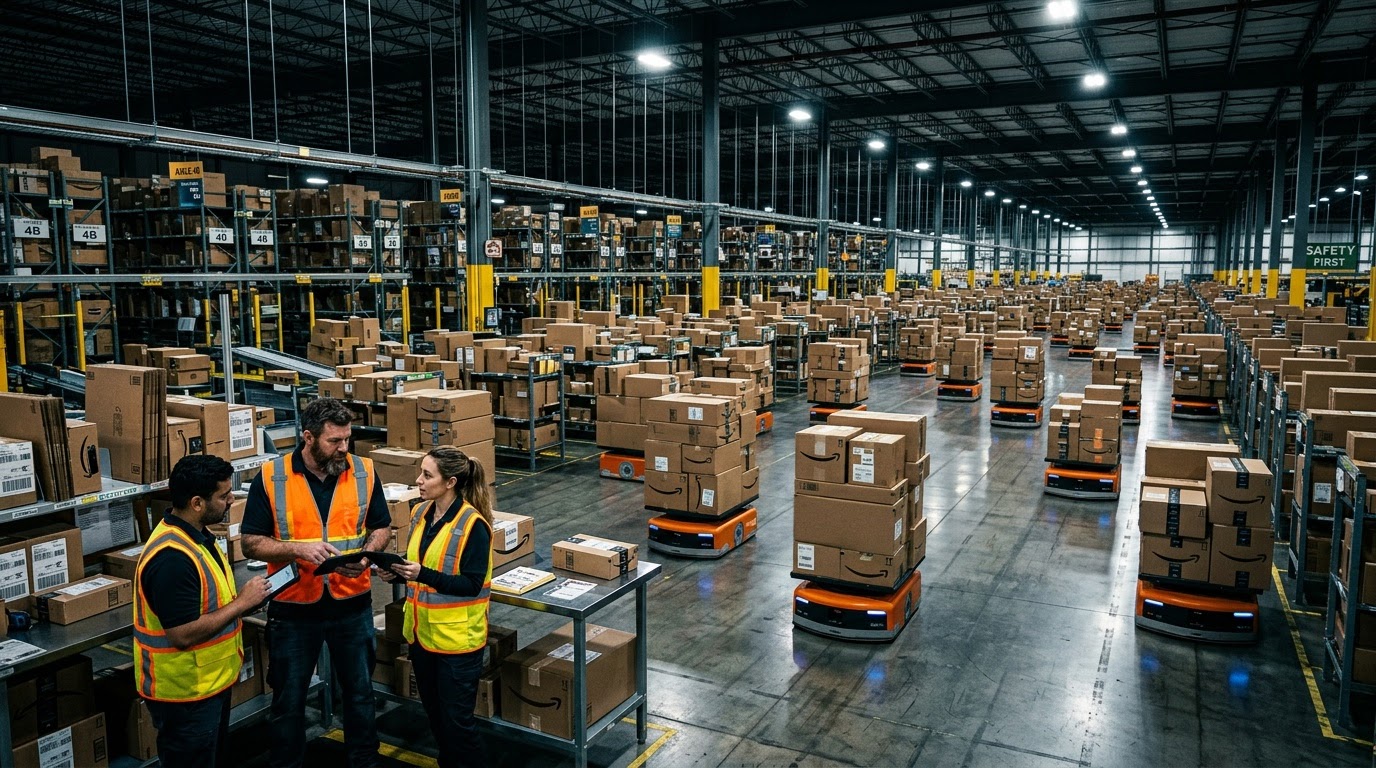
Amazon.com Inc. (AMZN) is doing what it has always done: building more warehouses, adding more robots and trying to move packages faster and cheaper than everyone else. The twist is that Wall Street is starting to frame that old retail grind as an AI story.
Bank of America Securities analyst Justin Post maintained a Buy rating and $317 price forecast on the stock, saying he continues to view Amazon retail as a key beneficiary of AI and robotics-driven automation that can improve delivery efficiency and speed.
Capacity Growth Expected to Accelerate
Post leaned on estimates from logistics consultant Marc Wulfraat of MWPVL, who expects Amazon to add about 91 million gross square feet of retail capacity in 2027. That would be up 38% from roughly 66 million square feet in 2026.
MWPVL estimates Amazon will spend about $28 billion on new supply-chain facilities across 2026 and 2027, excluding maintenance and retrofits. That spending could increase by about $10 billion on an annualized basis, with investment focused on smaller robotic fulfillment centers, inbound cross-docks and delivery stations.
Post noted that retail capital spending remains relatively small compared with BofA's estimate of $240 billion in AWS capex for 2027. Still, he said higher retail investment and Leo capitalization could modestly lift overall capex growth next year.
Automation Could Lower Labor Needs
Automation remains a key part of Amazon's logistics strategy. MWPVL expects Amazon to introduce new Gen14 automated fulfillment centers in 2028, with seven sites pending.
The newer centers are expected to operate with about 1,000 employees on average, compared with roughly 2,430 employees at Gen11 facilities and about 1,310 at Gen12 sites. That is a lot fewer people per building, which is the whole point of automation.
MWPVL expects Amazon's broader automation effort to target moving the same amount of volume with about one-tenth of the labor.
Amazon could also test fully automated last-mile delivery stations under Project Tetromino in 2028. MWPVL expects one pilot that year, five sites in 2029 and another 10 in 2030. Sorting rates at those facilities could reach about 2.5 times current levels.
Logistics Network Keeps Expanding
MWPVL expects Amazon Logistics to move about 8 billion packages in 2026, up from 6.67 billion in 2025 and 6 billion in 2024.
Amazon currently operates 592 delivery stations, with MWPVL projecting expansion toward roughly 950 by 2030.
Its Amazon Supply Chain Services offering is also expanding, with rates estimated at 20% to 25% below United Parcel Service, Inc. (UPS) and FedEx Corp. (FDX) for some business-to-consumer shipments.
However, Wulfraat sees higher barriers in business-to-business delivery, reverse logistics and national less-than-truckload shipping. He estimates Amazon currently has fewer than 30 LTL cross-docks, versus about 300 needed for a scaled national network.
Costs Remain a Watchpoint
MWPVL estimates that a $1-per-hour increase in wages raises delivery cost per package by about 3.4%, while a $1 increase in gas prices adds roughly 1.3%.
Even with higher labor and fuel costs, MWPVL estimates Amazon's shipping cost per unit has fallen 16% since the fourth quarter of 2021, helped by regionalization and inbound logistics improvements.
AMZN Price Action: Amazon.com shares were up 3.04% at $265.72 at the time of publication on Wednesday, according to market data.