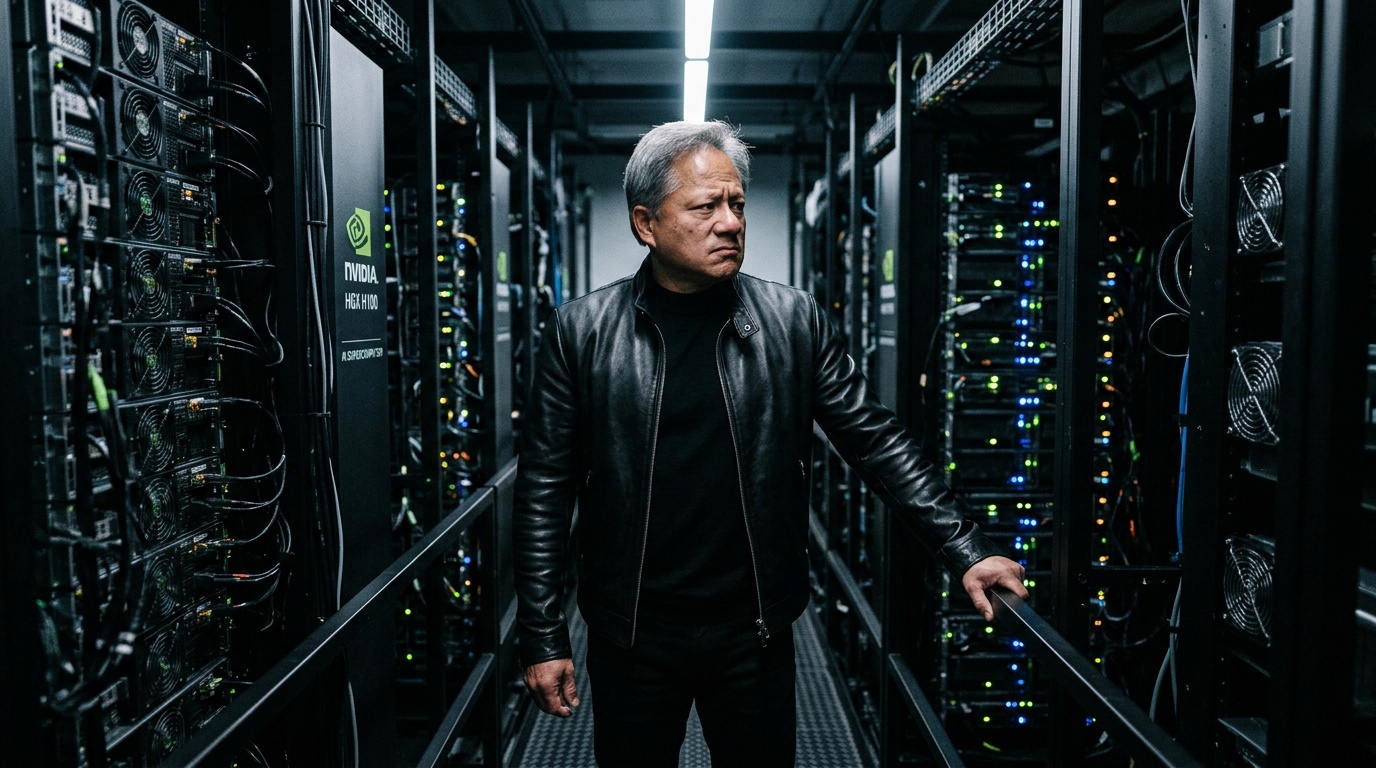
NVIDIA Corp. (NASDAQ:NVDA) just lost the guy who made it the most important company in tech, and analysts are already gaming out what happens next. Counterpoint Research's Neil Shah and Brady Wang said Friday that Jensen Huang's abrupt departure could reshape the entire artificial intelligence industry, ending the annual innovation cycle that drove semiconductor and infrastructure investments.
That's a big deal. Huang wasn't just a CEO. He was the conductor of an orchestra that stretched from chip fabs to liquid cooling vendors, and his exit leaves a leadership vacuum that could hand Advanced Micro Devices Inc. (NASDAQ:AMD) its biggest competitive opportunity in years.
Chief Financial Officer Colette Kress has stepped in as interim CEO, while semiconductor industry veteran Harvey Jones has become NVIDIA's first board chair, according to the report. That's a notable structural change for a company that has long operated with Huang at the center of everything.
The Chip Roadmap Is Fine, for Now
Counterpoint expects NVIDIA's transition from Blackwell to Vera Rubin to proceed, and the company's deep engineering bench should sustain the AI ecosystem's momentum over the next 18 to 24 months. But there's a catch: interim and incoming executives could prioritize execution and corporate governance over new technological experiments. In other words, the company might get more boring. And boring, in the AI chip world, can mean slower.
Under Huang, NVIDIA synchronized product development across its entire supply chain, from advanced chip manufacturing and packaging to high-bandwidth memory, networking, and liquid cooling systems. That synchronized dance kept suppliers on their toes and competitors perpetually behind.
A slower product development cycle could ease research and capital spending pressure on suppliers, including Taiwan Semiconductor Manufacturing Co. Ltd. (NYSE:TSM), Micron Technology Inc. (NASDAQ:MU), and SK hynix Inc. (NASDAQ:SKHY). But those same suppliers could also face slower sequential revenue growth and margin pressure. Less pressure to spend, but also less revenue to book. Pick your poison.
AMD and Custom Chips Smell Blood
Counterpoint sees the leadership transition as the biggest competitive opening in years for AMD and cloud computing companies developing custom chips. The research firm's forecast that server AI application-specific integrated circuit (ASIC) unit shipments will surpass graphics processing unit (GPU) shipments in 2027 now looks even more likely.
Alphabet Inc. (NASDAQ:GOOG) (NASDAQ:GOOGL) and Amazon.com Inc. (NASDAQ:AMZN) could accelerate investments in their custom AI chips, including Google's Tensor Processing Units and Amazon's Trainium processors, to reduce their reliance on NVIDIA. That's a trend that was already building, but a distracted NVIDIA makes it easier to justify.
Meanwhile, other cloud providers could curb spending amid power grid constraints, permitting delays, and growing scrutiny of investment returns. The analysts expect more diversified chip purchases in 2027 and 2028 as cloud providers seek to reduce their dependence on a single supplier. Translation: NVIDIA's customers are about to start playing the field.
No One Person Can Replace Huang
Huang played several critical roles at NVIDIA, ranging from technology visionary and supply chain negotiator to AI ecosystem financier. The analysts believe no single successor can fulfill all those responsibilities. That's not a knock on Kress or anyone else. It's just math.
NVIDIA's competitive advantage spans five layers of the AI ecosystem: energy, chips, infrastructure, models, and applications. Weak leadership in any of these areas could erode its GPU dominance. Counterpoint also warned of potential senior executive departures as NVIDIA searches for a permanent CEO. Executive retention is about to become a full-time job for someone in Santa Clara.
Meanwhile, government-backed AI deals and financing for specialized cloud providers could slow during the leadership transition. That's a quieter risk, but a real one.
Export Controls Could Get Even Tighter
The analysts expect Washington to expand its regulatory focus beyond physical chip shipments to verifying end users and monitoring remote access to AI computing infrastructure. Tighter regulations could trigger more customer verification audits, regional shipment restrictions, and longer delivery timelines for smaller buyers.
Large telecommunications companies and established enterprise operators that meet regulatory requirements could benefit, while less transparent resellers could struggle. The compliance moat gets wider, and the little guys get squeezed.
Can NVIDIA Find Its Tim Cook?
Counterpoint drew parallels between Huang and technology pioneers Gordon Moore, Steve Jobs, and Bill Gates. The analysts wrote: "Visionary founders such as Gordon Moore, Steve Jobs, Bill Gates, and Jensen Huang start revolutions. Disciplined operators turn them into multi-trillion-dollar institutions."
The research firm believes NVIDIA needs a technically credible, disciplined executive capable of preserving its competitive advantage and steering the chipmaker through its next decade of growth. The analysts questioned whether NVIDIA could find its equivalent of Apple Inc. (NASDAQ:AAPL) CEO Tim Cook, Microsoft Corp. (NASDAQ:MSFT) CEO Satya Nadella, or Alphabet CEO Sundar Pichai.
That's the billion-dollar question, or rather the trillion-dollar one. Huang built the revolution. Now someone else has to run the institution. And in the meantime, AMD and the custom chip crowd are more than happy to eat NVIDIA's lunch.