Nvidia Corp (NVDA) has a new interim CEO, Colette Kress, and she inherits a company whose China strategy has become a national security issue. Just as one of its most prominent AI competitors prepares to enter the public markets. No pressure.
A May report from short seller Culper Research estimated that China still accounted for more than 20% of Nvidia's fiscal 2026 compute revenue, despite U.S. export restrictions. The report alleged that much of that business flowed through Southeast Asian intermediaries.
Culper's verdict: "China didn't go to zero; it just took a new shape."
How do those sales happen? And does Washington want them stopped?
Culper's Map Starts in California
San Jose, California-based Aivres Systems builds the servers at the center of the alleged supply chain. Formerly known as Inspur Systems, the company was renamed after its Chinese parent was blacklisted by the U.S. government. Inspur retains a one-third ownership stake.
Trade records cited by Culper show that Speedmatrix, the Malaysian subsidiary of Singapore-based Megaspeed International, imported $4.6 billion worth of products between December 2024 and January 2026. Aivres accounted for $4 billion of those imports.
The transactions also raise questions about how Nvidia reports its geographic revenue. The company attributes revenue to its direct customers' headquarters, rather than necessarily the location where its products are ultimately used. As a result, sales through a U.S.-based OEM (original equipment manufacturer) can be classified as U.S. revenue even if the servers eventually reach Chinese customers.
The CEO Connection
The controversy also touches Nvidia's leadership.
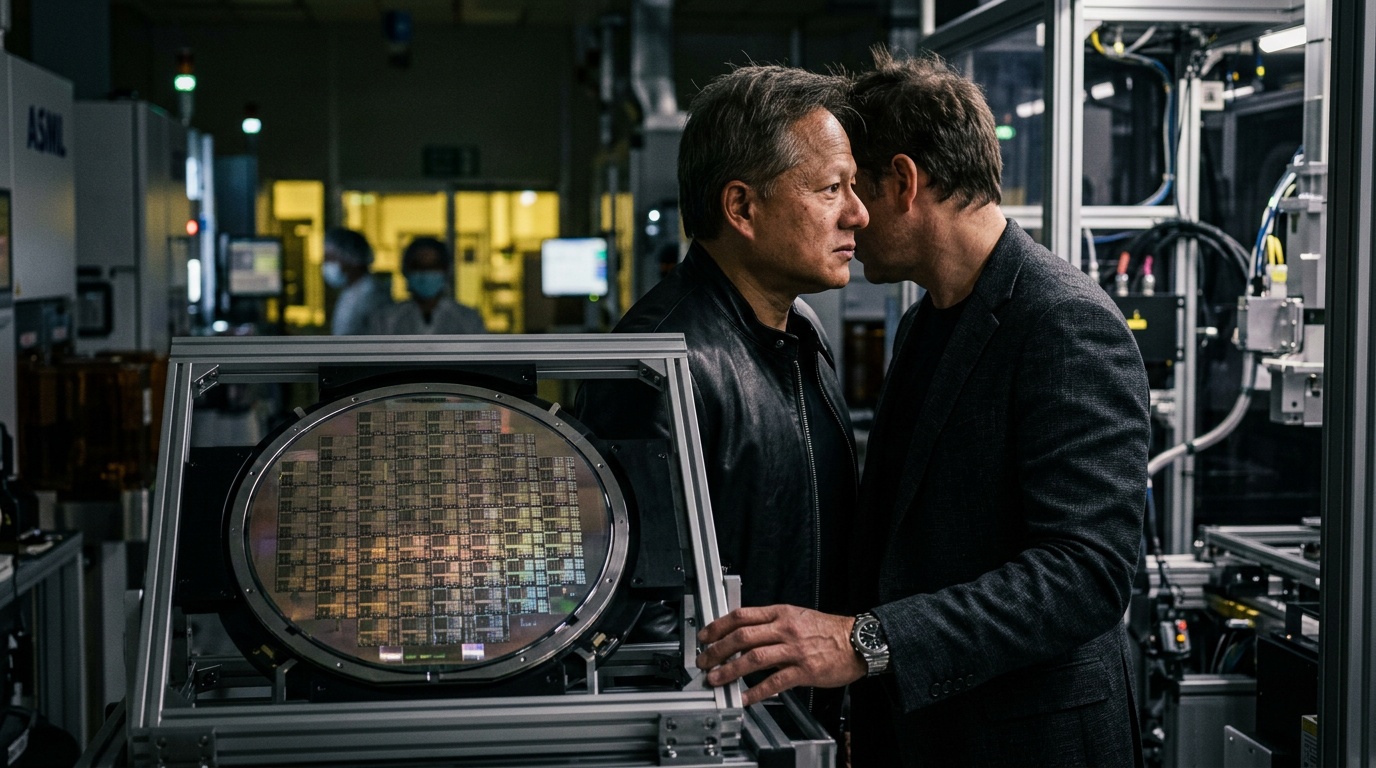
Nvidia co-founder Jensen Huang resigned as CEO on Thursday amid an investigation into his relationship with former Megaspeed executive Alice Huang, whom U.S. intelligence officials reportedly suspect of working for China's Ministry of State Security.
The allegations against Alice Huang have not been independently verified.
The Money Runs Through Singapore
Culper alleges that Speedmatrix pledged its entire business to Apex Enterprise Solutions, a procurement vehicle ultimately owned by Alibaba Group Holding Ltd. (BABA). Apex had $4.2 billion in loans from Alibaba-related companies.
Culper identifies two potential routes into China: Servers can remain in Southeast Asian data centers that rent computing capacity to Chinese firms, or they can be physically transported across the border.
In March 2026, the Justice Department charged three people tied to Super Micro Computer Inc. (SMCI) in an alleged scheme to divert Nvidia-powered servers into China, using "dummy" replicas to fool auditors.
Culper cited an unnamed former Nvidia director-level employee as saying: "Megaspeed is just the tip of the iceberg."
Megaspeed denies illegally exporting chips. So far, Nvidia has not directly rebutted Culper's May 2026 report.
Culper disclosed that it held a short position in Nvidia shares, meaning it could profit if the stock declines. Nvidia shares are down more than 15.4% year to date.
The Stakes Are Frontier AI
Advanced GPUs are the bottleneck for training leading models, and export controls exist to keep Chinese labs behind in capabilities for military use.
Anthropic CEO Dario Amodei made that case at Davos, comparing H200 sales to China to selling nuclear weapons to North Korea.
Huang called the comparison "lunacy."
Nov. 19: Two Events, One Date
On Nov. 19, as President Donald Trump prepares to meet Chinese President Xi Jinping on the sidelines of the APEC meetings in Shenzhen, Anthropic is expected to start trading on Nasdaq under the ticker ANT with a $70-$78 price range.
Huang attended both of Trump's earlier meetings with Xi this year. This time he will not be there.
On the same day, the company whose CEO compared chip sales to China to arm North Korea makes its market debut. The man who called that comparison "lunacy" will be watching from outside Nvidia.