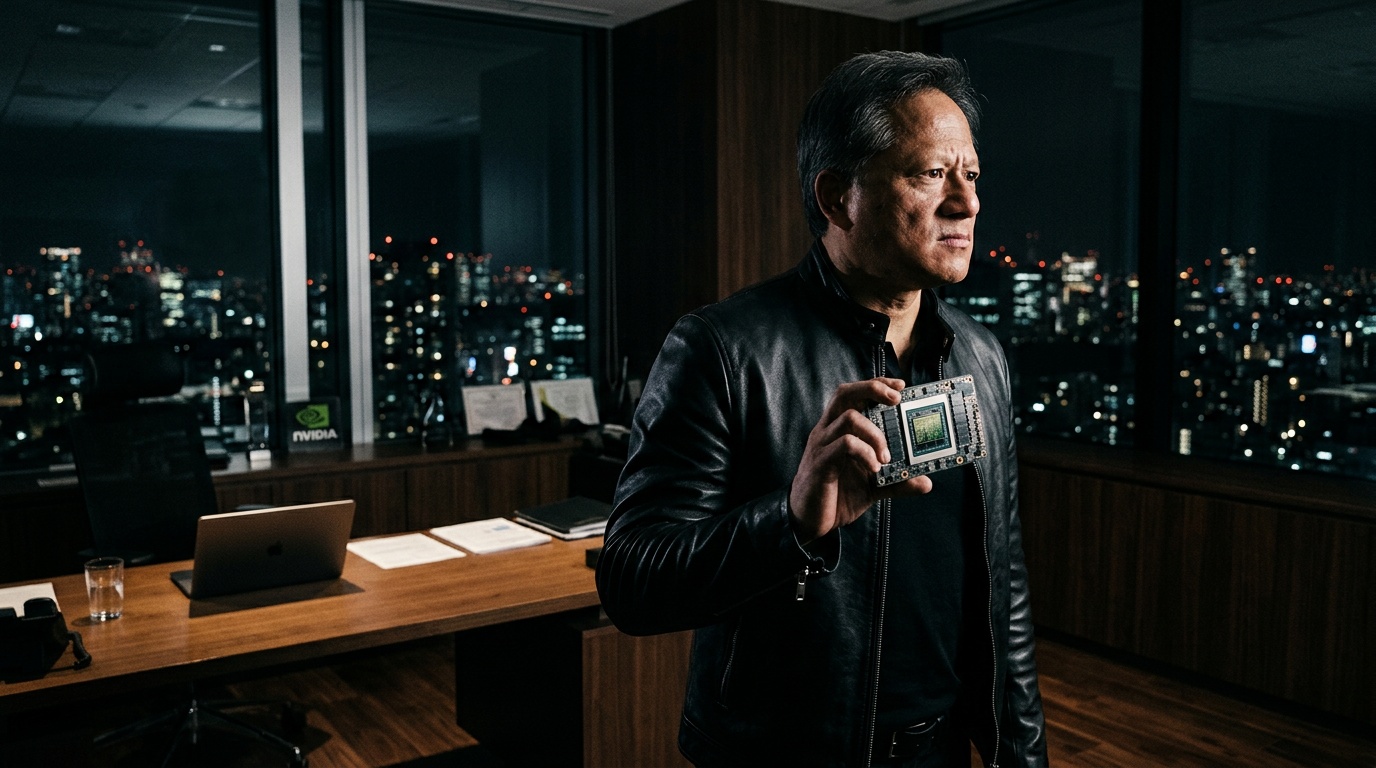
NVIDIA Corp. (NASDAQ:NVDA) is still the center of the AI investing universe. Strong chip demand, a growth story that refuses to quit, and a stock that trades at roughly 10 times 2028 earnings estimates will do that. But a new variable has entered the chat: scrutiny around CEO Jensen Huang, succession planning, and whatever regulatory fallout comes next.
The stock slid over 4% on Monday as the story surrounding Huang surfaced. By Tuesday premarket, shares were up 0.55% at $179.63, according to market data. So investors are not exactly sprinting for the exits. They are, however, asking the question that tends to make boards nervous: what happens if the person who is the company is no longer running the company?
Wedbush Sees Growth Outweighing Leadership Risk
Wedbush analyst Matt Bryson acknowledged significant key-person risk at NVIDIA but maintained his Outperform rating and $345 price forecast. That is not a small statement. Key-person risk is the polite Wall Street term for "this whole thing depends on one human being," and NVIDIA has it in spades.
Bryson told CNBC on Tuesday that NVIDIA remains the leader in AI semiconductors, could grow more than 70% next year, and trades at roughly 10 times 2028 earnings estimate. Those are the numbers that keep the bulls comfortable.
He expects the investigation around Huang to remain an overhang well into next year but said he sees "no reason" for Huang to step down if the matter proves personal and does not affect NVIDIA's business. In other words: if this is a Huang problem and not an NVIDIA problem, the business case survives.
Bryson pointed to past executive scandals, including those involving Intel's Paul Otellini and HP's Mark Hurd, but said those cases differed from Huang's situation. He suggested that historical precedent, including the U.S. government's handling of the Super Micro case, indicates Huang may remain at NVIDIA despite the controversy. History, in other words, offers clues, and the clue is that CEOs in this position often stick around.
Bernstein Says Issue Looks NVIDIA-Specific
Bernstein senior analyst Stacy Rasgon said the controversy appears specific to NVIDIA rather than a broader threat to AI demand. That distinction matters a lot. If the AI buildout were wobbling, you would see it across the entire supply chain. This looks more like a single-company story.
Rasgon told CNBC on Monday that customers are unlikely to reduce purchases because of the controversy. But he highlighted leadership risk because "Jensen is NVIDIA, NVIDIA is Jensen" and said it remains unclear who could replace Huang's long-term strategic role. That is the uncomfortable part. Customers may not care today, but the board eventually has to care about who runs the place.
Stephen Witt Flags Succession Risk
Stephen Witt, author of The Thinking Machine, said NVIDIA has "no real succession plan" and does not have an obvious replacement for Huang. That is a governance observation, not a stock call, and it lands with some force.
Witt told CNBC on Monday that the board is unlikely to remove him, although a finding that Huang knowingly enabled MegaSpeed to violate the law could create serious problems. So the board probably stays put, unless the investigation produces something much worse than an overhang.
Sonnenfeld Calls Governance a Key Issue
Yale School of Management's Jeffrey Sonnenfeld took a more cautious stance, saying there is "good cause to put him on hold" while investigations proceed.
Sonnenfeld told CNBC on Tuesday that NVIDIA has several capable executives, including Colette Kress, but flagged gaps in succession depth and corporate governance. That is the tension in a nutshell: there are capable people, but there is not an obvious heir, and the governance structure has not been stress-tested like this before.
Miskin Calls NVIDIA a High-Quality Stock
Manulife John Hancock Investments co-chief investment strategist Matthew Miskin called NVIDIA "one of the highest-quality stocks on the planet Earth," citing strong cash generation, margins, its balance sheet and leadership in the AI buildout.
He told CNBC on Tuesday that he would look at the stock opportunistically during the drawdown and would not allow a single event to overwhelm the underlying business case. That is the classic buy-the-dip instinct, and it explains why a 4% slide did not turn into something uglier.
Clinton and Goldberg See Huang As Central to NVIDIA
Intelligent Alpha CEO Doug Clinton told CNBC on Monday that he estimated a 10%-20% chance that Huang could be pushed out but said shareholders and customers would not want that outcome. That is a wide range, but the direction is clear: most people with money on the line would rather keep him.
Seaport Research Partners senior analyst Jay Goldberg similarly said Huang "is NVIDIA" and argued that investors should avoid assuming broader business damage before the investigation establishes the facts. Fair point. Markets love to price the worst case before anyone knows anything.
Ives Warns of Sharp Downside If Huang Exits
Yorkville Ives & Co.'s Dan Ives called the episode a "black eye moment" for Huang and NVIDIA while maintaining his Outperform rating.
He told CNBC on Tuesday that he estimated roughly a 15% chance that Huang could lose his role and said NVIDIA shares could fall 25%-30% initially if he were forced out, given Huang's central role in the company and the broader AI ecosystem. That is the number that should make investors sit up. A 15% probability of a 25%-30% drawdown is not nothing, even if the base case is that Huang stays.
Cramer and Scissors Focus on China Exposure
Jim Cramer told CNBC on Monday that the investigation should focus on what Huang knew about MegaSpeed and whether the relationship affected NVIDIA's business dealings. That is the factual question underneath all the noise.
American Enterprise Institute economist Derek Scissors told CNBC on Tuesday that the episode could intensify scrutiny of NVIDIA's China exposure and U.S. export controls. That is the part of the story that could outlast the headlines. China exposure and export controls were already a live issue for NVIDIA, and a controversy like this gives policymakers another reason to look closely.
For now, the scoreboard is simple. NVIDIA shares were up 0.55% at $179.63 during premarket trading on Tuesday. The stock is wobbling, not breaking. Wall Street's consensus seems to be that Huang stays, the business keeps growing, and the succession question remains a background hum rather than a fire alarm. But background hums have a way of getting louder.