Walmart Inc. (WMT) is up 16.2% in October, on track for its best month since 1999.
And it is not alone.
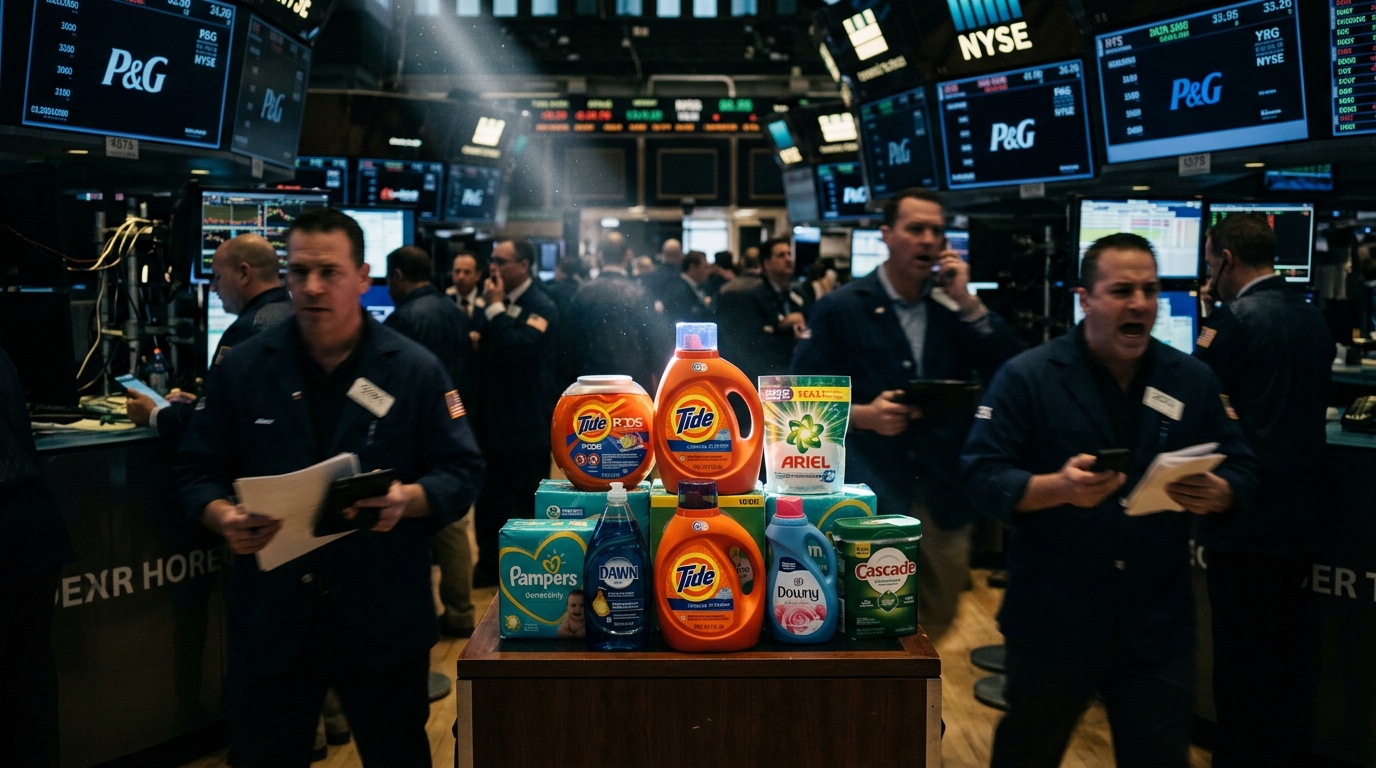
Toothpaste, laundry detergent and soda are beating artificial intelligence on Wall Street this month.
By a wide margin.
The Consumer Staples Select Sector SPDR Fund (XLP) is up 11.3% in October, heading for its best month since it launched in December 1998.
Meanwhile, the SPDR S&P 500 ETF Trust (SPY) is roughly flat, and the Technology Select Sector SPDR Fund (XLK) has lost 6.9%. Chipmakers, as tracked by the iShares Semiconductor ETF (SOXX), have tumbled over 15%.
That puts staples about 11 percentage points ahead of the S&P 500 in a single month. In the fund's 27-year history, only April 2022 produced a gap that wide.
So why are investors loading up on shampoo and cereal? And more importantly, are they seeing trouble coming?
The AI Trade Is Losing Its Grip
On Thursday, Meta Platforms Inc. (META) fell about 8% on worries about its artificial intelligence spending. As a result, XLK dropped 3.4%, while XLP rallied 2.7%.
The 10-year Treasury yield fell about 17 basis points to 4.95%, its biggest one-day drop since Aug. 2, 2024.
The exit started earlier.
Bank of America clients sold a record $14.8 billion of individual U.S. stocks in the week through Oct. 16.
"Clients sold stocks in 8 of 11 sectors led by Tech (2nd biggest outflows ever)," Bank of America equity quant strategist Jill Carey Hall said in a Bank of America Global Research report.
Staples were among the few sectors clients bought.
Defensives Can Get Crowded Too
Bank of America's equity derivatives team, which includes strategist Abhinandan Deb, does not see the start of a tech crash.
The strategists described the AI selloff as "a largely positioning-driven hiccup on the fringes of the AI trade rather than evidence of secular weakness in the core," in a report this week.
"US equities continue to rotate sharply in times of stress rather than rupture, with the recent outperformance of defensives vs tech historically extreme," they said.
That rotation has its own risks.
"While seemingly paradoxical, defensives like healthcare and staples now sit among the highest BRI pockets of the market," analysts added, referring to the bank's Bubble Risk Indicator.
The buying among staples has been across the board.
Updated by 3:10 p.m. ET on Oct. 22. Source: TradingView, Yahoo Finance
Procter & Gamble Has Not Had a Month Like This Since 1998
Procter & Gamble Co. (PG) rose 5.9% on Thursday after its fiscal first-quarter results.
The maker of Tide and Gillette is up 14.6% in October, on pace for its best month since October 1998, when it jumped 24.7%.
Core earnings rose 1% to $2.00 per share, net sales climbed 4% to $23.28 billion, and volumes grew 2.4%. The company also kept its fiscal 2027 core earnings outlook.
Still, P&G expects about $1.4 billion in after-tax commodity cost headwinds this fiscal year. Its chief financial officer said those pressures will be materially higher in the second quarter and second half because of oil prices.
What Happened the Last Times Staples Ran This Far Ahead
| Month | XLP | SPY | SPY 12 months later |
|---|
| October 2026 | +11.3% | -0.1% | — |
| April 2022 | +2.3% | -8.8% | +1.0% |
| November 2000 | +3.4% | -7.5% | -13.8% |
| February 2001 | +0.6% | -9.5% | -10.3% |
| September 2000 | +4.0% | -5.7% | -27.3% |
| October 2018 | +2.0% | -6.9% | +12.1% |
| April 2000 | +5.3% | -3.5% | -13.9% |
| May 2000 | +7.2% | -1.6% | -11.8% |
Months with the widest XLP lead over SPY, price changes. Source: TradingView
Five of the seven earlier months came in 2000 and 2001, as investors fled the dot-com winners before a recession that began in March 2001.
The S&P 500 was lower a year later in five of the seven cases.
However, there is one key difference.
In every earlier case, the S&P 500 itself fell, by 1.6% to 9.5%. This October, SPY is flat and sits about 2.5% below the record intraday high it hit this month. In other words, money is rotating inside a market near its peak.
The closest match is recent. In February 2026, XLP gained 7.8% while SPY slipped 0.9%. Six months later, SPY was up 11.8%.
Prediction Markets Do Not See a Recession Yet
Polymarket traders see a 7.5% chance of a U.S. recession by the end of 2026 and a 35% chance by the end of 2027.
What the record month does show is how much investors want protection from the AI trade. The last time that urge was this strong, in 2000 and 2001, a bear market and a recession followed.