On Tuesday morning, Applied Materials Inc. (AMAT) CEO Gary Dickerson and his leadership team took the stage at Semicon West in San Francisco and laid out targets through 2030.
By the afternoon, shares fell as much as 7% to around $462, the sixth consecutive losing session. The stock is down about 15% since Oct. 5 and sits 36% below its record close of $723 set on June 30.
In a note shared the same day, Cantor Fitzgerald analyst C.J. Muse just reiterated an 'Overweight' rating and $850 price target. From Tuesday's price, that implies roughly 85% upside.
Six Red Sessions and a Memory Scare
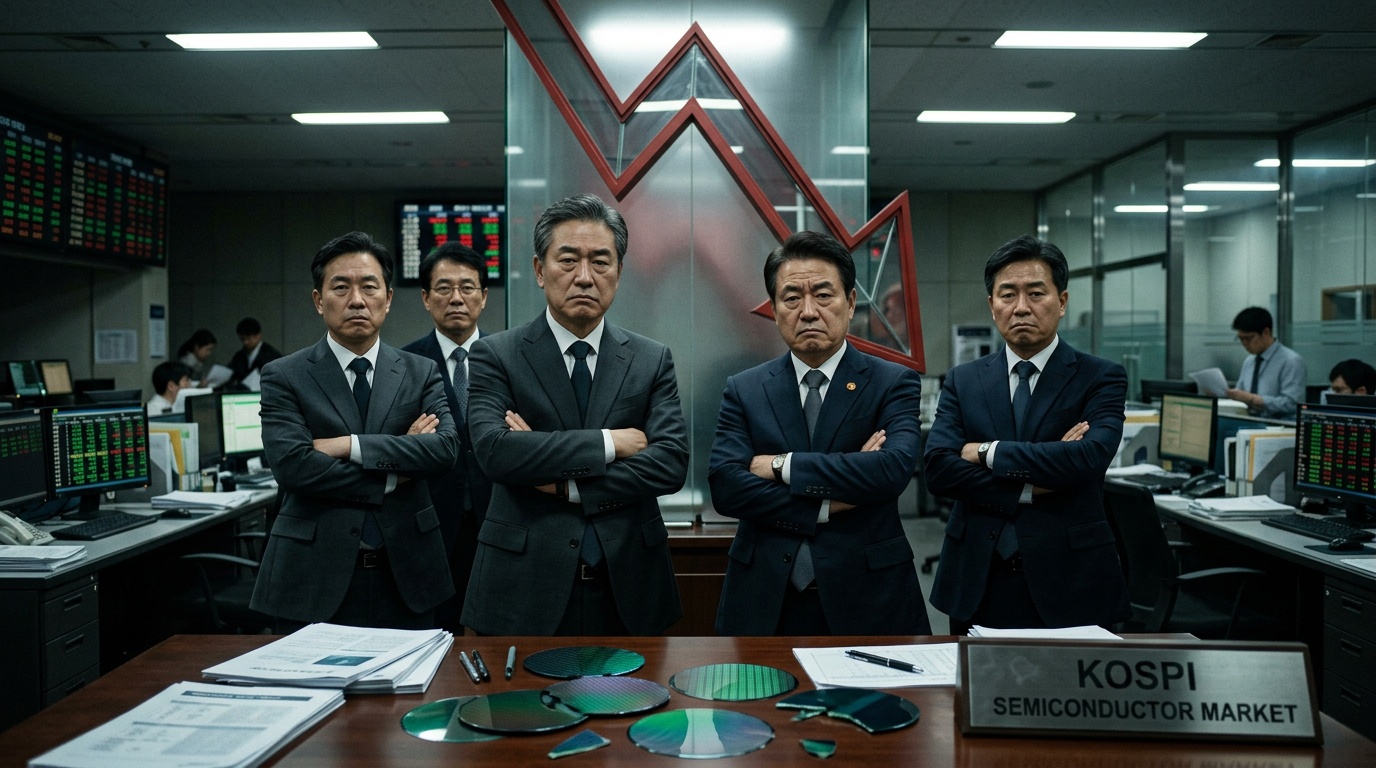
The selling is sector-wide. The Philadelphia Semiconductor Index is also on a six-session losing streak, down about 8% from its Oct. 5 close.
Memory stocks took the hardest hit.
SK Hynix Inc. (SKHY) plunged 10.1% in Seoul and Samsung Electronics Co. Ltd. (SSNLF) lost 7.4% after a report that China's ChangXin Memory Technologies had made progress on a new memory architecture both Korean rivals are developing.
Micron Technology Inc. (MU) fell 4.8%.
Equipment makers followed.
Lam Research Corp. (LRCX) dropped 3.5%, KLA Corp. (KLAC) 3.4% and ASML Holding N.V. (ASML) 2.6%. Applied Materials fell twice as much as any of them.
What Applied Materials Promised Through 2030
The case rests on wafer fab equipment, or WFE, the machines chipmakers buy to build and upgrade factories.
Applied Materials expects WFE spending to grow faster through 2030 than over the past decade, with artificial intelligence driving about 80% of the incremental growth, and targets at least 2 percentage points of share gain.
Its services arm is expected to grow more than 20% in 2026 and exceed $12 billion in revenue by 2030. Profitability targets call for a 54% gross margin and a 40% operating margin.
Together, the model implies earnings of $33 to $42 a share in 2030, assuming WFE spending of $300 billion to $400 billion. The company earned $9.42 a share in fiscal 2025.
"The global buildout of AI infrastructure is driving a new era of growth for wafer fab equipment," said CEO Gary Dickerson in the company's release.
Cantor's Math Behind $850
Muse said the 2030 model is in step with Cantor's own stretch estimate of $35 a share for 2029, and in places too cautious.
He called the 54% gross margin conservative given the mix shift toward Silicon and value-based pricing, and said the 40% operating margin at the high end of the WFE range points to earnings power near $50 a share.
On the fears behind the selloff, Cantor pushed back on two fronts.
It challenges the idea that ChangXin's new architecture is a near-term threat, putting it closer to 2030 and at a cost and yield disadvantage without extreme ultraviolet lithography. It also said recent comments by Broadcom Inc. (AVGO) CEO Hock Tan in Singapore were misread, describing memory shortages easing rather than oversupply.
Everything heard at Semicon West, Muse said, points to a shortage of compute, with equipment makers asked to expedite deliveries for 2028 to 2030.
At Tuesday's price, the stock trades at about 18 times Cantor's 2028 earnings estimate of $25. The $850 target is 24 times a 2030 estimate of $48, discounted back three years at 10%.
"We would be buyers on weakness," Muse said.
The main risk, he added, is China, where Applied Materials has the most domestic exposure among equipment makers.
Where the Rest of Wall Street Stands
According to MarketDash Analyst Ratings, 26 analysts rate the stock a consensus Buy with an average target of $652, about 41% above Tuesday's price.
Cantor's $850 has stood since at least mid-August, when the stock was above $600. The upside has grown only because the price has fallen.
The next test comes on Nov. 12, when Applied Materials reports fiscal fourth-quarter results.
Analysts expect $4.05 a share on revenue of $10.30 billion, up from $2.17 and $6.80 billion a year earlier.