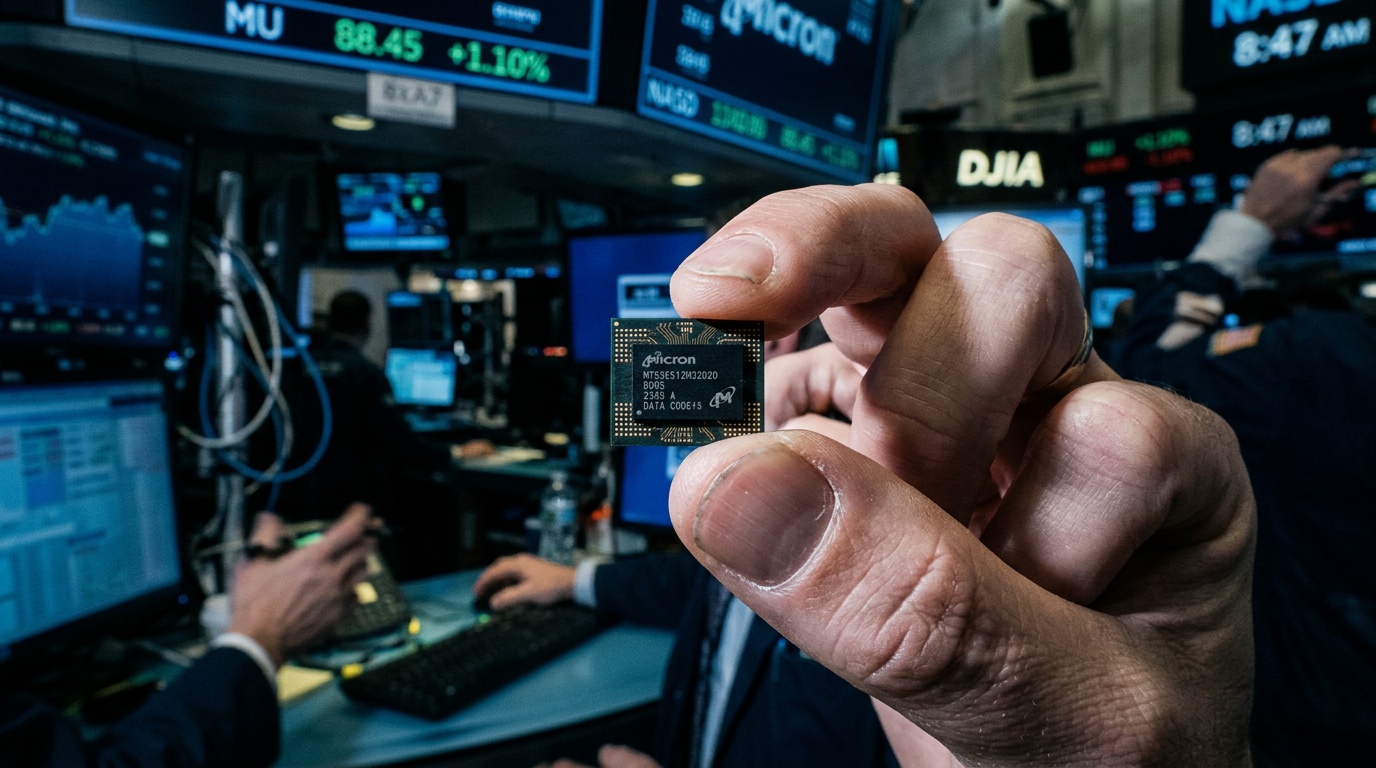
U.S. equities split down the middle at the start of a week loaded with catalysts, as an unwind in memory and optical-component stocks dragged the Nasdaq 100 lower.
President Donald Trump escalated the trade fight with Ottawa in a Truth Social post, writing that on “January First, 2027, Tariffs on all Cars, Trucks, both large and small, Automotive Parts, and Steel, will be increased to 50%.”
The order landed just days after reports that Washington and Ottawa were closing in on a deal to halve the existing 50% levy on Canadian steel and aluminum – a whiplash that has left investors repricing North American industrial supply chains with almost no notice.
The second front is Tehran. Treasury Secretary Scott Bessent is due to speak on Iran Monday afternoon to unveil what the administration has billed as an economic blockade.
Treasuries offered modest relief. The 10-year yield eased about 4 basis points to 4.69%, holding just below last week’s 20-month high of 4.75%, while the 30-year fell roughly 6 basis points to 5.22%.
Rate expectations are the week’s live wire. Fed Chair Kevin Warsh speaks at Jackson Hole on Friday.
Across U.S. equity markets by midday Monday, the damage was concentrated rather than broad, with two-thirds of S&P 500 sectors higher even as the index itself drifted lower.
The S&P 500 slipped 0.1% to 7,664.26, while the Dow Jones Industrial Average added 0.3% to 53,459.34, a gain of roughly 182 points.
The Nasdaq 100 was the clear laggard, down 1.0% to 29,015.54. The Russell 2000 fell 0.5% to 3,001.85.
Gold – tracked by the SPDR Gold Shares (GLD) – kept grinding higher, rising 1.0% to $4,654.67 an ounce and extending a 14.2% advance over the past month as investors hedged Wednesday’s inflation print and Friday’s Jackson Hole address.
Bitcoin (CRYPTO: BTC) also rallied past $79,000, up 2.2% for the session.
Monday’s Performance In Major US Indices
| Index | Last | % Change | MTD | YTD |
|---|
| S&P 500 | 7,664.26 | -0.1% | +2.3% | +12.0% |
| Dow Jones | 53,459.34 | +0.3% | +2.4% | +11.2% |
| Nasdaq 100 | 29,015.54 | -1.0% | +2.9% | +15.2% |
| Russell 2000 | 3,001.85 | -0.5% | +2.5% | +21.2% |
Updated by 12:25 PM ET
According to market data:
- The Vanguard S&P 500 ETF (VOO) slipped 0.1%.
- The SPDR Dow Jones Industrial Average ETF Trust (DIA) rose 0.3%.
- The Invesco QQQ Trust (QQQ) fell 0.8%.
- The iShares Russell 2000 ETF (IWM) declined 0.5%.
Memory Unwinds While Defensives Do The Heavy Lifting
The day’s real laggards were in memory and storage.
Sandisk Corporation (SNDK) tumbled 7.0%, Seagate Technology Holdings plc (STX) fell 5.9%, Micron Technology Inc. (MU) dropped 5.7% and Western Digital Corporation (WDC) lost 5.5%.
The trigger was overnight in Seoul, where Samsung Electronics fell 9% after a record shareholder-return plan fell short of expectations.
Marvell Technology Inc. (MRVL) slid 3.9%, Advanced Micro Devices Inc. (AMD) fell 3.0% and Intel Corporation (INTC) lost 3.2%.
The Consumer Staples Select Sector SPDR Fund (XLP) led all S&P 500 sectors with a 1.5% gain, followed by the Financial Select Sector SPDR Fund (XLF) at 1.2% and the Communication Services Select Sector SPDR Fund (XLC), also up 1.2%.
At the other end, the Technology Select Sector SPDR Fund (XLK) and the Energy Select Sector SPDR Fund (XLE) tied for worst, each down 1.5%, with XLE tracking crude lower.
The Industrials Select Sector SPDR Fund (XLI) fell 0.7% on the Canada tariff escalation, while the Consumer Discretionary Select Sector SPDR Fund (XLY) held a 0.5% gain and the Health Care Select Sector SPDR Fund (XLV) was roughly flat.
Among industry funds, the SPDR S&P Insurance ETF (KIE) climbed 1.5% and the U.S. Global Jets ETF (JETS) rose 0.5% as cheaper jet fuel offset the risk-off tone.
The Invesco WilderHill Clean Energy ETF (PBW) was the standout loser at 2.6%, while the iShares Biotechnology ETF (IBB) fell 0.7% and the VanEck Gold Miners ETF (GDX) eased 0.4% despite bullion’s advance – GDX is still up more than 38% month-to-date.
Applied Optoelectronics Inc. (AAOI) was the worst large-cap performer of the session, sinking 10.9% after the optical networking supplier disclosed a $600 million at-the-market equity offering – its third large financing of 2026 – reigniting dilution concerns despite record second-quarter revenue of $191.9 million and a 140% jump in data center sales.
AST SpaceMobile Inc. (ASTS) fell 6.8% as space names sold off across the board with investors pricing execution risk against the White House’s 1,000-launch-by-2030 memo.
Tempus AI Inc. (TEM) dropped 6.8%, handing back part of the roughly 24% surge it booked last week on a Merck and Moderna Phase 3 cancer-vaccine update that validated its $1.5 billion Personalis acquisition. MongoDB Inc. (MDB) lost 6.5%.
On the upside, crypto-linked equities led. Bitmine Immersion Technologies Inc. (BMNR) jumped 8.5% and Strategy Inc (MSTR) rose 4.9%, extending last week’s move as Bitcoin held near $79,700 after a 22% weekly surge – its best five-day run since March 2024 – driven by Bessent’s expanded Treasury buyback program and a White House push for the CLARITY Act.
Etsy Inc. (ETSY) climbed 4.6% on the back of a cluster of sell-side upgrades: BofA Securities moved to Buy from Neutral with a $105 target, up from $88, and Rosenblatt initiated at Buy with a $95 target, both building on a second quarter that delivered adjusted EPS of $0.98 against $0.73 consensus alongside a $2 billion buyback.
Cleveland-Cliffs Inc. (CLF) rose 4.4%, the most direct beneficiary of Trump’s 50% tariff order on Canadian steel and vehicles, and a continuation of Friday’s 7% pop on a $1 billion investment at its Middletown Works plant in Ohio. The mirror image played out in autos, where Ford Motor Company (F) slumped 4.1% on cross-border cost exposure.
On the earnings tape, PDD Holdings Inc. (PDD) reported before the open with earnings per share of 19.33 Chinese yuan against 18.73 yuan expected.
The week’s main event remains Nvidia Corp. (NVDA) on Wednesday evening, with Marvell also on deck.