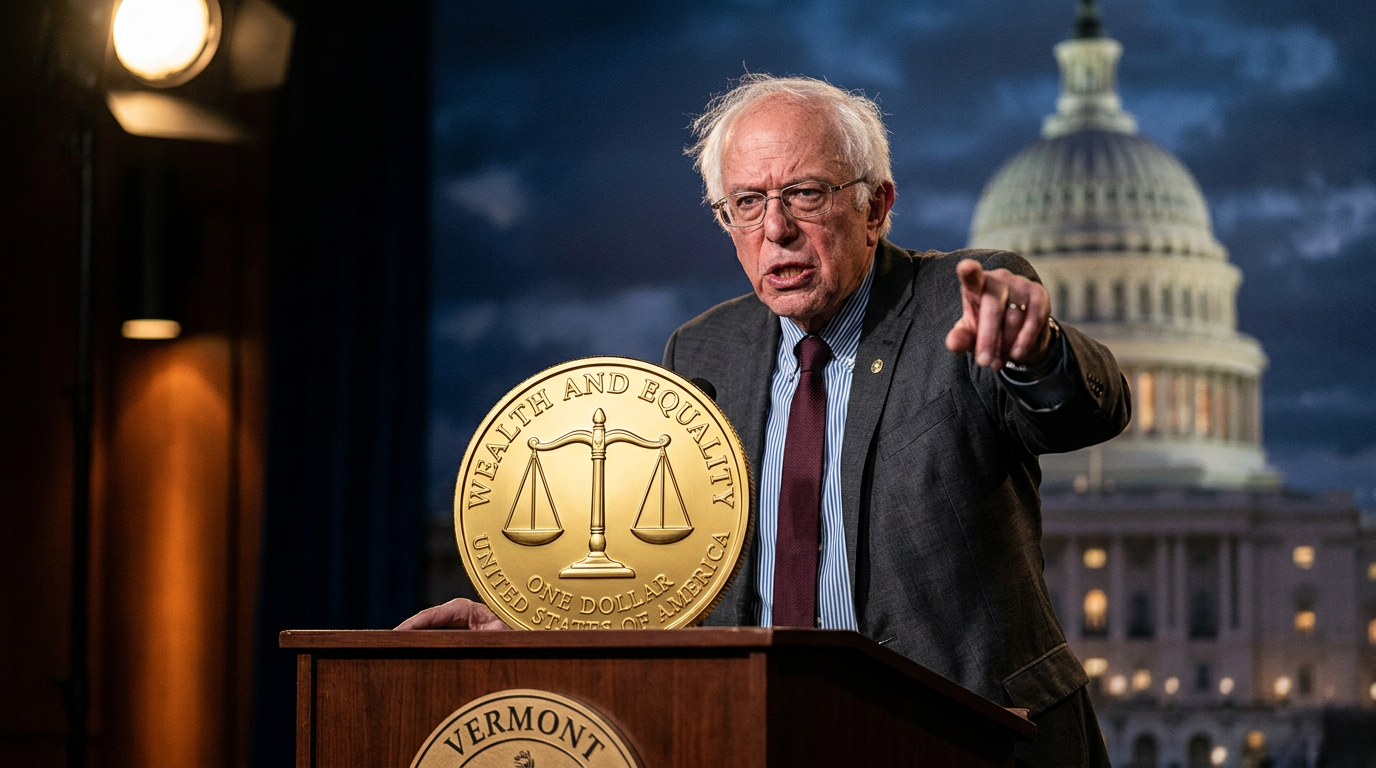
On Tuesday, the wealth of the world's richest technology executives ballooned by a combined $210 billion in a single day. For most people, that number is incomprehensible. For Senator Bernie Sanders, it's proof that the American economy is fundamentally broken.
"THE INSANELY RIGGED ECONOMY," Sanders wrote on X, in all caps, before listing the seven billionaires who saw their net worths spike: Elon Musk of Tesla (TSLA) and SpaceX, Alphabet co-founders Larry Page and Sergey Brin, Amazon founder Jeff Bezos, Oracle co-founder Larry Ellison, Dell Technologies founder Michael Dell, and Meta CEO Mark Zuckerberg. "Yesterday, while tens of millions of families were struggling to pay for rent, food, healthcare, childcare and gas, seven of Trump's oligarchic friends became $210 billion richer. Not last week. Not over the past decade. In less than 24 hours."
Sanders went on to note that the combined fortunes of these tech titans have risen by more than $1.5 trillion since President Donald Trump's election victory in November 2024. "Yes. We are living in an oligarchy," he wrote, pointing to income inequality, childhood poverty, and the financial struggles of seniors as evidence.
Senator Elizabeth Warren quickly echoed Sanders' sentiment, reviving her long-standing call for a wealth tax on the ultra-rich. "Our system is rigged so that one man becomes a trillionaire while millions of Americans can't afford a trip to the doctor," Warren wrote on X. "Wealth is funneled to the wealthy while everyone else is hanging on by their fingernails. My wealth tax would level the playing field. Let's get it done."
Representative Ro Khanna, a California Democrat, offered a slightly different take. He argued that the problem isn't necessarily that Elon Musk has become a trillionaire—it's that the country, despite generating unprecedented wealth, still can't provide healthcare for all its citizens. "It is a values issue," Khanna wrote, calling for "a New Deal for our time."
The debate over billionaire wealth isn't just happening on social media. In California, a proposed ballot measure backed by the Service Employees International Union-United Healthcare Workers West would impose a one-time 5% tax on billionaires' net worth to fund healthcare programs. But the measure's path to the ballot is looking shaky. Prediction market Kalshi showed the odds of the measure qualifying for the November ballot falling sharply on Tuesday, following reports that Governor Gavin Newsom is working to keep it off the ballot.
The timing of these political salvos is no coincidence. As the gap between the ultra-wealthy and everyday Americans continues to widen, the question of how—or whether—to tax extreme wealth is becoming a central political issue. For Sanders, Warren, and Khanna, the answer is clear: the system needs a fundamental overhaul. Whether that message resonates with voters remains to be seen, but one thing is certain: the conversation about billionaires and inequality isn't going away anytime soon.