Could SpaceX Overtake Nvidia As The World's Biggest Company In 2026?
MarketDash
SpaceX is the world's fifth-most-valuable company after a massive post-IPO rally. Can Musk's company overtake Nvidia by year-end?
Get Apple Alerts
Weekly insights + SMS alerts
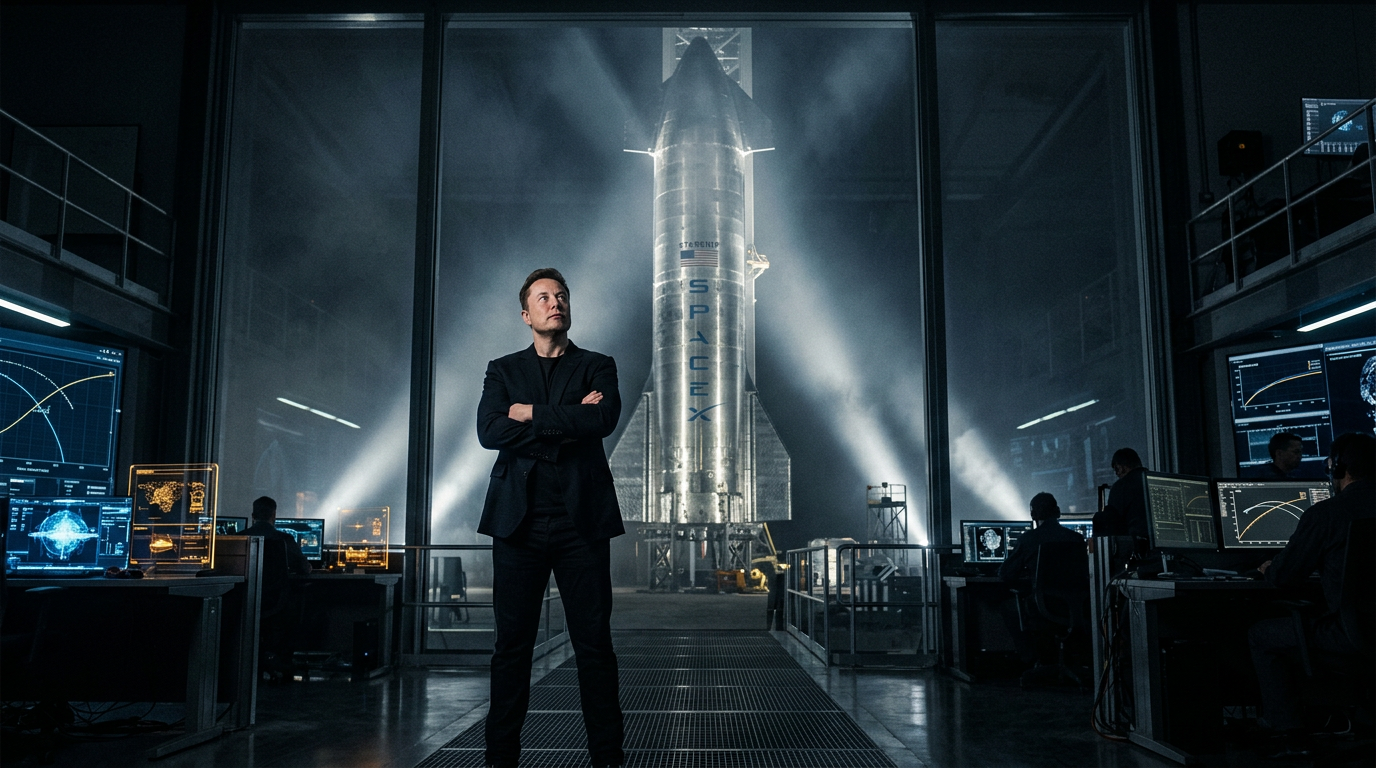
Space Exploration Technologies Corp. (NASDAQ:SPCX) just became the fifth-most-valuable company on the planet — and it took three trading sessions to do what Amazon.com Inc. needed nearly three decades to achieve.
Elon Musk's rocket and satellite company priced its initial public offering at $135 a share on June 12 in the largest IPO in history.
By midday Tuesday, the stock had jumped nearly 60% to around $213, lifting its market value to nearly $2.75 trillion and pushing it past Amazon's roughly $2.66 trillion.
This begs a question: Could SpaceX overtake Nvidia and close 2026 as the world's biggest company?
RANK
COMPANY
MARKET CAP
1
NVIDIA
$5.071 T
2
Alphabet
$4.546 T
3
Apple
$4.371 T
4
Microsoft
$2.921 T
5
SpaceX
$2.797 T
6
Amazon
$2.671 T
Polymarket Already Prices SpaceX As the World's Biggest Company
On Polymarket, the contract on the largest company at year-end gives Nvidia about 69%, Alphabet 15%, and SpaceX roughly 9% — up from under 4% a day earlier.
The climb is steep.
Nvidia is worth more than $5 trillion, so the four-day-old stock would need to add well over $1.5 trillion in value to catch it.
For SpaceX to overtake Nvidia, two things must occur:
SpaceX shares have to rally about 81% to close the gap to Nvidia's $5.07 trillion, with Nvidia flat — and by more if Nvidia keeps rising.
Alphabet, Apple and Microsoft, all currently ranked above SpaceX, must not climb faster and reach the top first.
One Analyst Says The Stock Is Worth Half Its Current Price
Only one analyst has formally initiated coverage, and the call is bearish.
CFRA's Keith Snyder started SpaceX at Sell with a $115 price target, implying about 46% downside from current levels.
According to Snyder, the SPCX problem is not the business but the price.
He describes SpaceX as a profitable, fast-scaling Starlink platform funding an enormously capital-intensive bet on Starship and artificial intelligence.
In 2025 the company produced $6.8 billion in operating cash flow but spent $20.7 billion on property and equipment, leaving free cash flow near negative $14 billion. Capital spending stayed heavy into the first quarter of 2026.
He also points to Musk's grip on the company, noting that the founder controls about 85% of the voting power.
“High-quality business, but not yet a low-risk one,” Snyder wrote.
So the market is crowning SpaceX a $2.8 trillion giant while the only analyst covering it bets the shares are worth less than half that.
Yet, Snyder also concedes the bears may be early.
Like Tesla Inc. (TSLA) before it, SpaceX carries what Snyder calls a Musk premium — a willingness to fund the story and look past the financials. The post-IPO surge looks like exactly that.
The question now is whether SpaceX's post-IPO euphoria can carry it all the way past Nvidia. Only time will tell.