President Donald Trump made it clear on Tuesday that his administration's top priority is stopping Iran from getting a nuclear weapon—even if that means Americans keep paying more at the pump. In a White House press briefing, Trump described rising gas prices as "peanuts" compared to the Iranian nuclear threat, and thanked Americans for tolerating high fuel costs "for a little while."
The comments landed like a lead balloon. Illinois Governor Jay Robert 'JB' Pritzker (D) fired back on X, saying, "The President is out of touch and out of his mind." Pritzker added that Trump doesn't think about people's finances and even acknowledged that gas prices could go higher.
Trump's logic: ships are already arriving in Louisiana, Texas, and Alaska to load up on oil, but he doesn't "even think about that" because Iran can't "have a nuclear weapon." The message is clear—the White House is willing to let fuel costs climb if that's what it takes to contain Tehran.
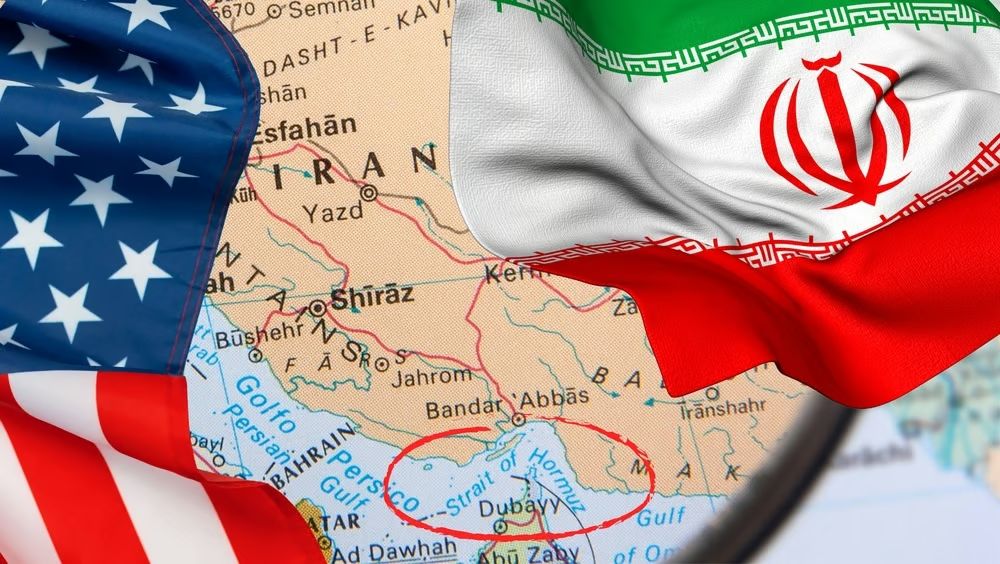
GasBuddy analyst Patrick De Haan also took aim at Trump on X, pointing out the inconsistency: when gas prices fall, Trump takes credit; when they rise, he says, "Why does everyone care so much?" De Haan had previously warned that it would take global oil inventories over 78 weeks to recover from supply chain disruptions caused by the closure of the Strait of Hormuz, as tensions between the U.S. and Iran escalate.
House Minority Whip Katherine Clark (D-Mass.) joined the chorus, posting on X: "Families can't afford Trump's skyrocket gas prices." She echoed Pritzker's disbelief, asking, "Is he out of his mind?!"
The political firestorm comes as real pain hits drivers' wallets. According to the American Automobile Association, the national average price for a gallon of gas hit $4.533 on Tuesday. California is the hardest-hit state, with an average of $6.146 per gallon. Governor Gavin Newsom (D-CA) has urged Trump to work on lowering prices, but bettors on the prediction market platform Kalshi aren't optimistic—they see a more than 70% chance that California's average could hit $7.40 before the year ends.
For now, the administration is betting that voters will accept higher prices as the price of national security. But with midterm elections looming and household budgets squeezed, that bet may be a tough sell.