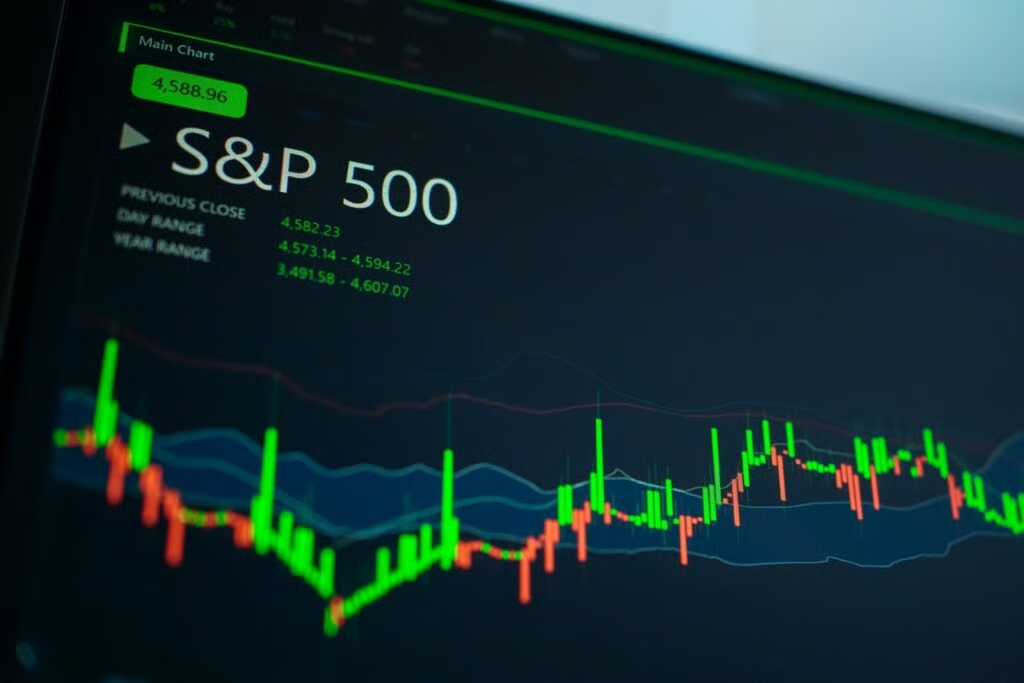
Semiconductor stocks took another hit Tuesday, with the iShares Semiconductor ETF (SOXX) on track for its third straight decline. Investors are turning risk-averse as a global bond rout picks up steam, and the pain is concentrated in the names that have led the AI rally.
Memory stocks are bearing the brunt. Micron Technology Inc. (MU) and SanDisk Corp. (SNDK) — two of the biggest AI-memory winners in 2026 — extended Monday's selloff. The trigger? The bond market.
The 30-year U.S. Treasury yield broke above 5.18% Tuesday morning, its highest level since July 2007. The 10-year yield cleared 4.59%, the highest since May 2025. And it's not just the U.S.: long-dated government debt yields in Europe and Japan have also moved more than the 90th percentile of their historical ranges over the past week and month, according to 22V Research.
How the Bond Selloff Started
It began on May 13, when the U.S. Treasury sold $25 billion of new 30-year bonds at a yield of 5.046% — the first time since 2007 that a long-bond auction cleared above 5%. The auction saw weak demand. Two days later, CPI came in at 3.8% year-over-year, the highest since May 2023. The producer price index was even worse, rising 6.0%, the steepest pace since late 2022.
Fed funds futures now imply a 60% chance of a quarter-point rate hike by year-end, up from about 20% earlier this month, according to the CME FedWatch tool.
There's a political subplot here, too. Kevin Warsh was sworn in last week as Federal Reserve chair, succeeding Jerome Powell. He inherits what economists describe as the most divided Federal Open Market Committee in more than 30 years.
Deutsche Bank rate strategist Steven Zeng told clients last week that the 5% yield level on the 30-year could start attracting pension fund demand — but that depends on how the Fed responds to the inflation pickup. So far, the Fed hasn't responded. The long end has filled the silence.
Why Memory Stocks Are Ground Zero
"The unusually sharp increase in 10yr yields over the past week has increased tail risk. Something could break," warned 22V Research analyst Dennis Debuschere in a note Tuesday.
22V's surveyed investors see demand-destruction thresholds at a 10-year yield above 5% and Brent crude above $115 per barrel — a combination they expect would produce sub-1% GDP growth over multiple quarters.
The mechanics are straightforward: long-end yields rise due to inflation and supply concerns, equity duration discount rates rise with them, the highest-multiple names take the biggest hit, and net market exposure declines. 22V identifies the most exposed trades as Price Momentum, AI capex beneficiaries, semiconductors, and small caps. Within semiconductors, memory has been the highest-conviction sub-trade — and it's now reversing first.
The Most Crowded Trade Inside the Crowded Trade
Bank of America's May Global Fund Manager Survey, released Monday, showed the largest monthly jump in equity allocation in 24 years. A whopping 73% of fund managers named "long global semiconductors" the most crowded trade, up from 24% in April. Cash levels triggered BofA's contrarian sell signal at 3.9%.
Earlier this month, BofA analyst Vivek Arya nearly doubled his price target on Micron to $950 and raised his addressable market forecast for AI data center systems to $1.7 trillion by 2030 — the third upward revision in eleven months. Melius Research lifted its Micron target to $1,100 from $700 on Monday. Citi raised its target to $840. Mizuho moved to $740. DA Davidson and Deutsche Bank's Melissa Weathers both hold the Street-high near $1,000, each describing what Weathers calls "a memory supercycle the market still underestimates." Of 30 analysts covering Micron, 27 rate the stock a buy.
But the bond market is now stress-testing that argument in real time.
The Setup Heading Into Nvidia Earnings
Nvidia Corp. (NVDA) reports earnings on Wednesday after the market close. A strong print would supply the catalyst that the memory supercycle thesis still needs to absorb the rate move. A weak print — or strong-but-not-strong-enough guidance — hands the bond market its veto.
The supercycle thesis was never really about whether demand for AI was real. It was always about what discount rate the market would apply to revenue arriving in 2028 and 2030. That discount rate is rising in real time. Wednesday decides whether earnings can keep up with it.