





If you thought the drama around AI chip exports was just about trade policy and corporate compliance, think again. U.S. authorities have now unsealed allegations that read like a tech-thriller plot: a co-founder of a major server maker, a shadowy Bangkok-based company, and billions of dollars worth of NVIDIA chips allegedly ending up in the hands of Alibaba. Let's dig into what's actually going on.
The $2.5 Billion AI Chip Smuggling Case That Has Super Micro, NVIDIA, and Alibaba in the Spotlight
MarketDash
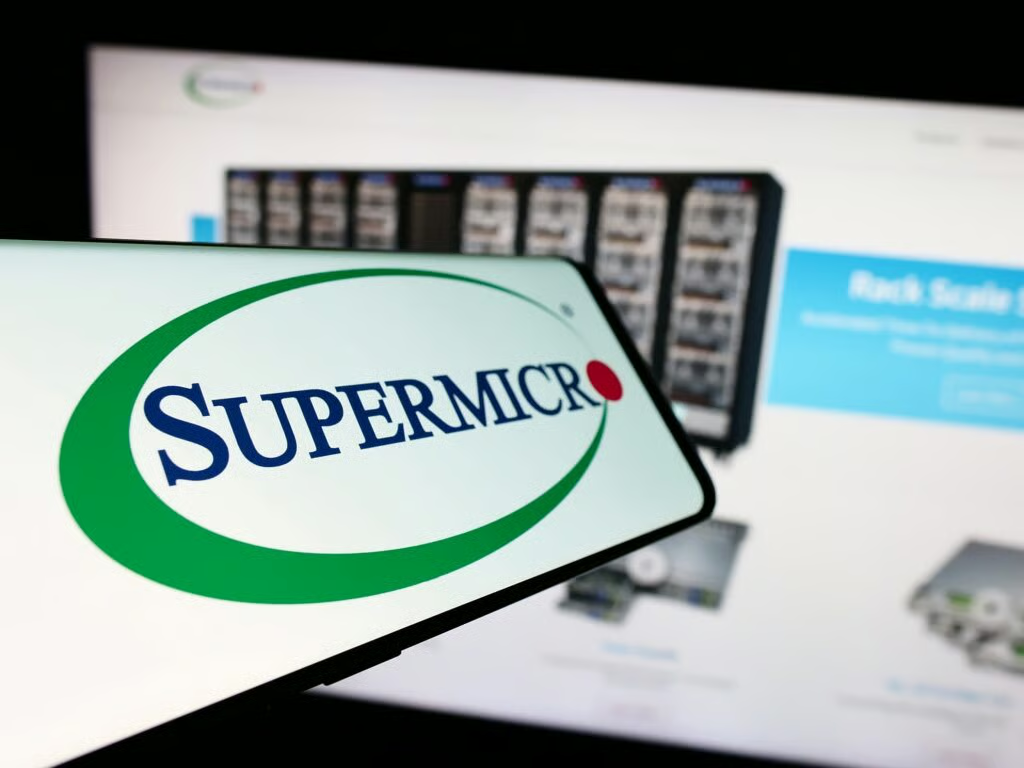
U.S. prosecutors allege a Thailand-linked network diverted Super Micro servers with NVIDIA chips to China, with Alibaba as an end customer. Here's what we know.
Get Advanced Micro Devices Alerts
Weekly insights + SMS alerts
The Allegations: A Network of Diversion
According to a Bloomberg report on Friday, U.S. prosecutors allege that Super Micro Computer (SMCI) co-founder Yih-Shyan "Wally" Liaw worked with a Southeast Asian company and multiple third-party brokers to divert NVIDIA-powered AI servers to China, violating U.S. export restrictions. The indictment, filed in March, doesn't name the company, but people familiar with the matter identified it as OBON Corp., a Bangkok-based firm.
Here's where it gets interesting: some of the $2.5 billion worth of servers sold to OBON allegedly ended up with Alibaba Group (BABA). But—and this is important—neither OBON nor Alibaba is named in the indictment, and U.S. authorities haven't publicly accused either of wrongdoing. So we're in the realm of allegations and unnamed sources, but the stakes are real.
The March indictment triggered a sharp selloff in Super Micro shares and marked the largest crackdown tied to alleged AI chip smuggling since Washington imposed restrictions on NVIDIA chip exports to China in 2022.
How the Companies Are Responding
NVIDIA (NVDA) said its partners must maintain strict compliance with export-control regulations and noted that its diligence efforts have helped authorities pursue suspected smuggling operations. Super Micro launched an internal investigation, placed Liaw on administrative leave, and said the company remains committed to complying with U.S. export laws.
Interestingly, U.S. authorities alleged that Super Micro temporarily paused shipments to Company-1 (the unnamed entity) after internal audits flagged unusual sales activity. The Commerce Department's Bureau of Industry and Security later requested a hold on all shipments to that company, and that restriction remained active as of the March indictment.
The whole affair has renewed concerns about oversight across NVIDIA's AI hardware ecosystem, especially in Southeast Asia, which has become a key transit point for chips heading to China.
What This Means for the AI Chip Market
Washington's export restrictions on NVIDIA chips and the broader crackdown on smuggling have sharply disrupted China's AI hardware market. The result? Sky-high prices and a scramble for supply.
Chinese tech firms now reportedly pay around $1 million for NVIDIA B300 servers—nearly double the roughly $550,000 price in the U.S.—due to export controls and reduced gray-market supply. Buyers who can't afford direct purchases are increasingly turning to rentals, with some one-year contracts reportedly reaching 190,000 yuan per month.
The B300 server is not officially available in China, and NVIDIA has warned that diverted systems won't receive company support. The gray market reportedly weakened further after the charges against the Super Micro-linked executive. And supply pressures have intensified because NVIDIA's H200 chips, despite export approvals from both Washington and Beijing, have yet to reach Chinese data centers.
China's AI Boom Meets Supply Constraints
All this is happening just as Chinese AI adoption is accelerating at a breathtaking pace. Reuters cited Morgan Stanley data showing Chinese AI models accounted for 32% of global token usage in March 2026, up from just 5% a year earlier. That growth is being driven by coding and agentic AI applications. Companies including MiniMax, Zhipu, and Alibaba's Qwen reportedly recorded sixfold to sevenfold increases in token usage between December and March.
Despite the restrictions, NVIDIA still controls about 55% of China's AI chip market. But Advanced Micro Devices (AMD) and Huawei are trying to gain share amid the supply disruption. The question is whether the smuggling crackdown will accelerate that shift or just make it harder for everyone to get the chips they need.
Price Action: NVIDIA shares were up 1.08% at $213.78 and Super Micro shares were up 1.19% at $34.02 during premarket trading on Friday.
More News
Nvidia's AI Boom Has a Hidden Cost—And Uber and Microsoft Are Finding Out the Hard Way

Remember Tesla?
Huawei Says It Has a Chipmaking Breakthrough. Did US Sanctions Backfire?

AI's $8 Trillion Buildout Is Not A Bubble – It's A Bottleneck, Analyst Says

The Next Big Crypto Catalyst Isn't a Bitcoin Rally—It's a Bill in Congress

The SpaceX filing just happened. You’ve got weeks.
Forget Nvidia: IREN CEO Says A New AI Factory Built Today May Not Go Live Until 2030
Mark Kelly Accuses Trump of a $1.8 Billion 'Slush Fund' While Gas Prices Bite
Get Advanced Micro Devices Alerts
Real-time alerts on price moves, news, and trading opportunities.
Join 20,000+ investors. No spam, ever.
Featured Articles
View all newsNvidia's AI Boom Has a Hidden Cost—And Uber and Microsoft Are Finding Out the Hard Way
By MarketDash
May 25, 2026
The SpaceX filing just happened. You’ve got weeks. (Ad)
By The Oxford Club
Huawei Says It Has a Chipmaking Breakthrough. Did US Sanctions Backfire?
By MarketDash
May 25, 2026
AI's $8 Trillion Buildout Is Not A Bubble – It's A Bottleneck, Analyst Says
By MarketDash
May 25, 2026
The Next Big Crypto Catalyst Isn't a Bitcoin Rally—It's a Bill in Congress
By MarketDash
May 25, 2026
Mar-a-Lago Bombshell (Ad)
By Stansberry Research
Forget Nvidia: IREN CEO Says A New AI Factory Built Today May Not Go Live Until 2030
By MarketDash
May 25, 2026
Mark Kelly Accuses Trump of a $1.8 Billion 'Slush Fund' While Gas Prices Bite
By MarketDash
May 25, 2026