American Consumers Are Miserable: Confidence Hits Record Low as Inflation Fears Spike
MarketDash
The University of Michigan's consumer sentiment index just crashed to its lowest level ever, with inflation expectations surging to 4.8% as the Iran war rattles household finances.
Get Market Alerts
Weekly insights + SMS alerts
Here's a simple way to think about the American consumer right now: they're not happy. Actually, scratch that—they're historically, record-breakingly unhappy.
The University of Michigan's consumer sentiment index just crashed to 47.6 in its preliminary April reading. That's not just bad—it's the worst reading in the survey's entire history. It's an 11% monthly plunge, and it missed the 52 consensus by a wide margin. The reason? The economic fallout from the Iran war has moved from something you see at the gas pump to something that's coloring how households view their entire financial future.
Consumer Surveys For April 2026: The Full Breakdown
Indicator
April 2026
March 2026
April 2025
MoM Change
vs. Consensus
Consumer Sentiment
47.6
53.3
52.2
–10.7%
MISS vs. 52.0
Current Economic Conditions
50.1
55.8
59.8
–10.2%
—
Consumer Expectations
46.1
51.7
47.3
–10.8%
—
1-Year Inflation Expectations
4.8%
3.8%
5.3%
+100bps
BEAT vs. 3.8%
5-Year Inflation Expectations
3.4%
3.2%
—
+20bps
—
It's Not Just About Prices—It's About What People Expect Prices To Do
If the sentiment number wasn't shocking enough, the inflation expectations component delivered another gut punch. Year-ahead inflation expectations surged from 3.8% in March to 4.8% in April. That's a 100-basis-point jump in a single month—the largest one-month increase since April 2025—and it blew past the 4.2% consensus.
Think about that for a second: consumers now expect nearly 5% inflation over the next year. That's higher than every reading in 2024 and sits well above the 2.3%–3.0% range that was normal before the pandemic. Five-year expectations also ticked up, from 3.2% to 3.4%, which is the highest since November 2025. That longer-term number is more contained than the short-run surge, which actually matters a lot to the Federal Reserve.
'Consumers Are Loud And Clear'
Joanne Hsu, director of the University of Michigan Surveys of Consumers, put it bluntly in an interview Friday. "Consumers are speaking loud and clear," she said. "They are very, very frustrated by the persistence of high prices, and they're feeling very weighed down with the cost of living."
She noted the report was "not much of a surprise, particularly given this morning's CPI print, which consumers had already incorporated"—pointing specifically to "this 25% increase in gas prices" at the pump as the central weight on household psychology.
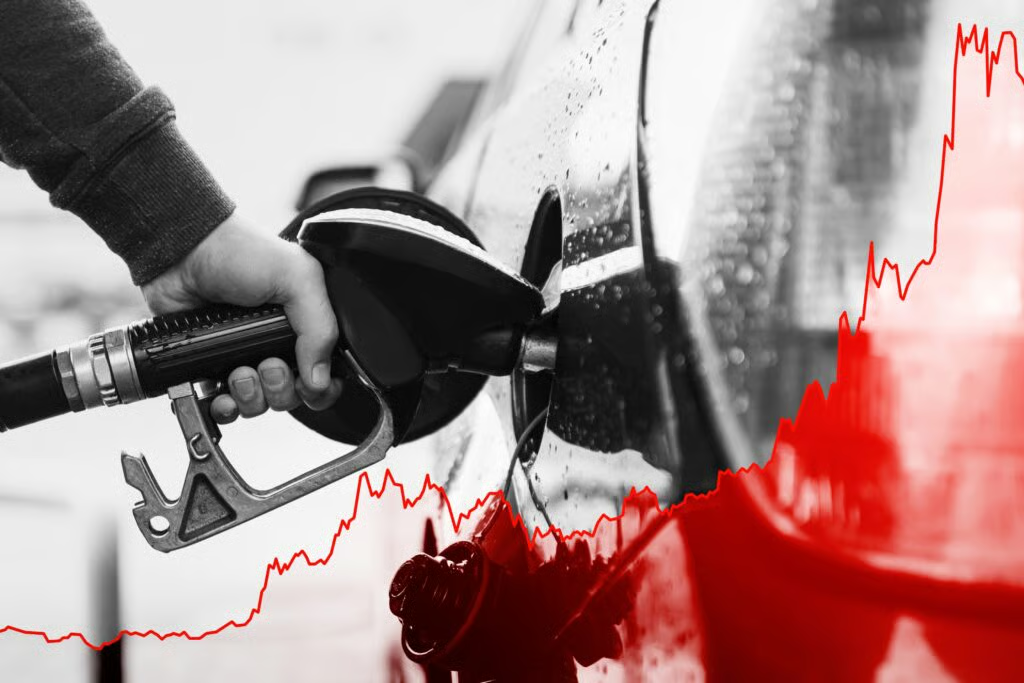
That CPI report, released earlier Friday, showed headline inflation jumping 0.9% month-over-month in March—the steepest monthly rise since June 2022. The driver? A 21.2% surge in gasoline prices, which was the largest monthly increase since the Bureau of Labor Statistics started tracking the series in 1967. Regular gasoline nationally now averages $4.153 per gallon, up 39% from $2.98 the day before the war started.
Hsu drew a clear line between short-term panic and the longer-term picture. "Their short-term outlook has deteriorated quite a bit, but there is a glimmer of hope—the long-term outlook did not sour nearly as much as the short run did," she said.
On the five-year measure specifically, Hsu cautioned against reading too much into the relative stability: "I don't think that people should hold on to this 3.4% five-to-ten year inflation expectations number as something that is definitively going to keep going for the foreseeable future—depending on how things look with geopolitical events and supply disruptions, this could very well change quite quickly in the months ahead."
Why The Fed Can't Just Shrug This Off
Hsu made the case for why sentiment surveys deserve as much attention as hard economic data. "Our data is really showing something forward-looking, whereas what we often call hard data is always backward-looking," she said. "We are taking a pulse of what consumers are feeling right now."
She noted that sentiment has been "very, very low near historic lows for most of 2025 and for the first few months of this year" and that incoming data on consumer spending from the fourth quarter and first quarter "have shown weakness as well." According to Hsu, "consumers' feelings about the economy are passing through to the decisions that they make—it may not be a massive pullback, but it is starting to pull back."
So here's the Federal Reserve's problem. Core CPI—which strips out food and energy—came in at a contained 0.2% month-over-month in March. That offers some technical relief and suggests the Iran war's inflation impact is mostly energy-driven, for now.
But the Michigan data show consumers aren't anchoring on that soft core number. They're anchoring on the $4.15 gallon of gasoline and the 4.8% inflation they expect to be paying over the next twelve months. When what consumers experience and what they expect diverges this sharply from what the Fed officially monitors, the central bank's communication task gets a lot harder. It's one thing to manage inflation; it's another to manage inflation expectations when people are this pessimistic.