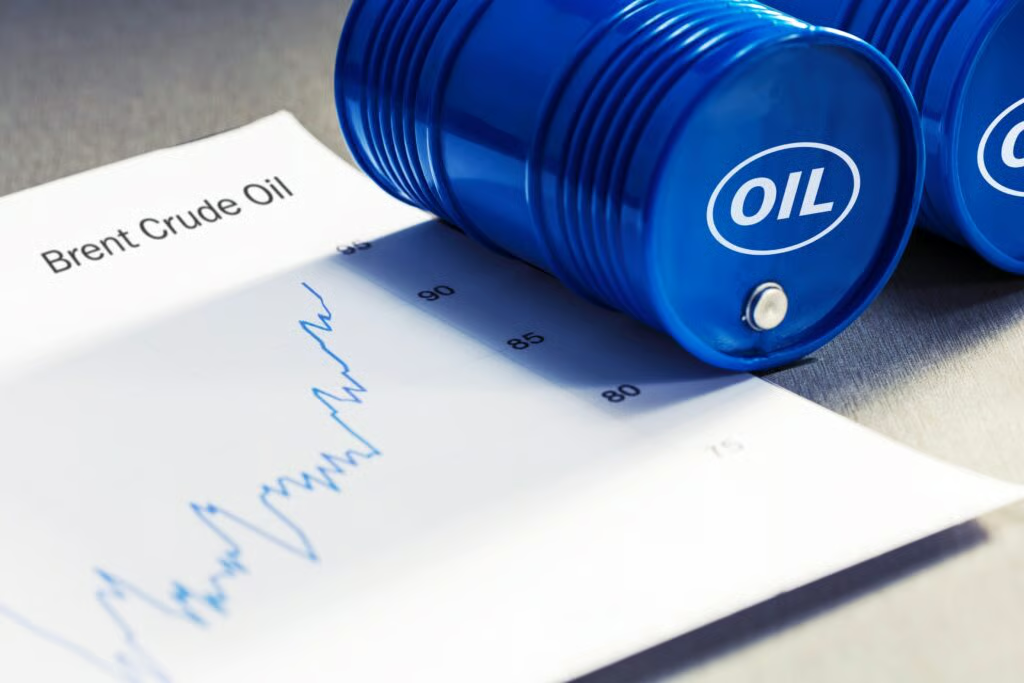
Here's a sobering thought for anyone filling up their car: oil prices might not just be spiking—they could be settling in for a long, expensive stay. According to a note from Goldman Sachs (GS) reported by Bloomberg, Brent crude could remain above $100 per barrel for the rest of 2026 if the Strait of Hormuz stays shut for another month. That's not a blip; that's a new reality.
Analyst Daan Struyven called the "situation is fluid," which in finance-speak often means "buckle up." He echoed comments from Vice President JD Vance about a "fragile" truce after a two-week ceasefire between the U.S. and Iran was announced earlier this week. "We continue to see the risks to our price forecast as skewed to the upside," Struyven said. Translation: things are more likely to get worse than better.
Goldman's math is pretty straightforward. If the strait stays closed, it chokes off upstream production in the Middle East, pushing Brent to an average of $120 per barrel in the third quarter and $115 in the fourth quarter of 2026. But if things calm down over the weekend? The analysts see prices dropping to $82 in Q3 and $80 in Q4. That's a $40-per-barrel swing depending on what happens in a narrow waterway.
The Strait That's Strangling the Market
The Strait of Hormuz has become the biggest casualty of the recent tensions. This isn't just any shipping lane—it handles about 20% of the world's oil. And right now, it's not really open. Even after the ceasefire, Tehran is keeping a tight grip, with maritime intelligence firm Windward noting that all vessel transits still need coordination with Iranian armed forces. "The strait has not reopened—it is in a supervised pause," they said. A "supervised pause" sounds like something a teacher might impose on rowdy students, but here it means the global oil market is holding its breath.
Iran has threatened to keep the strait shut after Israel conducted large attacks on Lebanon, which they say violated the ceasefire. The impact is already in the numbers: Brent crude has climbed 10.05% over the past month, even touching $109 per barrel earlier this month. As of early Friday, it was trading 0.62% higher at $96.51 per barrel.
Now They Want to Charge a Toll
As if a closure wasn't enough, Iran is also planning to charge tolls from vessels transiting the strait. Yes, you read that right. They might start making oil tankers pay to pass through a chokepoint they control. Oil industry leaders are reportedly lobbying the Trump Administration to reject any proposal for Iran to levy tolls and assume permanent control of the waterway. The executives estimate these tolls could add about $2.5 million per shipment through higher insurance and fees—costs that would almost certainly get passed on to consumers at the pump.
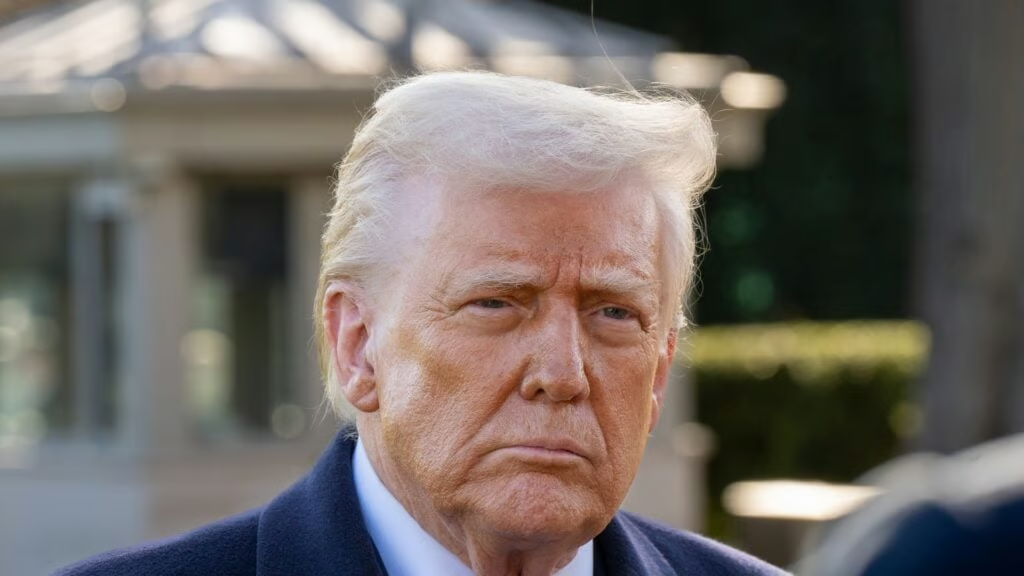
President Donald Trump berated Iran on Thursday for the toll idea. Meanwhile, Patrick De Haan, head of petroleum analysis at GasBuddy, pointed out that the ceasefire would do "little or nothing" to combat surging energy prices as long as the Strait of Hormuz remains a flashpoint. It's like having a traffic jam cleared but then being told you have to pay a new congestion charge to drive through.
High-level U.S. and Iranian officials are set to meet on Saturday morning local time in Islamabad, Pakistan, to negotiate a lasting peace deal. The outcome of those talks could determine whether we're looking at $80 oil or $120 oil for the rest of the year—and whether that $100 mark becomes a floor instead of a ceiling.