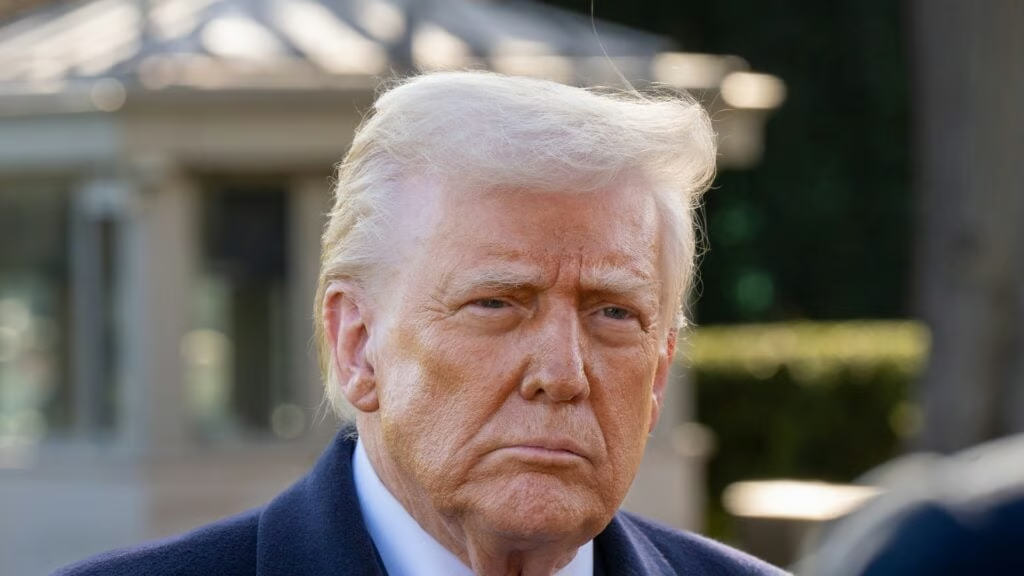
Here's a political fight that hits right in the wallet. Illinois Governor JB Pritzker, a Democrat, took to social media Thursday to blast President Donald Trump over the ongoing war with Iran, but he didn't just talk geopolitics. He talked about the price at the pump and the cost of milk.
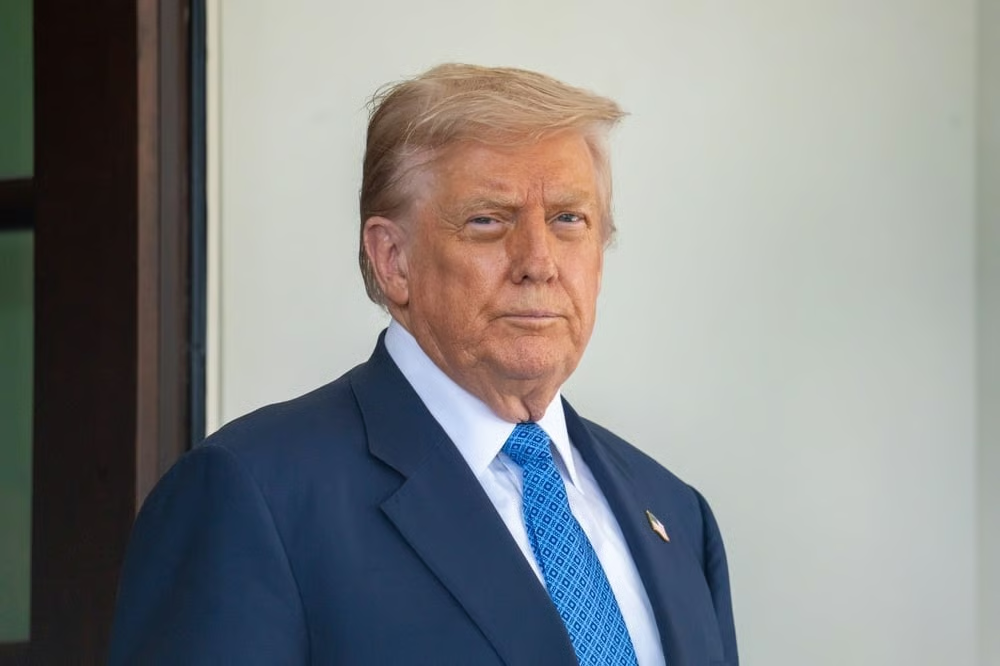
"Americans are struggling to afford gas and groceries," Pritzker posted. "Meanwhile Trump calls war an 'investment.'" That last bit seems to be a direct reference to the President's national address on April 1st, where he framed the conflict as "a true investment" for future generations and labeled Iran the "bully" of the Middle East. Pritzker's conclusion was succinct: "That tells you everything you need to know."
And the numbers back up the struggle part. According to AAA, the national average for a gallon of regular gas was $4.166 on Thursday. If you're filling up in California or Hawaii, you're feeling it even more—$5.929 and $5.633 per gallon, respectively. It's the kind of math you do in your head every time you drive past a station.
It's not just the fuel for your car. The war's ripple effects are hitting the fuel for your family. Economists warn that grocery prices, already up, could climb further as Middle East tensions continue. The official data shows the price of food at home was 3% higher in February than it was a year earlier. When a conflict on the other side of the world makes your weekly supermarket run more expensive, it stops being abstract foreign policy.
This isn't a new line of attack for Pritzker. He's been vocal in his criticism of Trump and the war since it began over a month ago. Recently, he's tied the rising gas prices to broader concerns, criticizing Trump's tariffs and even pointing to a spike in measles cases across the U.S. with a pointed "Where is Donald Trump?"
His critique also extends to more institutional side effects. He previously took aim at the administration when the United States Postal Service announced it was slapping an 8% surcharge on all packages—a first in its history—citing the soaring fuel costs that are driving up its operating expenses. It's a reminder that when fuel gets expensive, it doesn't just cost more to drive; it costs more to ship, which costs more to buy, and so on.
So, you've got a governor framing a war not in terms of national security or diplomatic strategy, but as a direct contributor to the cost-of-living crisis. It's a debate about priorities: Is it an "investment" in the future, as the President says, or is it a bill that everyday Americans are paying right now at the checkout counter? For Pritzker, the answer is clear, and it's written in the rising numbers on gas station marquees and grocery receipts.