





So here's where we are with Middle East ceasefires: the U.S. and Iran agreed to one on Tuesday, which should be good news, except Israel keeps striking Hezbollah in Lebanon, and everyone's already arguing about what the agreement actually means. It's like signing a peace treaty and then immediately fighting about the font size in the document.
Ceasefire Confusion: What Prediction Markets Think About Israel-Hezbollah Truce Timing
MarketDash
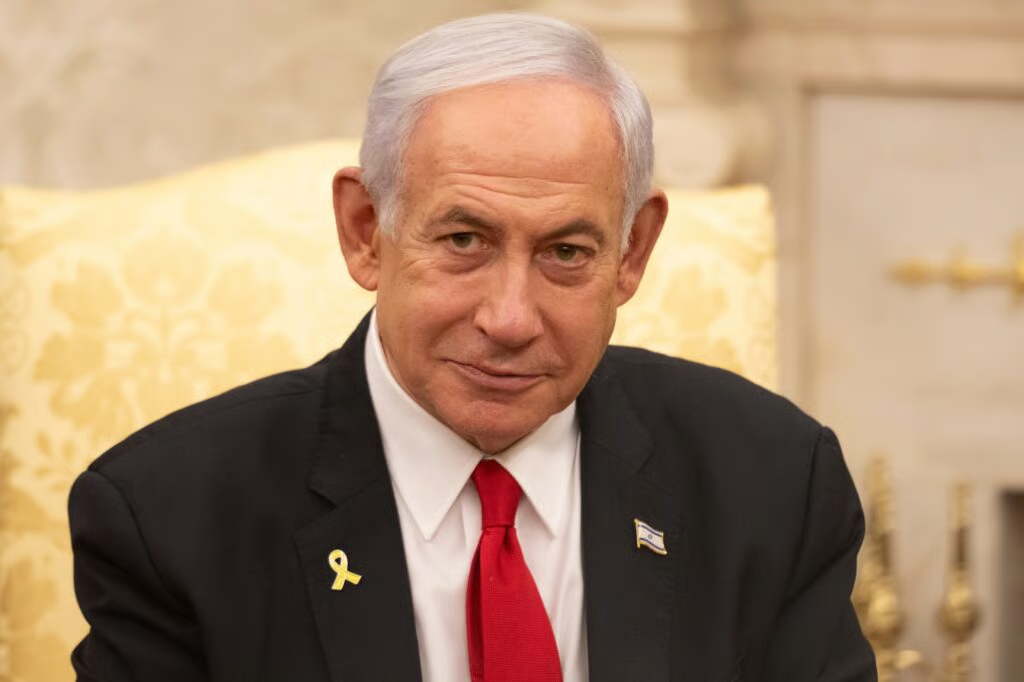
A U.S.-Iran ceasefire deal is already facing accusations of violations, while prediction markets show low confidence in a near-term Israel-Hezbollah truce.
Get Market Alerts
Weekly insights + SMS alerts
Iran Says the U.S. Broke the Deal
Iran came out swinging on Thursday, accusing the U.S. of violating the ceasefire. Iranian parliamentary speaker Mohammad Bagher Ghalibaf said the U.S. broke three clauses of the agreement and declared that "a bilateral ceasefire or negotiations is unreasonable." That's diplomatic speak for "we're not happy."
Who's Actually Covered by This Ceasefire?
Here's where it gets messy. Israel and the U.S. both say Lebanon isn't part of the ceasefire, according to a Reuters report. That directly contradicts Iran's position. So we have a ceasefire where the parties can't agree on who's supposed to stop fighting. This is why you need good lawyers when negotiating international agreements.
What the Gamblers Think
While diplomats argue, the prediction markets are placing their bets. Polymarket, a Polygon (POL)-based prediction platform where users wager with the USDC (USDC) stablecoin, has a contract asking "Israel x Hezbollah ceasefire by...?"
Over $1 million has been bet on this question so far. That's serious money betting on peace prospects.
Given all the strikes and Israel saying Lebanon isn't part of the ceasefire, the market isn't exactly optimistic about a quick resolution. Bettors have placed just a 30% probability on a ceasefire happening by April 30—that's down 13% from earlier levels.
But here's the interesting part: they're more confident about a ceasefire by June 30, with the probability rising to 58%. So the market is saying: not soon, but maybe by summer. It's the financial version of "I'll believe it when I see it."
The Oil Market's Rollercoaster
Meanwhile, oil prices have been on their own wild ride. When Trump announced the two-week ceasefire, WTI crude fell 15.11% to $95.88 per barrel. That's a huge move—markets really liked the peace news.
But with the ceasefire looking shaky, oil has bounced back up 3.5% to $97.71. The oil market is basically pricing in the probability that this ceasefire might not hold, or at least that it won't stop all the fighting that matters for oil flows.
More News
Nvidia's AI Boom Has a Hidden Cost—And Uber and Microsoft Are Finding Out the Hard Way

Remember Tesla?
Huawei Says It Has a Chipmaking Breakthrough. Did US Sanctions Backfire?

AI's $8 Trillion Buildout Is Not A Bubble – It's A Bottleneck, Analyst Says
The Next Big Crypto Catalyst Isn't a Bitcoin Rally—It's a Bill in Congress

The SpaceX filing just happened. You’ve got weeks.
Forget Nvidia: IREN CEO Says A New AI Factory Built Today May Not Go Live Until 2030
Mark Kelly Accuses Trump of a $1.8 Billion 'Slush Fund' While Gas Prices Bite
Get Market News Alerts
Real-time alerts on price moves, news, and trading opportunities.
Join 20,000+ investors. No spam, ever.
Featured Articles
View all newsNvidia's AI Boom Has a Hidden Cost—And Uber and Microsoft Are Finding Out the Hard Way
By MarketDash
May 25, 2026
The SpaceX filing just happened. You’ve got weeks. (Ad)
By The Oxford Club
Huawei Says It Has a Chipmaking Breakthrough. Did US Sanctions Backfire?
By MarketDash
May 25, 2026
AI's $8 Trillion Buildout Is Not A Bubble – It's A Bottleneck, Analyst Says
By MarketDash
May 25, 2026
The Next Big Crypto Catalyst Isn't a Bitcoin Rally—It's a Bill in Congress
By MarketDash
May 25, 2026

Mar-a-Lago Bombshell (Ad)
By Stansberry Research
Forget Nvidia: IREN CEO Says A New AI Factory Built Today May Not Go Live Until 2030
By MarketDash
May 25, 2026
Mark Kelly Accuses Trump of a $1.8 Billion 'Slush Fund' While Gas Prices Bite
By MarketDash
May 25, 2026