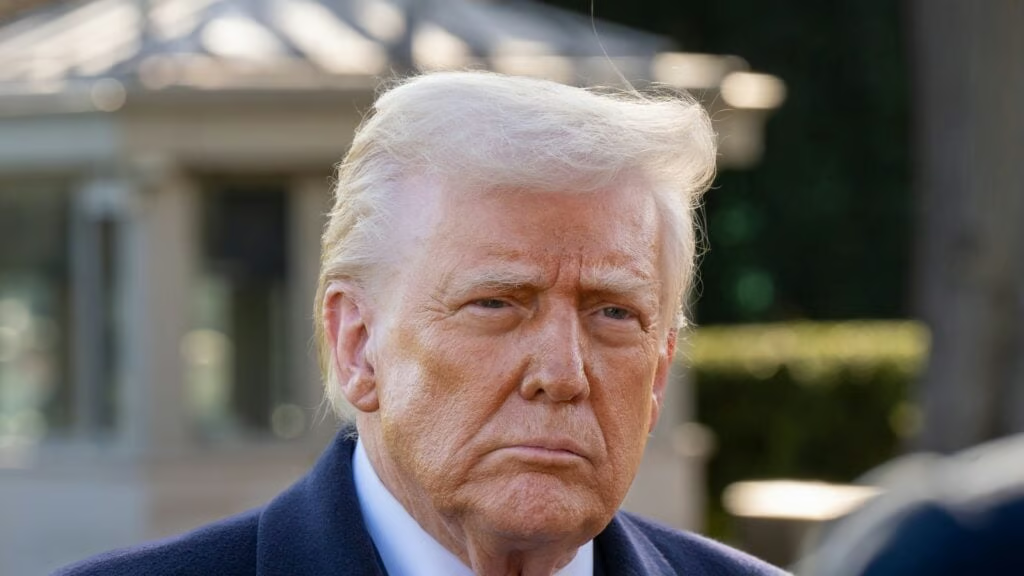
Here's a story about war, oil, and money—and how they all seem to be getting tangled up in American politics. On Wednesday, California Governor Gavin Newsom (D) took to social media to accuse President Donald Trump and his allies of benefiting financially from the conflict in Iran, just as gas prices surge across the country.
It's the kind of claim that makes you raise an eyebrow: are people really making money off this? According to Newsom's press office, which shared a post from a user named James Tate, an unnamed White House insider placed a $51 million bet against Brent Crude Oil hours before the ceasefire agreement with Iran was announced. When prices dropped, that bet reportedly turned into a $170 million profit. "This guy is now 16 for 16. A perfect streak," Tate said, implying the trader had advance knowledge.
Newsom's team didn't mince words: "While you're paying billions more at the gas pump, Trump's allies are cashing in." And let's be honest, if you've filled up your car lately, you know the pain is real. The national average for a gallon of gasoline hit $4.164 on Wednesday, with Californians shelling out a staggering $5.934—the highest in the nation, according to AAA data.
Meanwhile, crude oil prices have been on a roller coaster. After dipping post-ceasefire, they've crept back up: West Texas Intermediate is at $97.11 per barrel, and Brent Crude sits at $96.77. It's a reminder that geopolitics and oil markets don't always move in predictable ways.
Newsom isn't alone in his skepticism. Senator Adam Schiff (D-CA) has also criticized the administration, suggesting Trump insiders might be "getting richer" off the war. He's called for the White House to release transaction reports, pointing to a surge in futures trading just before Trump announced a halt on planned strikes against Iran two weeks ago. It's a demand that adds fuel to the fire of these allegations.
As for the ceasefire itself, it's not exactly smooth sailing. The U.S., Israel, and Iran reached an agreement, but Iranian parliamentary speaker Mohammad Bagher Ghalibaf has accused the U.S. of breaking the terms, citing Israel's continued strikes on Lebanon. Interestingly, Pakistan's Prime Minister Shehbaz Sharif noted that the ceasefire terms also covered Lebanon, with Pakistan facilitating talks that led to a two-week truce and the reopening of the Strait of Hormuz.
So, what's the takeaway? In a world where gas prices pinch every driver's wallet, accusations of insider profiteering are bound to stir up controversy. Whether there's substance to these claims or it's just political noise, one thing's clear: the intersection of war, oil, and money is as messy as ever.