Imagine you've been holding your breath for five weeks, waiting for the other shoe to drop in a tense geopolitical standoff. Then, suddenly, someone announces a ceasefire. You'd exhale, right? That's basically what the stock market did on Wednesday.
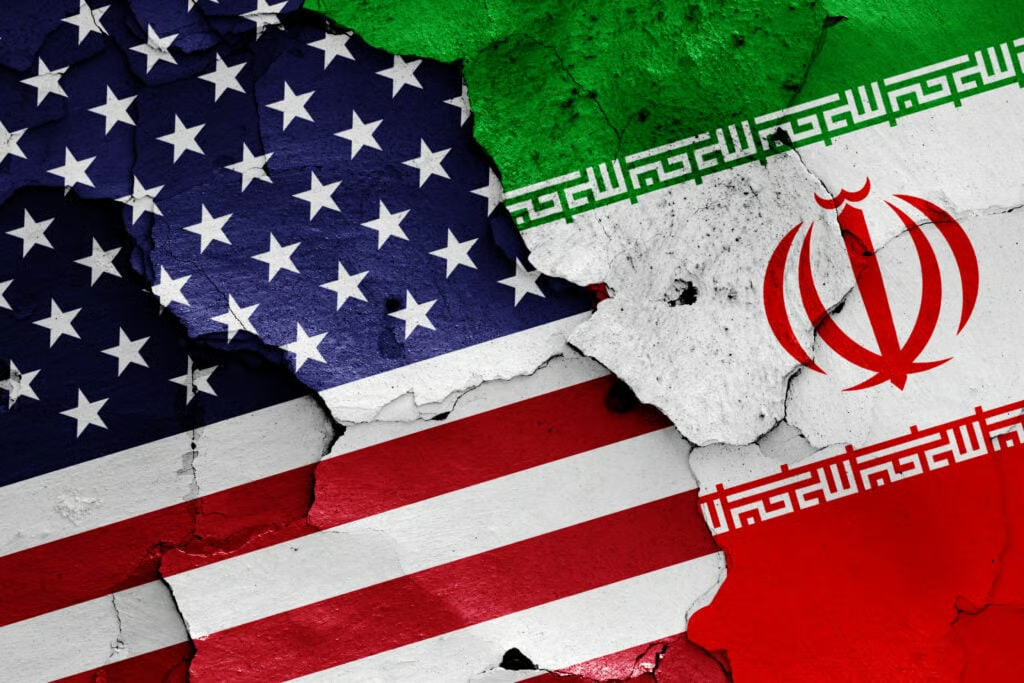
U.S. stocks shot up to their highest levels in a month after a temporary ceasefire between the U.S. and Iran sent oil prices into a tailspin. The collapse in crude—the biggest single-day drop in years—eased fears about energy-driven inflation and sparked a sweeping relief rally. It was a classic "risk-on" day, with everything from airline stocks to semiconductor makers catching a bid.
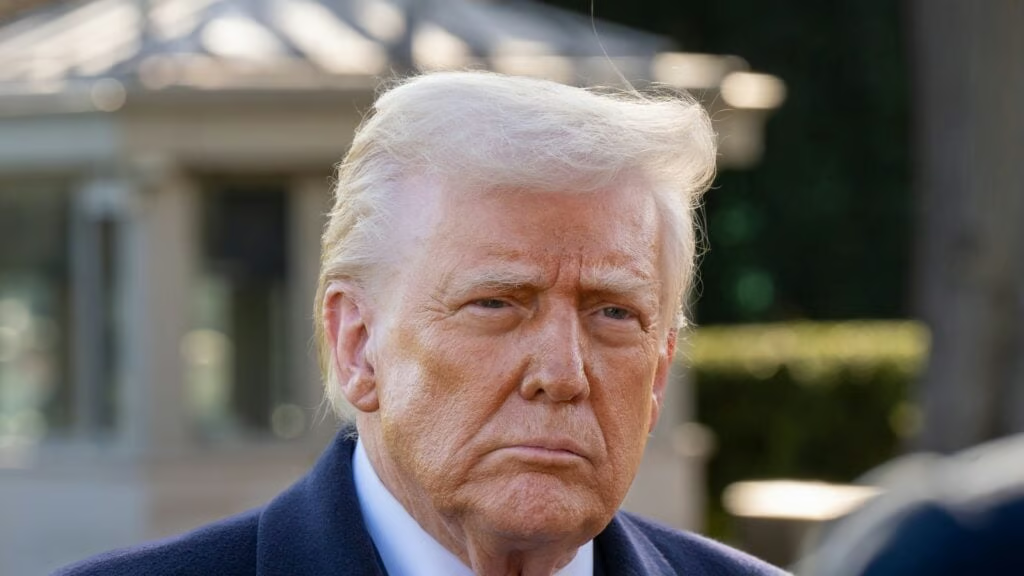
The catalyst was a major de-escalation. President Donald Trump declared on Truth Social that Iran "has gone through what will be a very productive Regime Change" and pledged "there will be no enrichment of Uranium." He added that many of the 15 negotiating points had been agreed to and that the U.S. would work with Tehran on tariff and sanctions relief. Perhaps most critically for markets, Iran's agreement to reopen the Strait of Hormuz eliminated a significant geopolitical premium that had been baked into oil prices.
Of course, it wasn't all smooth sailing. The session had its moments of turbulence. Iran's Foreign Minister Abbas Araghchi signaled that seriousness from the U.S. side would still be required to achieve lasting stability. An early-morning report of an attack on Saudi Arabia's vital east-west oil pipeline briefly tested the market's newfound optimism. Iran also warned that Israeli strikes on Lebanon made after the ceasefire would trigger a strong response. So, the path to peace remains a bit bumpy.
But by midday in New York, the numbers told a clear story of relief. WTI crude plunged 15.9% to around $95 per barrel—its steepest single-session drop since the chaotic days of April 2020. Brent crude fell 13.3%, settling near $94.70.
When oil crashes that hard, other things start to move. The yield on the 10-year U.S. Treasury note fell about three basis points to 4.27%, its lowest in roughly three weeks, as the oil price collapse dampened inflation expectations. Suddenly, the Federal Reserve's job looks a bit easier. Markets now price in roughly a 35% chance of a rate cut by the end of the year, compared with near-zero odds at the start of the week. That's a huge swing in sentiment in just a few days.
Across U.S. equity markets, the gains were broad-based and led by the sectors most sensitive to lower oil prices, falling yields, and rebounding risk appetite: technology, industrials, and consumer discretionary.
The S&P 500 climbed to 6,783, up 2.5%. SanDisk Corp. (SNDK) and Carnival Corp. (CCL) were both more than 10% higher, leading the charge within the index.
The Dow Jones Industrial Average surged 1,298 points, or 2.8%, to 47,882. Sherwin-Williams Co. (SHW), Caterpillar Inc. (CAT), and Home Depot Inc. (HD) led the Dow gainers, with advances of 6.9%, 6%, and 5.8%, respectively.
The Nasdaq 100 advanced 3.1% to 24,951. Within the so-called Magnificent Seven stocks, Alphabet Inc. (GOOGL) and Meta Platforms Inc. (META) each gained 3.7%. Meta also debuted its first AI model from its superintelligence research group, adding a company-specific catalyst to the tech rebound. Amazon.com Inc. (AMZN) added 3.7%, while NVIDIA Corp. (NVDA) rose 2.1% and Microsoft Corp. (MSFT) advanced 1.7%.
The Russell 2000 climbed 3.1%, with small caps leading gains as the risk-on rotation broadened into rate-sensitive domestic stocks.
In other markets, spot gold edged up 1.0% to $4,756 per ounce, while Bitcoin (BTC) held steady at $71,000.