Markets are celebrating a potential two-week pause in the Iran conflict, but attacks continue and the details remain murky.
Get American Airlines Group Alerts
Weekly insights + SMS alerts
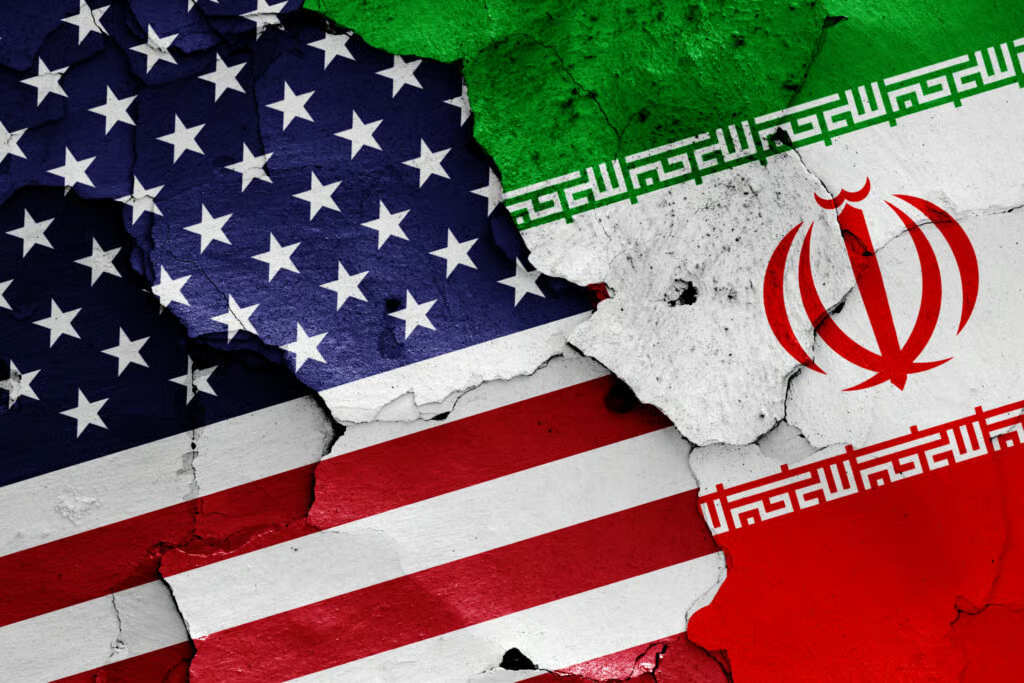
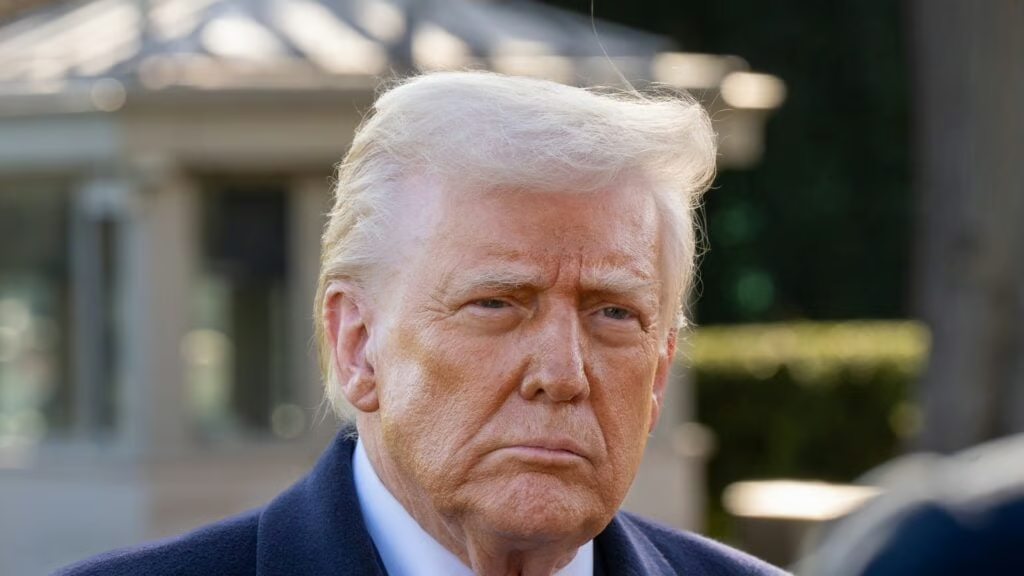
Here's how financial markets work sometimes: someone says something hopeful, and everyone decides to believe it for a minute, even if the evidence on the ground is still pretty messy. That's what happened early Wednesday, when President Donald Trump claimed a conditional two-week ceasefire with Iran. Hours later, reports of new attacks were still coming in. But crude oil traders didn't wait for confirmation—they just started selling.
West Texas Intermediate crude futures, the benchmark tracked by the United States Oil Fund (USO), dropped a staggering 17% to $93 a barrel. That puts it on track for its worst single-day drop since the chaos of April 2020. The sell-off ignited a broad pre-market relief rally, sending S&P 500 futures up nearly 3%.
Think of it as a giant position unwind. For weeks, traders had been pricing in a prolonged disruption to oil flowing through the Strait of Hormuz—a chokepoint for about 20% of the world's seaborne oil. The mere suggestion of a two-week pause was enough for them to aggressively reverse those bets. Brent crude followed right along.
The Ceasefire Announcement: High Drama, Murky Details
The drama unfolded on Tuesday evening. At 6:32 p.m. ET, shortly before a self-imposed 8 p.m. deadline to, in his words, "destroy a whole civilization," Trump posted on Truth Social.
"Based on conversations with Prime Minister Shehbaz Sharif and Field Marshal Asim Munir, of Pakistan, and wherein they requested that I hold off the destructive force being sent tonight to Iran, and subject to the Islamic Republic of Iran agreeing to the complete, immediate, and safe opening of the Strait of Hormuz, I agree to suspend the bombing and attack of Iran for a period of two weeks. This will be a double sided ceasefire!"
But by Wednesday, sporadic Iran-Israel attacks were still being reported, casting serious doubt over how "double sided" or durable this deal really is. U.S. Vice President JD Vance called it "fragile." Key terms are fuzzy; Iran says it could charge ships for transiting the strait, which isn't exactly a recipe for smooth, accepted international passage. Meanwhile, Israel signaled it would continue its operations in Lebanon against Hezbollah regardless.
Trump followed up with another tweet saying the "U.S. will work closely with Iran," offering no uranium enrichment in exchange for lifting tariffs and sanctions. He claimed many of his so-called 15 points have already been agreed to.
For its part, Iran's Foreign Minister Seyed Abbas Araghchi confirmed Tehran's acceptance via a statement from the Supreme National Security Council. The deal, as described, is that if attacks against Iran halt, its armed forces will stop defensive operations. Safe passage through the Strait of Hormuz would be possible for two weeks, coordinated with Iran's military.
The Relief Rally: 7 Stocks Bouncing Hard
When the price of the world's most important commodity drops 17% in a few hours, some stocks are going to have a very good day. The biggest winners were the sectors that had been crushed by the war's escalation: airlines, travel, and anything else getting murdered by high energy costs.
Seven stocks in the Russell 1000 surged more than 10% before the market opened on Wednesday. The mechanism was simple but brutal in reverse: these companies had been systematically compressed by soaring jet fuel costs destroying airline margins, by high-price anxiety freezing cruise bookings, or by energy-cost inflation gutting the economics of gold mining. A drop in oil is like a pressure valve releasing.
So, is this the all-clear signal? Analysts are cautiously optimistic but far from declaring victory.
Ed Yardeni of Yardeni Research said the ceasefire confirms his call from Tuesday night that the S&P 500 had bottomed on Monday. He noted that sentiment indicators remained bearish this week, which he reads as bullish from a contrarian standpoint. But he was direct about the ceiling: "A two-week pause is not a resolution, and financial markets will remain sensitive to any breakdown in talks."
The move also triggered a dramatic repricing in global bond markets and central bank expectations. John Canavan, lead analyst at Oxford Economics, pointed out a notable divergence overnight: U.K. gilt yields fell 19–26 basis points and German bund yields fell 11–25 bps, while U.S. Treasury yields fell only 3–8 bps.
The front end of the yield curve is driving the global rally as policy expectations shift sharply. Overnight, markets priced in more than 15 bps of Federal Reserve rate cuts for 2026. That's a dramatic reversal from just two weeks ago, at the height of the conflict, when traders were pricing in as much as 20 bps of hikes. Expectations for the European Central Bank moved from three hikes to two.
Oxford Economics' baseline view is that the Fed will look past the one-time inflationary boost from higher oil and cut rates twice this year to preempt labor market weakness. The risk, Canavan noted, is that the timing of those cuts gets delayed if oil prices stabilize at a higher level than expected. But with long-term inflation expectations still well anchored, the Fed might have the room to act.
For now, the market is taking the ceasefire announcement at face value and running with it. But as the analysts warn, it's a fragile deal. Traders celebrated the potential pause in the conflict, but everyone knows the real work—and the real risk—is just beginning.