So, the U.S. and Iran have agreed to stop shooting at each other for two weeks. You'd think that would be universally good news, right? Not so much. The announcement of this temporary truce has managed to produce a global reaction that's about as unified as a group chat planning a dinner.
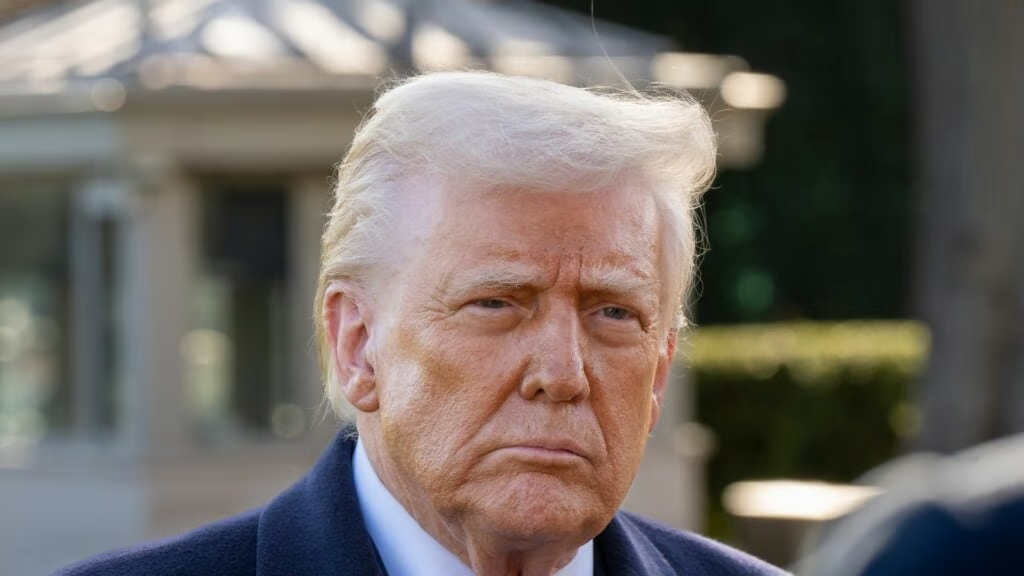
On one side, you have the victory lap. White House Press Secretary Karoline Leavitt called Operation Epic Fury "a victory for the United States," crediting President Donald Trump and the military for wrapping things up in 38 days—apparently ahead of schedule. Trump himself didn't hold back, labeling it a "total and complete victory" and suggesting that Iran's proposed 10-point framework actually offers a "workable basis" for the next round of talks. When the guy who coined "maximum pressure" starts talking about workable frameworks, you know the mood in the room has shifted.
And they've got some international backup. European Council President António Costa welcomed the move, urging everyone to play nice for "sustainable peace" and giving a shout-out to Pakistan for mediating. Ukrainian President Volodymyr Zelenskyy called it "the right decision," making the direct link that everyone's thinking about: stability in the Strait of Hormuz is directly tied to easing global economic pressure. Even Israel's Prime Minister's Office posted support for Trump's decision on X, with the crucial condition that Iran reopen the Strait immediately. They also made sure everyone knew the truce doesn't include Lebanon, because in this conflict, the fine print matters.
But then there's the other side of the chat—the one where the reactions are less "congratulations on the peace" and more "what have you done?"
The loudest critic might be Israeli opposition leader Yair Lapid, who didn't mince words. He called the agreement "the worst political disaster" in Israel's history and took aim at Prime Minister Benjamin Netanyahu for failing to achieve his stated goals. That's the kind of language you use when you're not just disagreeing with policy, but think it's a historic blunder.
Back in the U.S., Senator Chuck Schumer (D-NY) offered a more cynical take, dismissing the whole deal as Trump's attempt to find "any sort of exit ramp" from the conflict. Because in an election year, every foreign policy move is also a domestic political one.
And what about the other party in this "ceasefire"? Iran has been… cautiously ominous. Its Supreme National Security Council put out a statement warning that its "fingers are on the trigger" and emphasizing, very clearly, that a pause in fighting is not the end of the conflict. They're heading to formal negotiations in Islamabad on April 11, where they'll have to sit down and discuss pesky unresolved issues like, oh, Iran's stockpile of enriched uranium. So, the hard part might just be starting.
For those just catching up, this whole thing started over a month ago with U.S.-Israeli strikes against Iran. Pakistan stepped in to mediate, and the deal they brokered is straightforward: hostilities pause, and in exchange, Tehran reopens the Strait of Hormuz. That's the narrow waterway that handles a massive chunk of the world's seaborne oil trade. It's the geopolitical equivalent of agreeing to stop arguing because someone unplugged the router—the immediate crisis is paused, but the underlying connection issues are still very much there.
So, we have a two-week break. Some see a triumphant win, others a historic disaster, and the key player on the other side is reminding everyone they're still ready to fight. It's a ceasefire, but the war of words is just getting started.