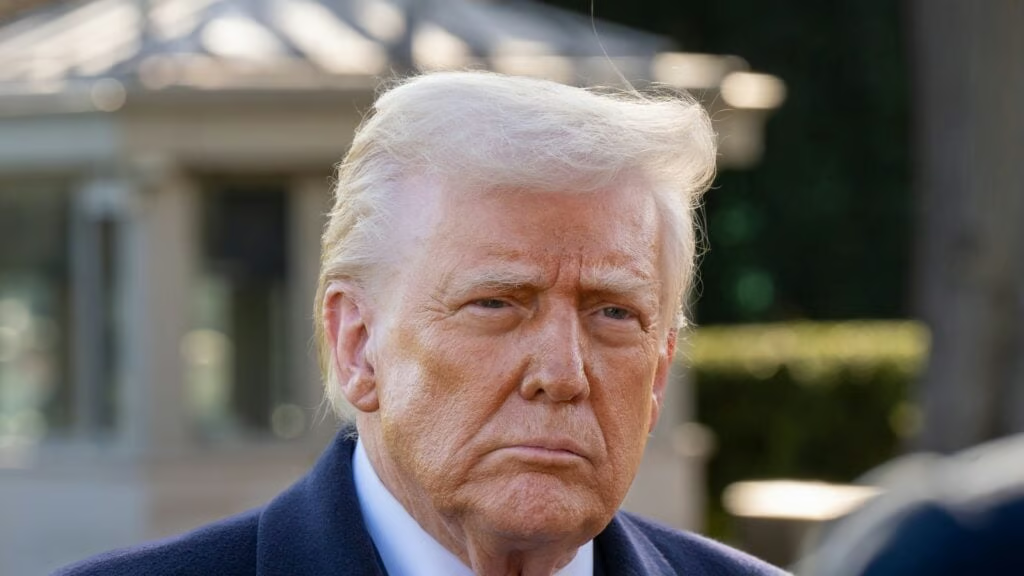
So, here's a development that might smooth out some very choppy waters—literally and figuratively. President Donald Trump says the United States is going to lend a hand to help sort out the traffic jam in the Strait of Hormuz. You know, that little stretch of water between the Persian Gulf and the Gulf of Oman where about a fifth of the world's oil passes through. It's been a bit of a mess lately.
Trump made the announcement in a post on Truth Social early Wednesday, calling it "A big day for World Peace! Iran wants it to happen, they've had enough! Likewise, so has everyone else!" But the part that really gets the financial world's attention is his next line: "Big money will be made." He also hinted that this move could kickstart Iran's reconstruction, with the U.S. providing supplies and helping ensure a smooth transition. It's a notable shift in tone.
This isn't happening in a vacuum. It comes right after a pretty dramatic de-escalation. On Tuesday, Trump agreed to suspend military action against Iran for two weeks. The trade? Iran would restore safe passage through the strait. Markets, which really don't like uncertainty, especially the kind that involves major oil routes and potential conflict, went bonkers. Dow futures shot up 848 points. Oil markets, on the other hand, tanked—crashing by 13% as the immediate risk of supply disruption eased.
As of early Wednesday, the numbers were still telling that story. Brent crude was trading 13.2% lower at $94.85 per barrel. Interestingly, the average U.S. gas price was still holding above $4 a gallon, according to AAA. These things take time to filter through.
What Does 'Big Money' Mean? A Hint at Tolls
Trump's "big money" comment is intriguing. What's he referring to? Well, he might have given us a clue earlier this week. During a press conference at the White House on Monday, a reporter asked him about the possibility of charging "tolls" for shipping through the Strait of Hormuz. His response was pretty direct.
"I'd rather do that than let them have them, right? Why shouldn't we? We're the winner. We won. Okay. They are militarily defeated," said Trump.
He had previously floated the idea that the Hormuz corridor would be jointly controlled by him and Iran's new Ayatollah. The concept of the U.S. potentially collecting fees on one of the world's most critical maritime chokepoints is, to put it mildly, a novel one in modern geopolitics.
It's also a reaction to what Iran has already been doing. Earlier this month, reports surfaced that after traffic through the strait plummeted by 90%, Iran set up its own tightly controlled shipping corridor near Larak Island. They were charging tolls starting at $1 per barrel of oil, payable in yuan or stablecoins. To get a passage permit, ships had to pass strict vetting by the Islamic Revolutionary Guard Corps (IRGC), proving no links to the U.S. or Israel. It was essentially a "toll booth" system, reportedly approved by Iran's own lawmakers.
So, the stage was set: a major disruption, a new Iranian-run toll road, a military pause, and now an announcement of U.S. assistance with a promise of financial upside. It's a complex puzzle where oil, money, and geopolitics are all mixed together. Trump's latest move suggests the U.S. isn't just looking to calm the waters, but might be thinking about how to profit from them, too.