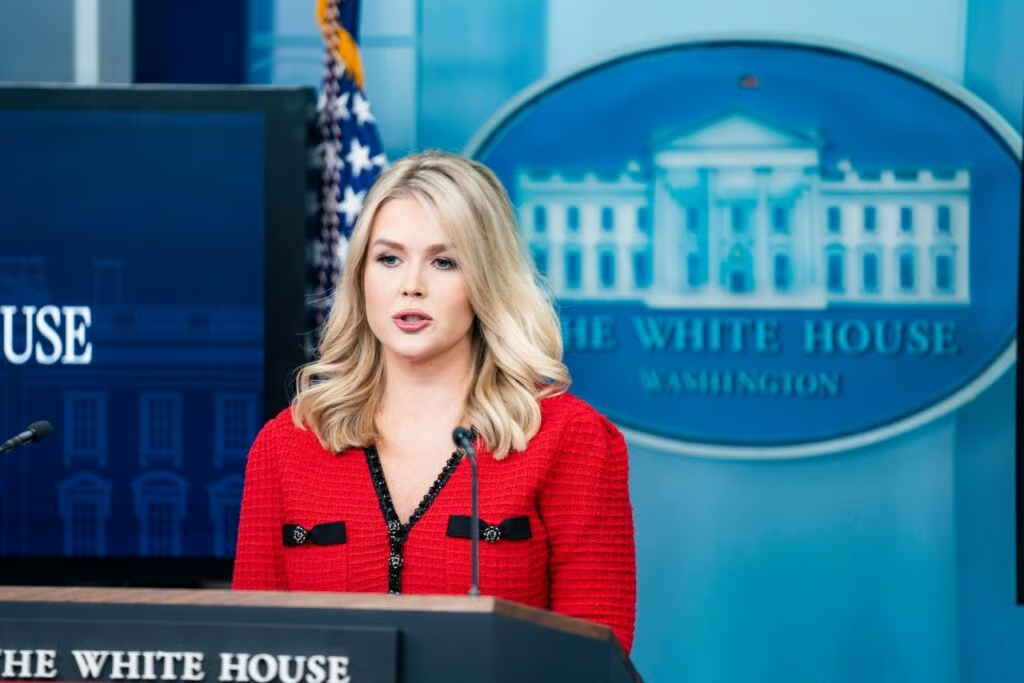
So, the White House is calling it a win. Operation Epic Fury—the U.S. military action in and around Iran—has wrapped up, and according to Press Secretary Karoline Leavitt, it wrapped up ahead of schedule and with its main goal achieved: getting the Strait of Hormuz open again.
Leavitt took to X on Tuesday to lay out the case. She called the operation "a victory for the United States that President Trump and our incredible military made happen." The mission was initially projected to last 4 to 6 weeks, but she says it was done in 38 days. "Thanks to the unbelievable capabilities of our warriors, we have achieved and exceeded our core military objectives in 38 days," she wrote.
Beyond the tactical timeline, Leavitt framed the operation as a strategic enabler. She said it gave President Trump "maximum leverage" to pursue diplomacy. And the big, tangible outcome she highlighted was the reopening of the Strait of Hormuz. That's the narrow passage between the Persian Gulf and the Gulf of Oman, and it's arguably the world's most important oil shipping lane. A lot of the global economy's crude flows through there.
"Never underestimate President Trump's ability to successfully advance America's interests and broker peace," Leavitt added, promising that more details would come from the Defense Secretary and military leadership.
Praise from the Ranks
Leavitt wasn't the only one talking about the operation. Former Vice President Mike Pence posted on X, "God Bless and Protect All Our Troops in Operation Epic Fury."
U.S. Central Command got in on the action too, sharing images and updates that showed U.S. Navy fighter jets launching from the USS Abraham Lincoln as part of what it described as ongoing strikes against military targets inside Iran.
Senator Dave McCormick (R-Pa.) also praised the operation and thanked U.S. troops, while adding a warning that Iran must not be allowed to gain nuclear weapons or advanced missile capabilities.
The Pause for Talks
The military action appears to be dialing back, at least temporarily, to make room for diplomacy. Late Tuesday, President Trump agreed to pause military strikes against Iran for two weeks. The move came in exchange for the reopening of safe passage through the Strait of Hormuz.
Trump suggested the suspension would allow time for negotiations, noting that most points of past contention with Iran had already been resolved. This sets the stage for what could be a crucial diplomatic window.
All of this comes just before a scheduled press briefing at the Pentagon. Defense Secretary Pete Hegseth and Joint Chiefs Chair Gen. Dan Caine are set to face reporters at 8 a.m. EDT on Wednesday. Interestingly, the Pentagon had canceled a briefing with the same officials on Tuesday, just hours before Trump's 8 p.m. EDT deadline for Iran to reopen the strait. That cancellation was made without explanation to the press, adding a layer of last-minute drama to the whole sequence of events.
So, the official line from 1600 Pennsylvania Avenue is one of success: objectives met, a key waterway reopened, and a path to negotiations opened. The Pentagon briefing will likely provide the military's perspective on how exactly that victory was achieved.