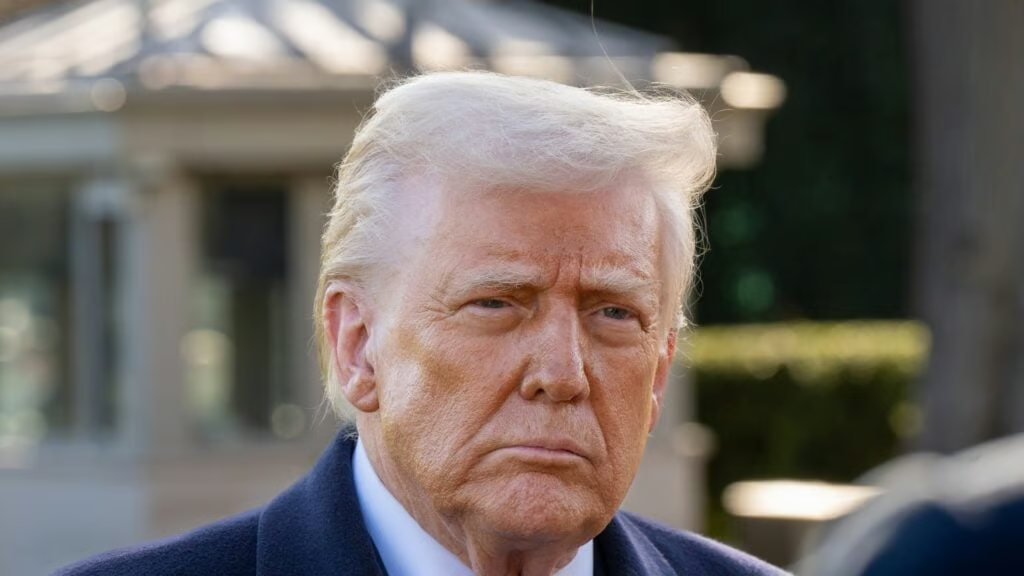
So, here's a thing that happened on Tuesday: President Donald Trump announced a two-week ceasefire with Iran. The deal? Iran restores safe passage through the Strait of Hormuz—you know, that little waterway where about a fifth of the world's oil passes through—and the U.S. hits pause on the whole "threat of large-scale military action" thing for a fortnight. Trump also claimed "total and complete victory," which, in diplomatic speak, often means "let's see what we can work out in the next two weeks."
And just like that, the prediction markets got to work.
What Are the Smart(?) Money Bets Saying?
When major geopolitical events happen, some people write think pieces. Other people place bets. On the prediction platform Polymarket, which runs on the Polygon (POL) blockchain and uses the USDC (USDC) stablecoin, traders are wagering real money on a very specific question: "Strait of Hormuz traffic returns to normal by end of April?"
So far, over $4.4 million has been piled into this contract. That's not Monopoly money; that's people putting actual digital dollars on the line based on their assessment of Middle Eastern politics and maritime logistics.
The current market-implied probability? Bettors think there's a 54% chance the strait is back to normal by April 30. They're a bit more optimistic about the end of May, assigning a 65% probability. It's a fascinating real-time poll of global sentiment, priced in dollars and cents.
For context, the UN Trade and Development agency says that back in February—before everything kicked off—an average of 129 ships were passing through the strait each day. According to a recent tracker, that number has plummeted to just 15 ships right now. So, "returning to normal" means getting from 15 back to 129. That's the bet.
Oil Markets Take a Deep Breath
Meanwhile, in the world of tangible commodities, oil prices did what they often do when a major supply chokepoint looks less choked: they tanked. West Texas Intermediate (WTI) crude fell 15.11% to $95.88 a barrel. Brent crude, the global benchmark, dropped 14.03% to $93.94.
That's a massive single-day move. It tells you just how much risk premium—the extra cost traders build in for potential disruption—was baked into the price. The ceasefire announcement came just before a U.S. deadline for Iran to reopen the passage, a deadline Trump had explicitly tied to the threat of military action. The market's immediate reaction suggests it believes, at least for now, that the immediate crisis has de-escalated.
So, we have a two-week pause, millions of dollars in prediction market bets on what happens next, and an oil market that just exhaled sharply. The next move depends on what happens in the negotiation rooms—and whether 15 ships a day becomes 129 again by the end of the month.