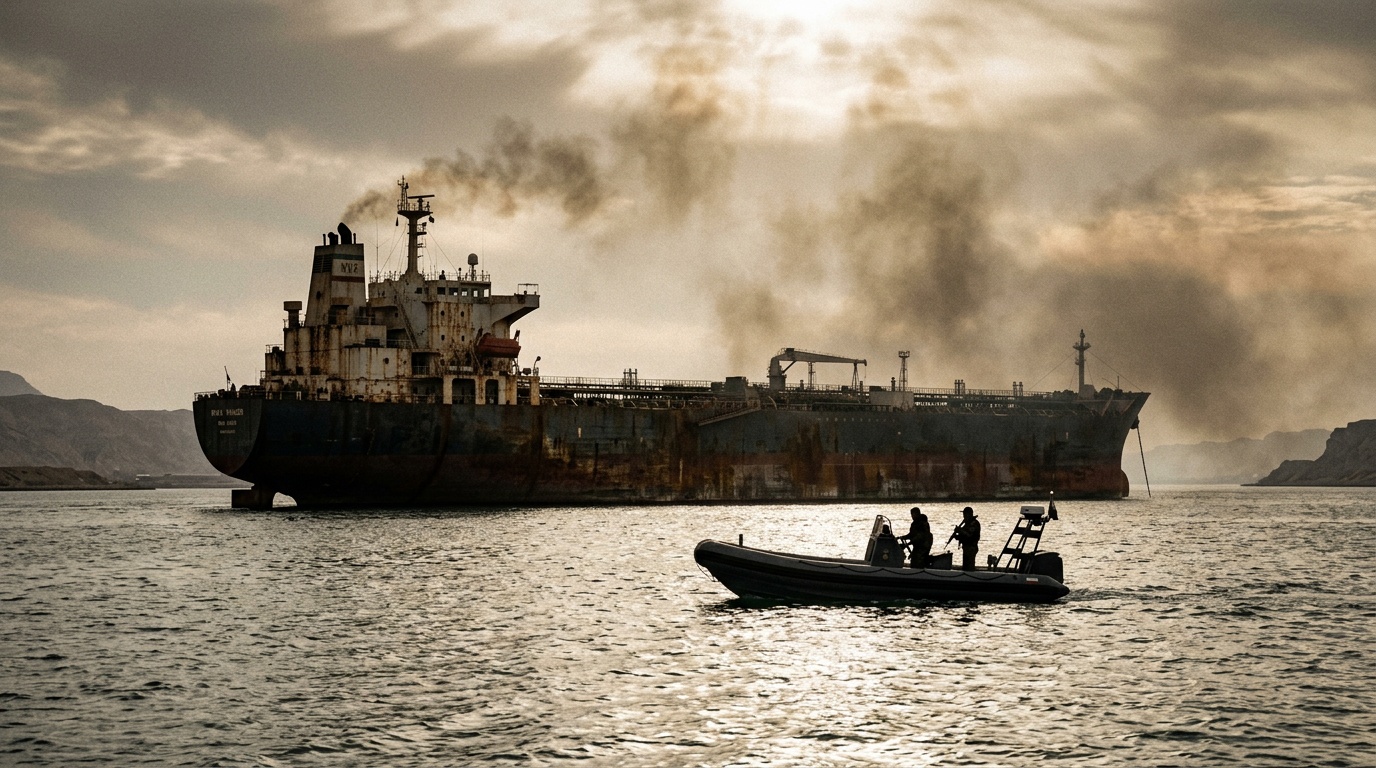
Everyone's watching the Middle East, right? Tensions, oil tankers, the whole geopolitical drama. But according to economist Steve Hanke, the real action—and the real danger—isn't happening overseas. It's happening on the U.S. government's balance sheet. The Johns Hopkins professor thinks the conflict around Iran and the Strait of Hormuz isn't just another news cycle; it's a stress test for American finances that he believes are already broken.
Hanke calls the situation a "massive supply-side shock to the world economy," which is economist-speak for: this is going to hurt in a very specific way. It's the opposite of the 2020 pandemic shock, he notes. Back then, demand vanished. Now, a key supply is getting choked off. "You'll probably get at least a 10% contraction in the supply of oil in the international market," he said in a recent interview. And since oil is "the major input to the world," higher prices won't just mean pricier gas. They'll ripple through everything—refined products, chemicals, plastics, fertilizer. The whole industrial complex gets more expensive.
The Insolvent Uncle Sam
An oil shock like that would be bad news even for a country with rock-solid finances. Hanke's central argument is that the U.S. is not that country. Not even close.
He points to the Treasury Department's own books. For fiscal 2025, the government reported $6.06 trillion in assets. Sounds like a lot, until you see the liabilities: $47.78 trillion. That's a negative net position of $41.72 trillion. And that eye-watering number excludes long-term social insurance promises like Social Security and Medicare. Add those in, and total obligations balloon past $136 trillion.
Numbers that big can feel abstract, like Monopoly money. So Hanke did what any good teacher would: he made it relatable. He shrunk the federal budget by eight zeros to turn it into a household budget. The result is… grim.
By his math, published in Fortune, this household earns $52,446 a year. Not terrible. But it spends $73,378. That's an annual deficit of $20,932—it's spending nearly 40% more than it takes in. As for its balance sheet? It has $60,554 in assets (maybe a car and some savings) stacked against $1,361,788 in liabilities and unfunded promises (a massive mortgage, credit card debt, and promises to pay for future expenses it hasn't saved for).
"Uncle Sam, by any accounting standard, is insolvent," Hanke wrote bluntly.
It seems bond investors might be getting a little antsy too. The iShares 7-10 Year Treasury Bond ETF (IEF) is down 1.55% year to date. Not a crash, but a subtle signal of unease.
Hanke sees two flickers of hope in Washington: the bipartisan Fiscal Commission Act (H.R. 3289) and talk of an Article V Convention focused on a fiscal responsibility amendment to the Constitution. He views these as potential paths to "rebalancing the economy." But they're just proposals on a very long road.
A Dangerous Policy Mix
This is where the Middle East comes back into the picture. War doesn't just disrupt oil supplies; it costs money. With the federal deficit already over 6% of GDP in peacetime, any new conflict-related spending could blow the budget wider open.
Hanke thinks absorbing those deficits will put the Federal Reserve in a very tough spot. "There'll be tremendous pressure on the Fed to monetize some of that deficit," he said. That's the polite term for the government essentially printing money to cover its bills, a move that historically fuels inflation.
But for Hanke—a veteran who advised the Reagan administration and foreign governments—the bigger threat isn't just the oil price spike. It's the broader policy environment surrounding it. He describes the current mix as "protectionism," "militarism," and "interventionism." He calls it a "deadly cocktail" for an economy already buckling under fiscal strain.
The bottom line is this: America can still project military and economic power across the globe. But Hanke's analysis suggests it's doing so from a financial foundation that looks less like a superpower's and more like that of a household that's already underwater on its mortgage, maxed out its credit cards, and is still adding to the tab. The next shock might be the one that forces a very uncomfortable conversation about the bill.