Remember when the Iran war started and everyone thought it would be over quickly? Yeah, about that. Three weeks in, the market is telling a very different story—one that involves months, not days, of disruption.
The clearest signal is a massive, 33-percentage-point spread that has opened between two groups of stocks. On one side, you have companies that actually do better when the Strait of Hormuz is closed or severely disrupted. On the other, you have companies whose entire business model depends on it being open. The gap between them has ballooned, and it's the market's way of saying, "Buckle up, this is going to be a long ride."
A basket of 10 "Hormuz Closed" stocks—think energy refiners, fertilizer producers, defense tech, and drone companies—has climbed an average of 17.55% since the conflict began. Meanwhile, a basket of 10 "Hormuz Reopen" stocks—cruise lines, airlines, logistics firms, and a gold miner—has fallen an average of 15.35%. That's a total divergence of over 32 percentage points. When Wall Street starts pricing in a timeline, it doesn't do so subtly.
The "Hormuz Closed" Basket: Who Wins When the Chokepoint Stays Shut
This is the group that thrives on chaos: elevated oil prices, snarled maritime routes, and bigger defense budgets. It's a mix of obvious and not-so-obvious beneficiaries.
Leading the charge is Red Cat Holdings (RCAT), a defense and drone company, with a stunning 40.95% gain. When a key shipping lane gets threatened, apparently the demand for military drone systems goes through the roof.
Fertilizer producers are big winners too, which makes sense when you think about it. A lot of ammonia and potash supply chains run through the Gulf. Disrupt that, and companies like CF Industries Holdings Inc. (CF) (up 25.53%) and Mosaic Co. (MOS) (up 3.81%) benefit.
Then there are the refiners. With Middle Eastern refined product flows getting choked off, refinery margins for domestic processors expand. That's why Marathon Petroleum Corp. (MPC) is up 18.15% and Valero Energy Corp. (VLO) is up 15.44%. Even the big integrated energy players like Chevron Corp. (CVX) are up 6.33%.
The list rounds out with petrochemicals (LyondellBasell Industries (LYB), +24.13%), aerospace defense (Karman Space & Defense (KRMN), +16.06%), and defense AI (Palantir Technologies Inc. (PLTR), +12.84%). Their shared characteristic? Each benefits directly or indirectly from the very things that make everyone else nervous.
| Company | Sector | Return Since Feb. 27 close |
|---|
| Red Cat Holdings (RCAT) | Defense / Drones | +40.95% |
| CF Industries Holdings (CF) | Fertilizers / Nat. Gas | +25.53% |
| LyondellBasell Industries (LYB) | Petrochemicals | +24.13% |
| Marathon Petroleum Corp. (MPC) | Refining | +18.15% |
| Karman Space & Defense (KRMN) | Defense / Aerospace | +16.06% |
| Valero Energy Corp. (VLO) | Refining | +15.44% |
| Palantir Technologies Inc. (PLTR) | Defense Tech / AI | +12.84% |
| Phillips 66 (PSX) | Refining / Midstream | +12.25% |
| Chevron Corp. (CVX) | Integrated Energy | +6.33% |
| Mosaic Co. (MOS) | Fertilizers / Potash | +3.81% |
The "Hormuz Reopen" Basket: Who's Getting Squeezed
This is the other side of the coin—the companies getting a lesson in global interconnectedness. Their earnings depend on open supply chains, cheap fuel, and people feeling good about traveling the world. None of those things are true right now.
The biggest loser in either basket is Alaska Air Group Inc. (ALK), down a painful 23.80%. Surging jet fuel costs and deteriorating economics for long-haul routes are a brutal combination. It's not alone: American Airlines Group Inc. (AAL) is down 17.05% and United Airlines Holdings Inc. (UAL) is down 12.32%.
Cruise lines are in a similar boat (pun intended). When your Gulf itineraries become impossible and your fuel budget explodes, your stock price sinks. Carnival Corp. (CCL) is down 20.14%, Norwegian Cruise Line Holdings (NCLH) is down 17.37%, and Royal Caribbean Cruises Ltd. (RCL) is down 9.22%.
Even the companies that move stuff around on land aren't safe. They're getting hit with a one-two punch of global freight disruption and fears of weaker demand. United Parcel Service Inc. (UPS) is down 15.48%, J.B. Hunt Transport Services Inc. (JBHT) is down 14.16%, and Old Dominion Freight Line Inc. (ODFL) is down 9.18%.
Interestingly, even Newmont Corp. (NEM), the gold miner in the basket, is down 14.83%. Sometimes, even the classic safe haven doesn't play out as expected in a complex crisis.
| Company | Sector | Return |
|---|
| Alaska Air Group Inc. (ALK) | Airlines | −23.80% |
| Carnival Corp. (CCL) | Cruise Lines | −20.14% |
| Norwegian Cruise Line Holdings (NCLH) | Cruise Lines | −17.37% |
| American Airlines Group Inc. (AAL) | Airlines | −17.05% |
| United Parcel Service Inc. (UPS) | Freight / Logistics | −15.48% |
| Newmont Corp. (NEM) | Gold Mining | −14.83% |
| J.B. Hunt Transport Services Inc. (JBHT) | Trucking / Freight | −14.16% |
| United Airlines Holdings Inc. (UAL) | Airlines | −12.32% |
| Royal Caribbean Cruises Ltd. (RCL) | Cruise Lines | −9.22% |
| Old Dominion Freight Line Inc. (ODFL) | LTL Freight | −9.18% |
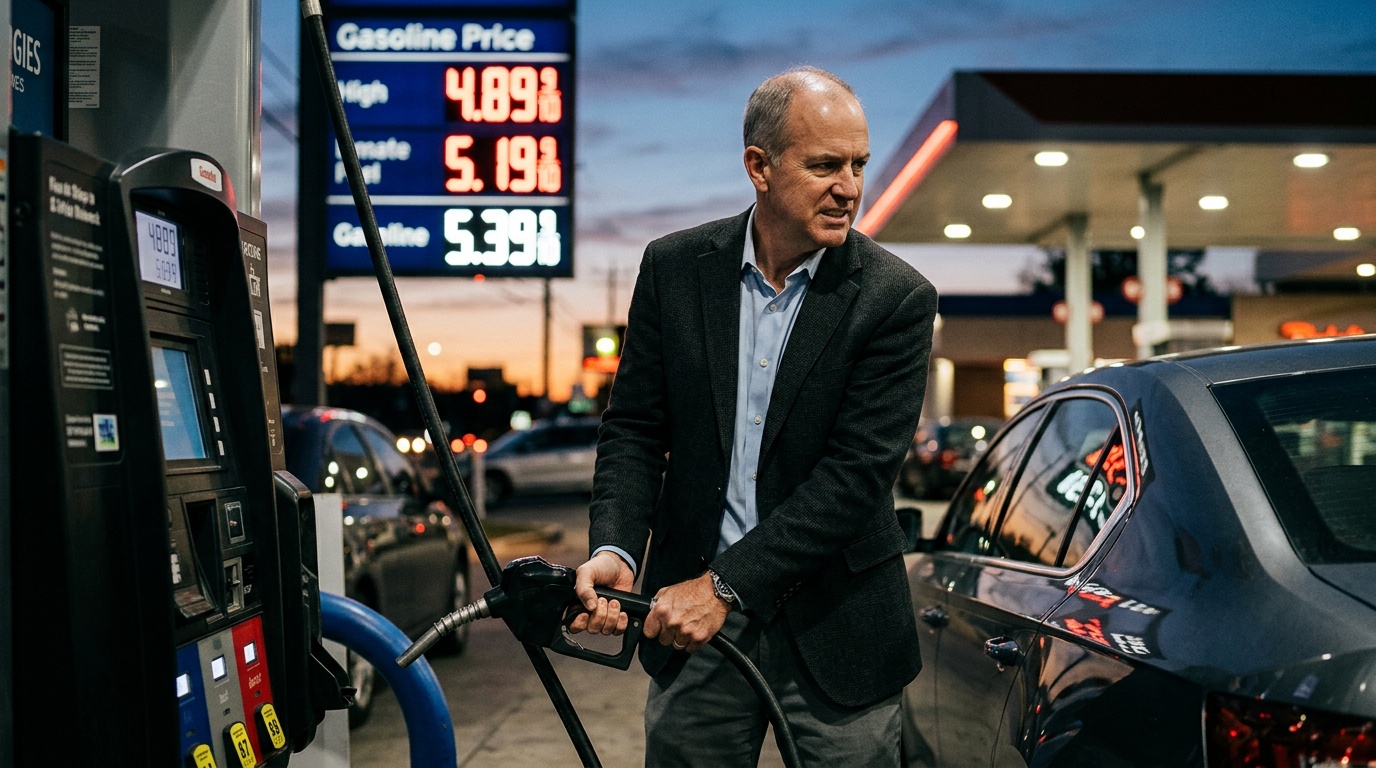
And if you want to see the impact without looking at a stock chart, just go to the gas pump. The national average for regular gasoline hit $3.79 per gallon on Tuesday, according to AAA. That's the highest price since October 2023.
So, How Long Is This Going to Last?
This is the trillion-dollar question, and the market is making its bet. The most direct read comes from prediction markets. Right now, Polymarket is assigning only a 26% probability that Strait of Hormuz traffic is back to normal by April 30. In other words, traders think there's a 74% chance the waterway stays messed up for at least another six weeks. The odds of seeing U.S. Navy escorts by the end of this month are even lower, at just 20%.
Analysts are adjusting their timelines too. "We initially estimated the conflict to last 1–3 weeks, with a maximum of two months. As the war unfolds, we now expect something closer to roughly two months, though the dynamics remain self-limiting," said Dan Alamariu, chief geopolitical strategist at Alpine Macro, in a note this week. He added, "Iran seems increasingly to be dictating the tempo. The regime is willing to absorb punishment to inflict economic and political pain."
The oil forecasts are getting revised upward in response. Last week, Goldman Sachs bumped its Brent price forecast up by 20%, projecting an average of $100 per barrel in March. They assume a three-week disruption. But here's the kicker: the bank warned that if the closure stretches to two months, its end-of-year forecast would jump from $71 to $93 per barrel.
The sentiment from the corporate world is similarly cautious. Tyler Goodspeed, chief economist at ExxonMobil, told CNBC that there are "many more scenarios, and more probable scenarios, in which the Strait remains effectively closed harder for longer" than scenarios where things go back to normal quickly.
So, until there's a major diplomatic breakthrough or a decisive naval action that changes the facts on the water, this 33-point stock spread isn't just a curious market anomaly. It's the clearest real-time gauge Wall Street has for how long it expects this war—and the economic disruption that comes with it—to last. And right now, that gauge is pointing firmly toward "longer."