Why Your First $1,000 Should Buy the Whole Market, Not a Hot Stock
MarketDash Editorial Team
Author
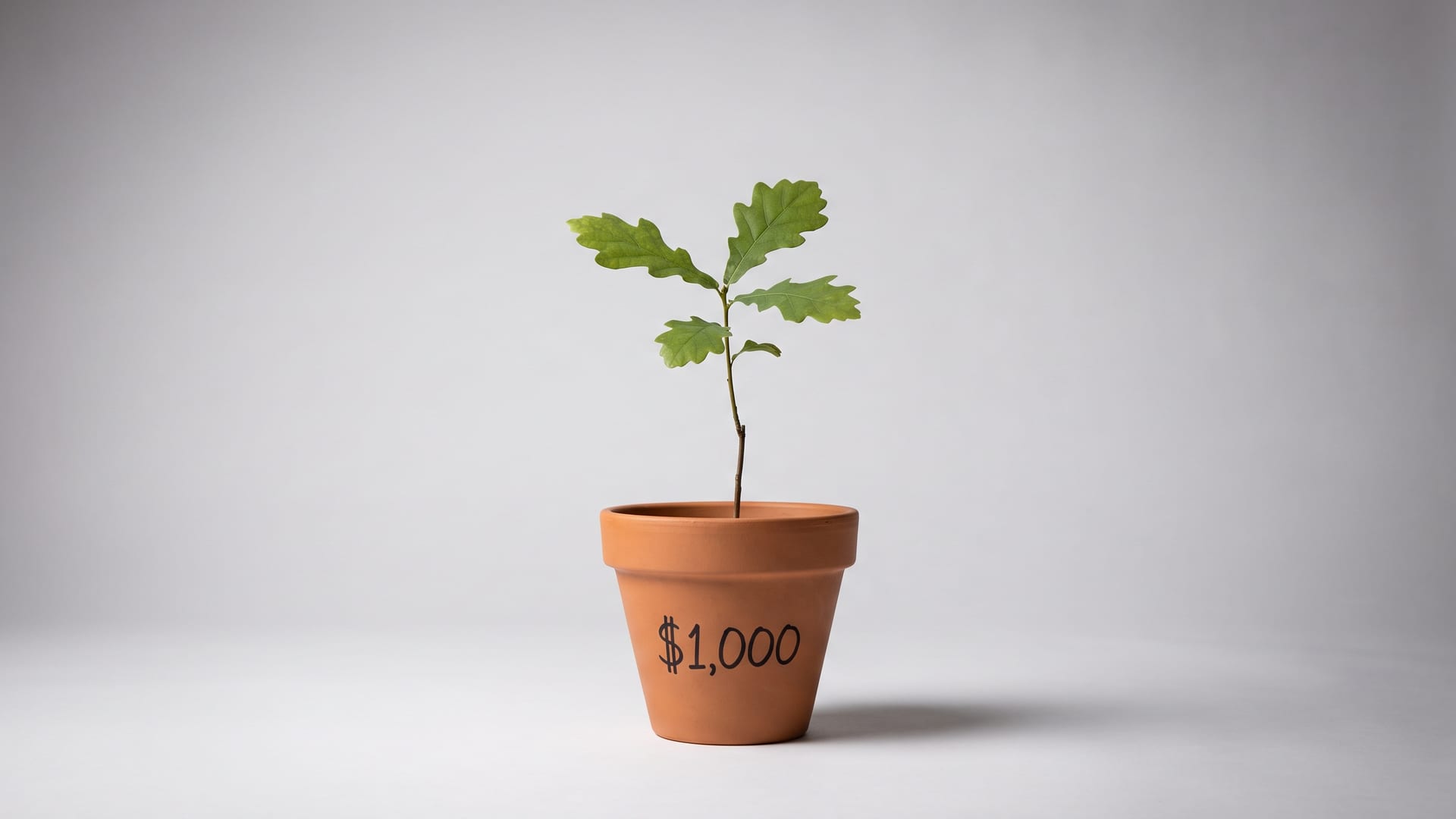
Here is what almost nobody tells a new investor: the first $1,000 is not a question about which company wins the future. It is a question about whether the next $1,000 shows up without you having to decide anything.
Run the boring version. Start with $1,000, add $200 a month, and let it grow at 8% a year before taxes and fees, not adjusted for inflation. After 10 years you have about $39,000. You put in about $25,000. The other roughly $14,000 came from time, not from you being clever. That is the entire pitch. Your job is to keep the money flowing in; time does the part that makes people rich.
The first $1,000 buys a habit, not a hit
Someone will text you a ticker. A cousin will have a friend who "knows something." The idea will sound specific, and specific feels like an edge.
It is not an edge. Picking a winning stock asks you to be right twice: right that the business does well, and right that you hold on long enough to benefit. Automating a contribution asks you to be right once, on the day you set it up, and then to forget it.
Boring has a second advantage. Boring compounds. Your money earns a return, and then that return earns its own return, and so on. You can estimate the doubling time with the rule of 72: divide 72 by a yearly return, and you get roughly how many years it takes money to double. At 8% a year that is about 9 years. Nothing showy happens inside those 9 years, which is exactly why the strategy survives contact with real life.
Park a cushion before you buy anything
Before the first dollar goes into an investment, put a small cushion somewhere dull: a savings account you can reach in a day. The size is your call, but the purpose is fixed. The cushion exists so that a surprise car repair does not force you to sell investments at the worst possible moment.
That order matters more than it sounds. Selling in a panic turns a temporary drop into a permanent loss, and permanent losses are the only ones that cannot recover. A cushion is not a drag on your returns. It is the thing that lets your returns keep running.
Buy the whole market, then check the fee
An index fund is a basket of hundreds of companies you buy in one purchase. You are not betting on one business; you are betting on the general direction of a large pile of them. That is the sensible default for a first $1,000.
Then look at the fee, because fees are where quiet money disappears. Take $200 a month for 30 years at 8% a year. With a 0.05% yearly fee you end at about $306,000. With a 1% yearly fee you end at about $252,000. The higher fee costs about $54,000, and it never sends you an invoice. It just takes a slice every year, and the slice stops compounding for you. A 1% fee sounds like a rounding error and behaves like a tenant who lives in your portfolio rent free.
One honest caveat: those figures assume 8% a year before fees, and they are not adjusted for inflation. Real returns will differ. The lesson is the direction, not the decimal.
The rules that stop you from undoing it
Three rules cover most of the ways people hurt themselves after they start.
The 4% rule: research from the 1990s found that pulling 4% of a stock-and-bond portfolio in your first year of retirement, then raising that amount with inflation, lasted at least 30 years in most historical periods. The shortcut version: save 25 times your yearly spending.
The withdrawal rules: taking money out of a traditional IRA or 401(k) before age 59½ usually means income tax plus a 10% penalty, with some exceptions. Money in a Roth account was already taxed going in, so qualified withdrawals in retirement are tax free. Know which bucket you are filling before you fill it.
The raises rule: when your pay goes up, raise the automatic amount. You will not notice the difference in your checking account, and your future self will notice it a great deal.
Check it yourself in MarketDash
You will still get tempted by a single stock, and that is fine. Just make the app do the arguing.
Open the stock page and read the Intrinsic Value section. You get an estimate of what the business is worth, built from a discounted cash flow and a comparison against similar companies. Your job is not to accept the number. Your job is to ask whether you can explain, in one sentence, why the price and that estimate differ.
Then open the Wall Street section and read the analysts: each rating, price target, upside, and the date it was published. Count how much they disagree. That disagreement is the most honest thing on the page.
Finally, go to the Screener and pull up columns like PE Ratio and Intrinsic Value %, and look at the "MarketDash Undervalued" preset. The PE ratio is the share price divided by a year of profit per share, which is a quick way to see what you are paying for each dollar of earnings. Use the screen as a test of your reasoning, not a shopping list.
Then close the app and set the automatic contribution. The next $1,000 should not need your opinion.
Get Market News Alerts
Real-time alerts on price moves, news, and trading opportunities.
Join 20,000+ investors. No spam, ever.
Featured Articles
View all news
Meta's $135 Billion AI Bill Sends Tech Tumbling, 10-Year Yield Drops Below 5%

Moderna Stock Sinks 25% on Leaked Melanoma Vaccine Data

Nvidia's AI Warning, $111 Oil: Why SOXL Just Got Wiped Out by 20%

Chevron Stock Hits a New 52-Week High as Oil Prices Surge on Middle East Tensions
AMD Stock Slides 7% as Chip Sell-Off Hits Semis: Supply Snags, Soft PCs and a $620 Price Target
Procter & Gamble's Best Day Since 2020 Is Really a Story About AI Stocks Cracking

Meta's Cash Flow Goes Negative for the First Time Since Its IPO Year, and Wall Street Shrugs