





Why a 1% Fee Can Cost Your Old Retirement Account $59,000
MarketDash Editorial Team
Author
The most expensive thing you can do with an old 401(k) is the move that feels most like getting your money back: cashing it out. The second most expensive is rolling it into an IRA on reflex, because a rollover feels like progress.
Both mistakes come from the same place. Nobody ever told you that an old 401(k) is allowed to just sit there, quietly, doing its job.
The three doors
An old 401(k) from a former job is the financial version of a storage unit. It holds your stuff, it charges you something to hold it, and you have vague plans to deal with it.
You have three real options. Cash it out. Leave it in the old plan. Roll it into your new employer's plan or into an IRA (an individual retirement account: a retirement account you open at a brokerage instead of through an employer).
Two of those are decisions. One is a mistake in a nice suit.
Cashing out a traditional 401(k) before age 59½ usually means income tax on the whole amount plus a 10% penalty, with some exceptions. You pay real money for the privilege of having less money, and you give up the years that balance would have kept growing. That's the whole case against it, and it's enough.
The fee is the entire argument
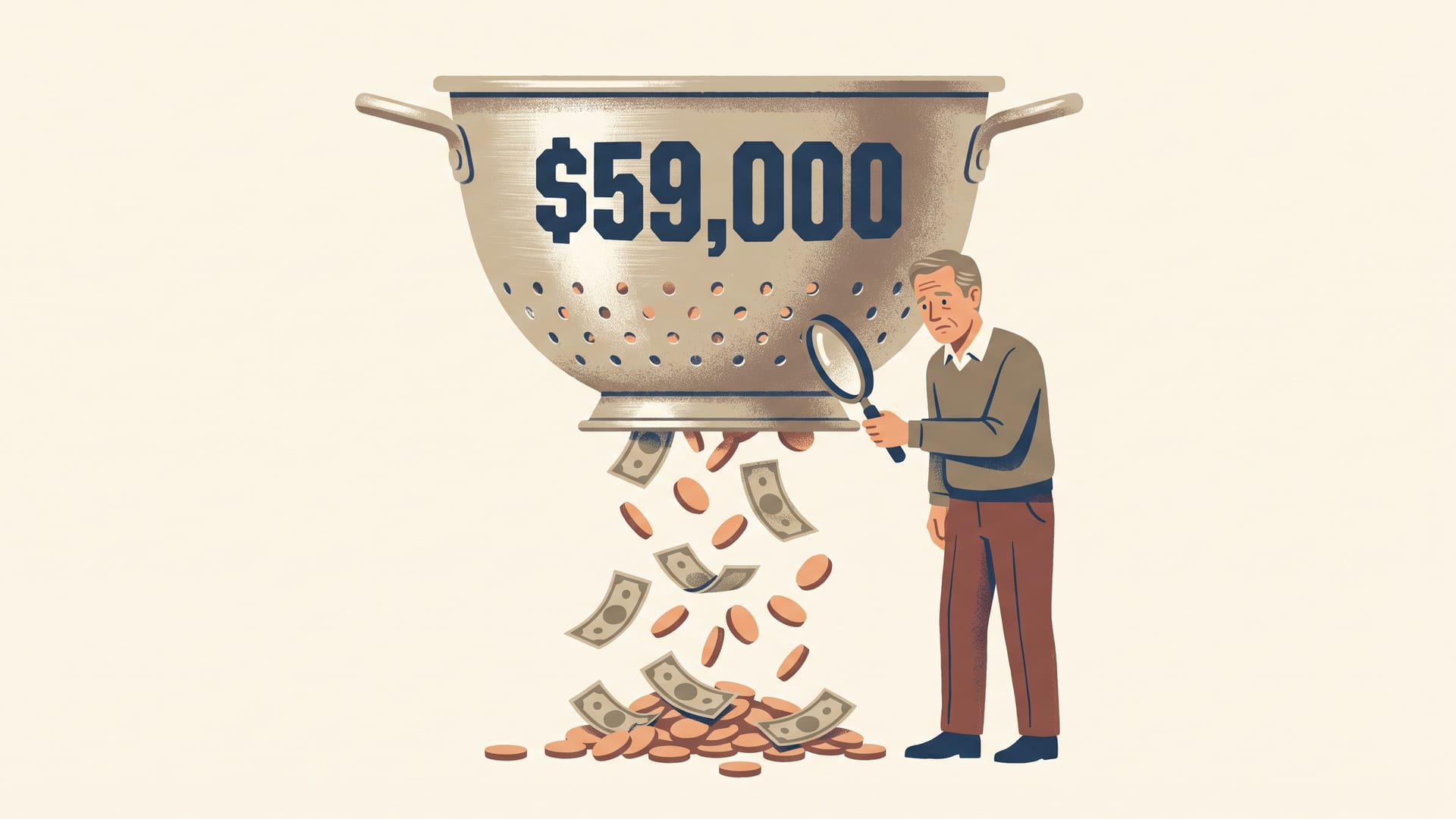
Here is the math that should settle most rollover debates. Start with $25,000, add $300 a month for 25 years, and let it grow 7% a year before fees. With a 0.1% yearly fee, you end with about $379,000. With a 1% yearly fee, you end with about $320,000. The gap between those two fee levels is about $59,000.
One percentage point. A 1% yearly fee means the fund company keeps a dollar out of every hundred in your account, every year, whether the fund went up or down. That's it. Fees are the rare part of investing you can compare before you commit, and most people spend their energy comparing fonts on the paperwork instead.
A rollover is a comparison, not a reflex
Nobody rolls over a 401(k) because the old plan is bad. They do it because a rollover has paperwork and a confirmation number and the satisfying feeling of a reorganized closet. Feelings are not a fee schedule.
So run the comparison. Two things to check. First, cost: the expense ratios on the funds in each plan (the yearly fee, shown as a percentage of your balance) plus any flat administration fee the plan charges. Second, the menu: does each plan offer a cheap, broad fund that owns a big slice of the market? If the old plan has that and costs less, leaving it alone is a strategy, not neglect.
More choice is usually where people get hurt. An IRA can offer thousands of funds, which sounds like freedom and behaves like a buffet with no closing time. You will not pick better because you had more options. You'll pick more, and trade more, and that activity is a cost that never shows up in a fee table.
One trap worth naming: moving pre-tax money into a Roth IRA means switching to an account funded with money that was already taxed, where qualified withdrawals in retirement come out tax-free. The tax bill lands when you convert, not later. Do that on purpose, with a calculator, not by accident.
And when you do move, ask the two providers to send the money directly to each other. You never want the balance taking a detour through your checking account.
Old is not the same as broken
Leaving a plan alone for 30 years does not mean you can't retire on it. The 4% rule, from research in the 1990s (William Bengen in 1994, the Trinity study in 1998), found that withdrawing 4% of a stock-and-bond portfolio in the first year of retirement and raising that amount with inflation lasted at least 30 years in most historical periods. Same idea, said plainly: save 25 times your yearly spending.
The old plan can mail you a paycheck in retirement. Consolidating is not what makes the money spendable.
Time is why fees deserve this much attention. The rule of 72 says you divide 72 by a yearly return to estimate how many years it takes money to double; at 8% a year, about 9 years. Fees compound too, just in the other direction. A gap you would shrug at over two years is exactly why a $59,000 difference shows up over 25.
Two chores either way: keep your address current with the old plan, and keep the login somewhere you will find it. The most expensive 401(k) is the one you forgot you had.
Your next step
Find the old plan's fee disclosure, the notice that lists what the plan charges and what each fund charges. Write down two percentages: what the old plan costs you over a year, and what the new one would cost. Then look at the fund list for a cheap, broad fund in each.
If the old plan is cheaper and holds a fund you would have picked anyway, leave it there and put one reminder on the calendar to recheck once a year. If the new place is cheaper and simpler, ask for a direct transfer between providers. Cashing out is not a third strategy. It's a tax bill with a story attached.
Get Market News Alerts
Real-time alerts on price moves, news, and trading opportunities.
Join 20,000+ investors. No spam, ever.
Featured Articles
View all news
Dow Drops as Nvidia Slips After Earnings, Dollar Hits 19-Month High: Stock Market Today

Fed Minutes: 'Almost All' Officials See More Hikes, and AI Debt Is Now on the Radar

Nvidia's $105 Billion OpenAI Bet Comes With a 20-Year Catch

Anthropic Reportedly Weighs $80-$85 IPO Price, Setting Up Record $96B Debut

Palo Alto Crushes Q1 Estimates, Drops $4.5B on AI Startup Applied Compute

Waller Warns of a December Rate Shock. Here's How TIPS ETFs Handle That Kind of Heat.

Wall Street Says the AI Trade Is Dead. ETF Investors Are Quietly Buying the Dip