



Target-Date Fund or Index Fund? A 1% Fee Can Cost $97,000
MarketDash Editorial Team
Author
A target-date fund and an S&P 500 fund can hold nearly the same investments on day one and behave nothing alike by year twenty. The gap isn't brainpower. It's maintenance.
So here's the stance: if you know in your bones that you will not rebalance, buy the target-date fund and stop feeling bad about it. If you will genuinely do the upkeep, an S&P 500 fund is a fine way to own big American companies. Either way, look up the expense ratio before you send money.
Two funds, two different promises
An S&P 500 fund buys the largest US companies in one package. It is all stock, all the time. No bonds, which are loans to governments or companies that pay interest and usually bounce around less than stocks. No automatic de-risking. Nobody adjusts it as you get older. It sits there being all stock while your retirement date walks toward you.
A target-date fund does the opposite. The year in its name is roughly when you plan to stop working. As that date gets closer, the fund shifts gradually from stocks toward bonds, so a bad stock market has less power to wreck you near the moment you start withdrawing. It does that shifting on its own, without an email asking for your opinion.
The S&P 500 fund is a tool. The target-date fund is a tool plus a robot that maintains it.
The chore that decides this
Rebalancing is the maintenance. It means selling whatever grew faster than you planned and buying whatever fell behind, to get back to your intended mix. Done right, you're regularly selling the thing that just went up. With your own money. On purpose.
That's why people skip it. Not laziness exactly. It feels like volunteering for a haircut.
The target-date fund doesn't have that problem. It has no feelings about the position that just fell, and it gets more careful with age without being asked, which puts it in a small club. Hold an S&P 500 fund instead, and the rebalancing, the eventual shift toward bonds, and the timing of all of it become your job. Some people are genuinely good at that. Most people are good at it right after they open the account and terrible by the first scary headline.
The fee you'll never see on a statement
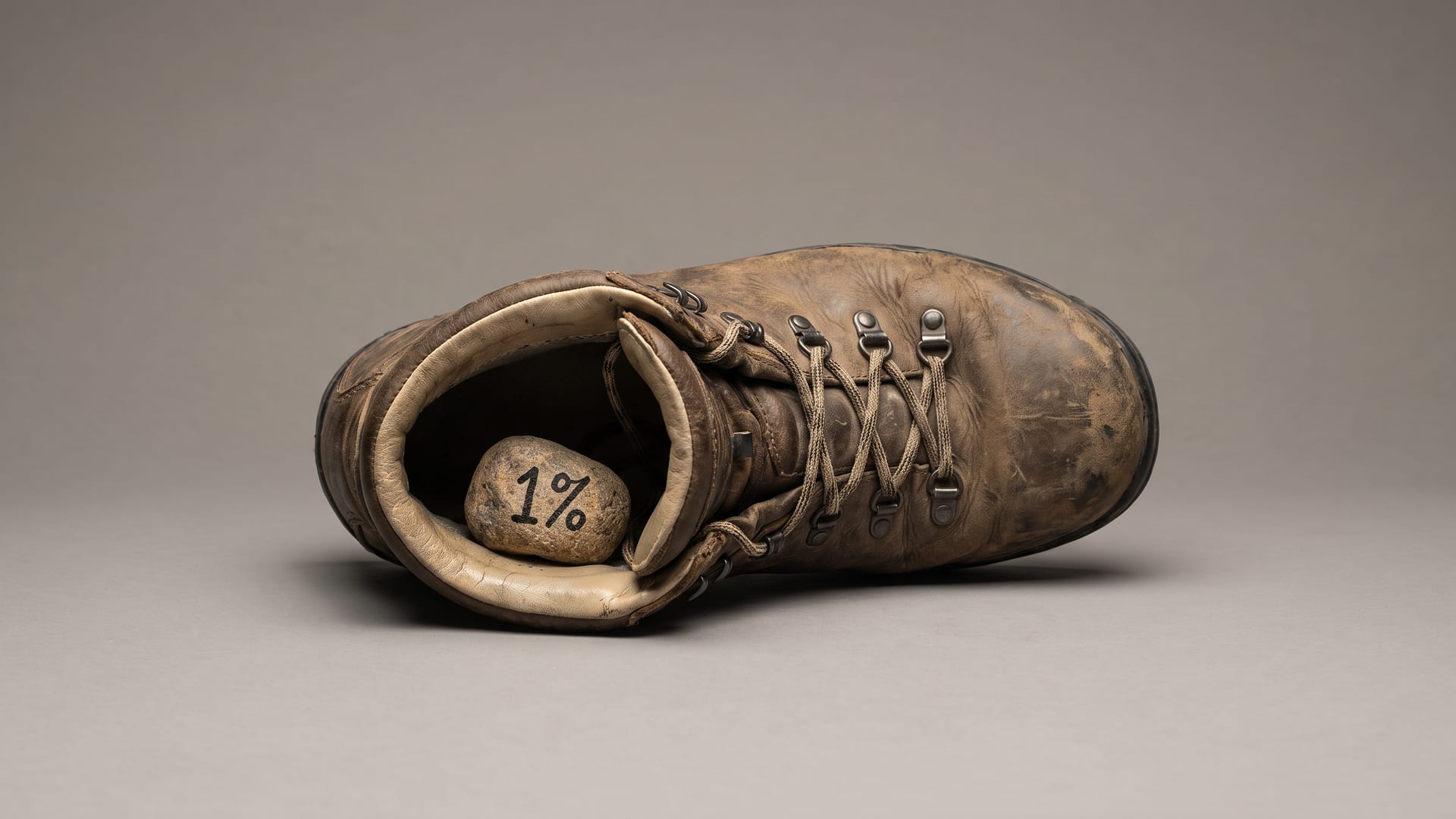
Fees are the one part you can inspect and control. They show up as an expense ratio: a yearly percentage pulled out of the fund's assets. You never get a bill. The money just doesn't grow.
Here's the arithmetic, with assumptions stated. Start with $10,000, add $300 a month for 30 years, and earn 8% a year before fees. With a 0.1% yearly fee you end at $544,281. With a 1% yearly fee you end at $447,156. The higher fee costs you $97,125. Same money in, same market, same patience. You simply paid $97,125 for the privilege of being charged more.
For scale on what patience does by itself: $10,000 plus $300 a month for 30 years, growing 8% a year before taxes and fees and not adjusted for inflation, ends at $556,465. You put in $118,000. The other $438,465 is growth.
Target-date funds vary a lot in what they charge, so the one with the right year in its name is not automatically the right fund. Read the number.
The rules of thumb behind all this
The 4% rule comes from research in the 1990s, William Bengen in 1994 and the Trinity study in 1998: withdrawing 4% in your first year of retirement and raising that amount with inflation lasted at least 30 years in most historical periods for a stock-and-bond portfolio. Same idea from the other end: save 25 times your yearly spending.
The rule of 72 estimates doubling time. Divide 72 by a yearly return. At 8% a year, money doubles in about 9 years. That's the case for leaving a retirement account alone.
Which assumes the money is for decades. Cash pulled from a traditional IRA or 401(k) before age 59½ usually means income tax plus a 10% penalty, with some exceptions. Neither fund is a rainy-day account.
Check it yourself in MarketDash
Two checks, then you're done.
First, the fee. Find your target-date fund's expense ratio, write it down, and compare it with a plain index fund before you commit. A number on paper is harder to ignore than a number on a website.
Second, open the Screener and look at the PE Ratio column: share price divided by a year of profit per share, which is roughly the price of a dollar of profit. The "MarketDash Undervalued" preset shows names that screen as cheap against intrinsic value, MarketDash's blend of a discounted cash flow estimate and a comparison with similar companies. Good context for what stocks cost. It won't pick your fund.
Then choose the boring one, set the contribution, and spend your attention on something you'll actually enjoy. The fund handles the maintenance. That's the trade.
Get Market News Alerts
Real-time alerts on price moves, news, and trading opportunities.
Join 20,000+ investors. No spam, ever.
Featured Articles
View all news
Dow Drops as Nvidia Slips After Earnings, Dollar Hits 19-Month High: Stock Market Today
Fed Minutes: 'Almost All' Officials See More Hikes, and AI Debt Is Now on the Radar
Nvidia's $105 Billion OpenAI Bet Comes With a 20-Year Catch

Anthropic Reportedly Weighs $80-$85 IPO Price, Setting Up Record $96B Debut
Palo Alto Crushes Q1 Estimates, Drops $4.5B on AI Startup Applied Compute
Waller Warns of a December Rate Shock. Here's How TIPS ETFs Handle That Kind of Heat.
Wall Street Says the AI Trade Is Dead. ETF Investors Are Quietly Buying the Dip