A 1% Fee Can Cost You $41,000
MarketDash Editorial Team
Author
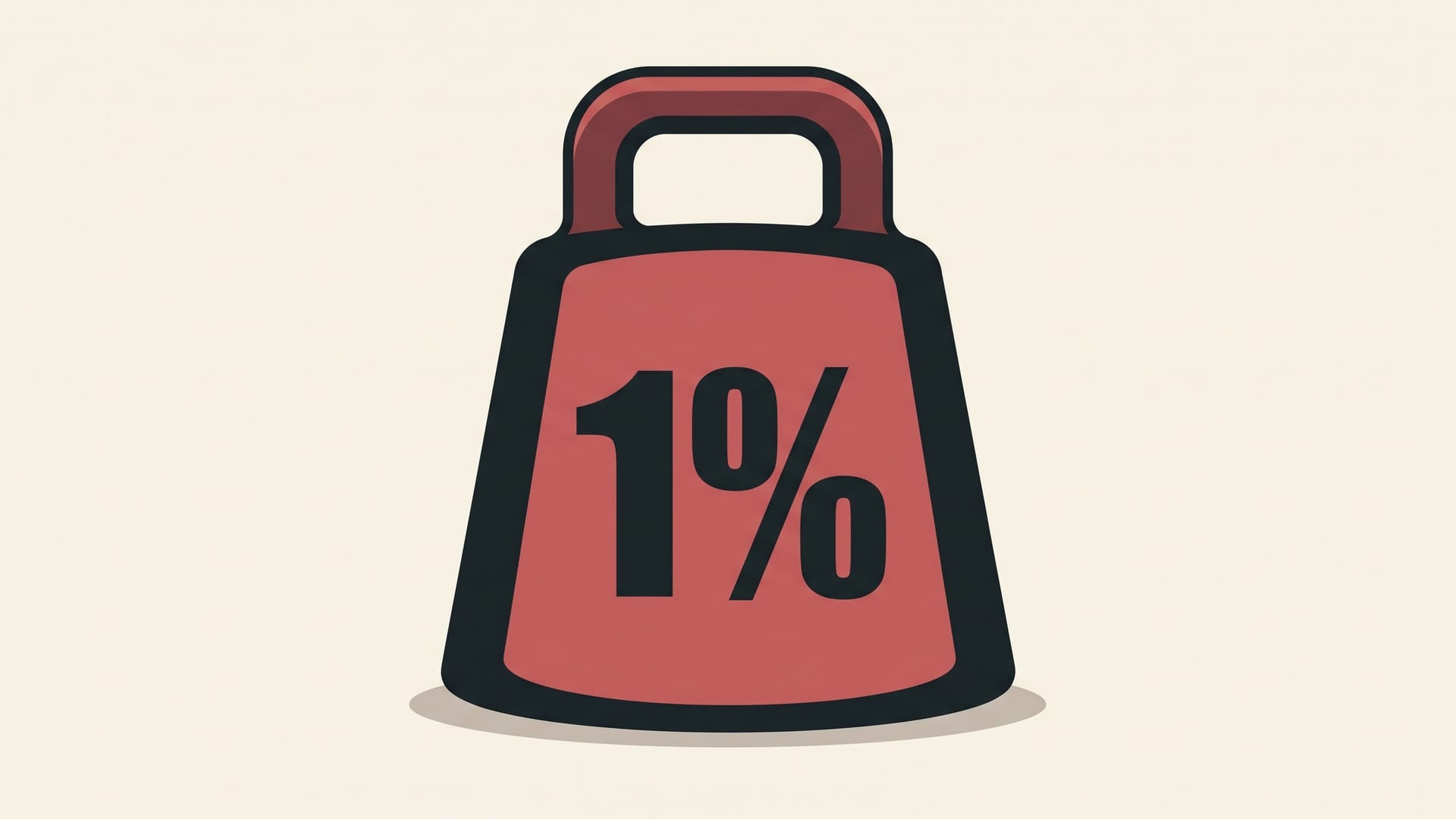
A small-sounding percentage is a large-sounding bill
Here is the most expensive sentence in personal finance: "that's basically nothing."
Take $10,000, add $500 a month, and let it grow at 8% a year for 20 years, before taxes and fees and not adjusted for inflation. You end with about $344,000. Of that, about $130,000 is money you put in, and about $214,000 is growth you did not.
Now change one thing: a yearly fee of 1% instead of 0.05%. The ending balance falls to about $301,000 from about $341,000. That one change costs about $41,000.
Neither fee sounds like anything. One is a rounding error you would never bring up at dinner. The other is a car. That is what percentages do: they make real money sound like a technicality.
Position size works the same trick in reverse. As a slice of a pie chart, a big holding looks tidy. As dollars, it is the number that decides whether a bad stretch is an inconvenience or a rewrite of your plans.
The biggest bet in your account is usually one you never made
Nobody's plan says "and then let one stock eat my retirement." You buy a little. The stock does well, or your other holdings do nothing, and one day the pie chart has a slice you do not remember ordering. Nothing was decided. Everything was allowed.
That is why rebalancing matters more than it is fun. Rebalancing means selling a little of what did well and adding to what did not, so your account keeps the risk you chose instead of the risk the market handed you. Trimming a winner feels like selling your best player to pay for parking. Leaving it alone is how a portfolio quietly turns into one story, told by one management team, on one earnings call.
One bad story is all it takes. A product that stops selling. A lawsuit. A restatement. You cannot predict which one, or when. You can decide in advance what it costs you.
Could you watch it fall by half?
Before you buy, picture the position cut in half and staying there long enough that you get bored of being unhappy about it. Then ask three questions. Would I have to sell something to pay a bill? Would I change a plan I care about? Would I stop sleeping?
If any answer is yes, the position is too big, even if you love the company. Especially if you love the company. The stock does not know how much you like it. A portfolio is not a fan club. Conviction is a feeling; size is a decision, and only one of them belongs in your account.
Capping a single stock means giving up some upside. What you buy with it is the ability to sit through a bad stretch instead of selling at the worst moment, and that ability is worth paying for. Money doubles roughly every 9 years at 8% a year (divide 72 by the return for the rough doubling time). A loss big enough to matter is measured in those 9-year blocks, not in one bad afternoon.
Wide disagreement means smaller, not louder
When the value of a business is genuinely uncertain, the right response is a smaller position, not a stronger opinion. If two careful estimates of what a company is worth land far apart, the stock is neither a bargain nor a trap. It is a wide range of outcomes, and wide ranges deserve less of your money.
Check it yourself in MarketDash
Open a stock's page and go to the Intrinsic Value section. Look at the discounted cash flow estimate next to the similar-companies estimate. When they sit close together, the value is easier to trust. When they are far apart, treat the stock as a wider range of outcomes and keep the position smaller.
Then scroll to the Wall Street section and read the spread of analyst price targets and how old each rating is, not just the average. A wide spread means even the professionals disagree about the basics.
Finally, use the Screener's "MarketDash Undervalued" preset and the Intrinsic Value % column to build a list of candidates. Sizing is the part no screen does for you. Write your cap down, check the pie chart on a schedule, and trim back to it. The boring version of this habit is the one that keeps a single story from becoming your whole account.
Get Market News Alerts
Real-time alerts on price moves, news, and trading opportunities.
Join 20,000+ investors. No spam, ever.
Featured Articles
View all news
Wall Street's $6 Trillion Wipeout Is Getting Reversed, And Chip ETFs Are Leading The Charge
Nvidia Stock Rebounds 3% While Wall Street Debates Huang's Return and Washington's Next Move
Bitcoin Flashes Capitulation Signals Near $61,600, But Analyst Says Don't Call It a Buy Yet
Micron Stock Jumps 7% as Chip Stocks Bounce Back From NVIDIA-Led Sell-Off
Sandisk Stock Jumps 10% as Memory Chip Stocks Bounce Back From AI Selloff
Futures Bounce Back as Wall Street Returns From Turkey Day: SPCX, PANW, HPQ and More in Focus
Trump Says Wall Street's 'Pretty Big Dips' Left Him 'A Little Concerned' — Then Credits Jensen Huang's Nvidia Return for the Rebound